

The Nebraska Boy
The town of Wahoo, Nebraska, did not seem like the kind of place that produced legends.
It sat on the flat prairie west of Omaha, a small farming community where life moved at the pace of seasons and hard work. In the spring of 1880, Samuel Earl Crawford was born there, the son of a family with no particular connection to the national pastime. He grew up doing what boys in small Nebraska towns did. He worked. He played. He dreamed of something bigger than the horizon in front of him.
As a teenager, Crawford took up barbering as a trade. It was honest work, the kind that could support a man through a long life. But baseball kept calling. He had a natural stroke and a pair of legs that could eat up the base paths. Word traveled the way it always did in small towns, through word of mouth, from one impressed observer to the next. By 1899, the Cincinnati Reds had seen enough. Crawford was nineteen years old when he put on a professional uniform for the first time.
He never looked back toward the barbershop.
Crawford arrived in Cincinnati raw but eager, and the National League took notice almost immediately. In 1901, he led the league with 16 home runs. That number sounds modest today. In the dead ball game of 1901, it was extraordinary. The baseball itself was softer, less lively, and often darkened with dirt and tobacco juice. It was not designed for power hitting. Crawford hit it hard anyway.
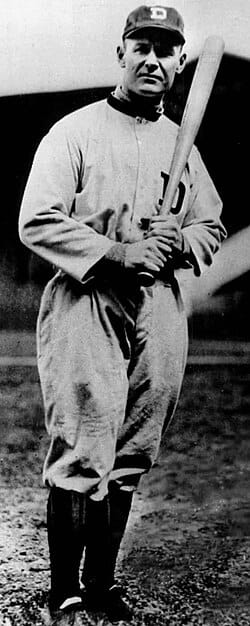
He stood six feet tall and carried around 190 pounds on a frame built for contact and speed. He was not a showman. He was not a provocateur. He simply arrived at the ballpark, took his cuts, and ran as hard as his legs would carry him. That quiet relentlessness defined everything that followed.
The town of Wahoo, Nebraska, did not seem like the kind of place that produced legends.
It sat on the flat prairie west of Omaha, a small farming community where life moved at the pace of seasons and hard work. In the spring of 1880, Samuel Earl Crawford was born there, the son of a family with no particular connection to the national pastime. He grew up doing what boys in small Nebraska towns did. He worked. He played. He dreamed of something bigger than the horizon in front of him.
As a teenager, Crawford took up barbering as a trade. It was honest work, the kind that could support a man through a long life. But baseball kept calling. He had a natural stroke and a pair of legs that could eat up the base paths. Word traveled the way it always did in small towns, through word of mouth, from one impressed observer to the next. By 1899, the Cincinnati Reds had seen enough. Crawford was nineteen years old when he put on a professional uniform for the first time.
He never looked back toward the barbershop.
Crawford arrived in Cincinnati raw but eager, and the National League took notice almost immediately. In 1901, he led the league with 16 home runs. That number sounds modest today. In the dead ball game of 1901, it was extraordinary. The baseball itself was softer, less lively, and often darkened with dirt and tobacco juice. It was not designed for power hitting. Crawford hit it hard anyway.
He stood six feet tall and carried around 190 pounds on a frame built for contact and speed. He was not a showman. He was not a provocateur. He simply arrived at the ballpark, took his cuts, and ran as hard as his legs would carry him. That quiet relentlessness defined everything that followed.
The Triple Machine
There is a number in the baseball record books that has stood for more than a century, and it belongs entirely to Sam Crawford.
Three hundred and nine career triples.
"No one in the history of professional baseball has come close to matching it. Ty Cobb, who sits second on the all-time list, finished his career 14 triples behind Crawford despite playing eleven more seasons. Crawford’s record is not the kind that inches closer to being broken with each passing generation. It is the kind that recedes further into history every year, belonging more to a vanished world than to the game played today.
To understand the number, you have to understand the era that produced it.
The dead ball game was played in vast open stadiums where outfield fences sat at distances that seem almost fictional today. Centerfield walls at 450, 460, and even 500 feet were common. What would be a routine fly ball in a modern park became an adventure in those dimensions. A hard-hit gap shot could roll to the wall and keep rolling while outfielders gave chase on grass that was rarely manicured the way today’s fields are kept.
Speed mattered more than power in that environment. The man who could put the ball in the gap and run, really run, could do serious damage. Crawford was that man in his purest form. He combined a line-drive stroke that consistently found the alleys with base-running instincts that bordered on reckless in the best possible way. He did not jog into second base and consider his options. He rounded second at full speed and dared the outfielder to throw him out at third.
He was right far more often than he was wrong.
After his contract dispute with Cincinnati sent him to Detroit following the 1902 season, Crawford found the perfect stage. Bennett Park, later rebuilt as Navin Field, had the kind of wide-open dimensions that suited his game. The American League was newer, hungrier, and faster than the established National League. Crawford thrived from the moment he arrived.
His triple totals across his Detroit years read like a different sport. He led the American League in triples six times. In 1914, at the age of 34, he still managed 26 three-base hits in a single season. Most modern players never reach that figure in a career, let alone a single year. Crawford was doing it when most men his age were considering retirement.
What separated him was not simply speed or power in isolation. It was the combination, and more importantly, it was judgment. Crawford understood angles. He knew which outfields played shallow, which had tricky hops off the grass, and which catchers threw accurately and which did not. The triple is the most complete offensive play in baseball. It requires a well-struck ball, real speed, sharp instincts, and a willingness to push the limit every single time. Crawford did all four better than anyone who ever played the game.
The numbers on the all-time triples list tell the full story of how far beyond reach Crawford’s record truly sits. Ty Cobb, the greatest hitter who ever lived by most measures, finished his career with 295 triples, 14 behind Crawford despite playing eleven more seasons. Honus Wagner, a man who could do everything on a baseball field, collected 252 in a career spanning two decades. The record belongs to the same category as Cy Young’s 511 career victories, Joe DiMaggio’s 56-game hitting streak, and Ted Williams’s .406 batting average in 1941. These are not records waiting to be broken. They are monuments to a version of the game that no longer exists.
His teammates marveled at it. Opposing managers tried to account for it and largely failed. The triple was not just Crawford’s signature. It was a declaration about how he believed baseball should be played, hard, fast, and without hesitation.
The Art of the RBI in the Dead Ball Era
If the triple was Crawford’s signature, the run batted in was his currency.
He finished his major league career with 1,525 runs batted in. That figure places him in the company of men whose names fill the Hall of Fame. For most of his career, no one talked about it. The RBI was not yet the celebrated statistic it would later become. Crawford simply kept driving runs home because that was what good hitters did when it mattered.
Driving in runs during the dead ball era required a specific set of skills that have little to do with the power hitting celebrated in today’s game. Home runs were rare. Walks were accepted but not celebrated. The game moved on contact, on placement, and on the ability to read a situation and respond to it with exactly the right swing.
Crawford was a master of the opposite-field hit. He could take a pitch on the outer half and drive it to right field with enough authority to score a runner from second base. He understood that the job in the batter’s box was not always to hit the ball as hard as possible. Sometimes the job was to hit it in the right place. Crawford figured that out before most of his contemporaries.
He also benefited from his place in the Detroit batting order. For most of his years with the Tigers, Crawford hit third and Ty Cobb hit fourth. The order was sometimes reversed, with Cobb leading the way and Crawford cleaning up behind him. Either way, the two men functioned as one of the most dangerous combinations of the dead ball era. Cobb’s extraordinary on-base percentage meant Crawford came to the plate with runners on base regularly. Crawford’s run production meant Cobb’s baserunning brilliance was consistently rewarded with a run on the scoreboard.
The partnership was professionally productive in ways that the statistics only partially capture. Crawford led the American League in RBI three times, in 1910, 1914, and 1915. His 1915 season was one of the quietly remarkable achievements of the era. He was 35 years old that year. He drove in 112 runs. Most players his age were winding down. Crawford was still doing the work that defined a Hall of Fame career.
He never chased the spotlight that came with those numbers. In an era when Cobb consumed every available column inch in the sports pages, Crawford went about his business with a steadiness that some mistook for modesty. It was not modesty exactly. It was the demeanor of a man from Wahoo, Nebraska, who had learned early that the work itself was the point.
The Tigers won American League pennants in 1907, 1908, and 1909. Crawford was at the heart of all three drives. Detroit lost the World Series all three times, to the Cubs twice and to the Pirates once, but those failures belonged to no single man. Crawford hit. Crawford ran. Crawford drove in runs. He gave the Tigers everything he had every time he walked onto the field.
That was all he knew how to do.
The Minor League Twilight
The Detroit Tigers released Sam Crawford after the 1917 season.
He was 37 years old. He had played 2,517 major league games, collected 2,961 hits, and established records that no one in the game fully appreciated at the time. A lesser man might have walked away from baseball with those credentials and considered himself satisfied. Crawford was not a lesser man.
He went west.
The Pacific Coast League in the early 20th century was not the minor league circuit it would later be reduced to. It operated as a near-equal to the major leagues in some respects, drawing serious talent, paying reasonable salaries, and playing in front of passionate crowds up and down the California coast. For a player who still had something left, it was a genuine option rather than a graceful exit.
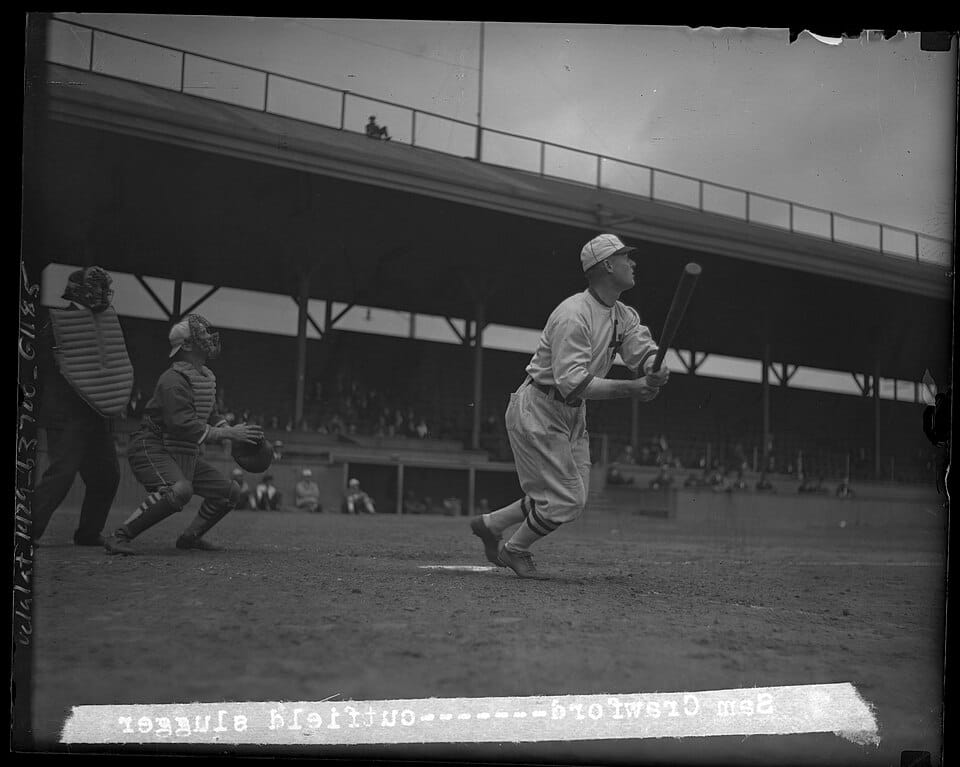
Crawford signed with the Vernon Tigers of the PCL and found something unexpected on the sun-baked diamonds of Southern California. He found that he could still play. Really play. He hit well in Vernon and later with the Los Angeles Angels, drawing crowds who came specifically to watch the old man from Nebraska do the things that had made him famous. He was not a curiosity. He was a ballplayer, full stop, long past the age when most men had traded their spikes for something more comfortable.
He played in the PCL until he was past 40. Let that settle for a moment.
The man who had terrorized American League pitching for fifteen years was still putting the ball in the gap and running hard past second base when he was old enough that most of his former opponents had been retired for years. It said something profound about Crawford’s relationship with the game. Baseball for him was never simply a profession. It was the thing that had lifted a barber’s apprentice from the Nebraska prairie and given him a life he could not have imagined as a teenager.
He loved it without apology and without self-consciousness.
Former teammates who encountered Crawford during those PCL years came away struck by the same quality. He was not hanging on out of vanity or financial desperation. He was playing because the game still called to him and he could still answer the call. The Pacific Coast League crowds loved him for it. There was something deeply American about the image, a big, quiet Nebraska man, graying now and thicker through the middle, still capable of stretching a line drive into a triple on a warm California afternoon.
When Crawford finally walked away from professional baseball for good, he did so on his own terms. He had given the game four decades of his life. He had asked nothing from it except the chance to keep playing.
The game gave him far more in return than he ever asked for.
The Long Wait
Sam Crawford waited forty years for the phone call from Cooperstown.
He was inducted into the Baseball Hall of Fame in 1957 by the Veterans Committee, long after the sportswriters who covered his career had retired or died themselves. He was 76 years old when the honor arrived. The delay was one of the more glaring oversights in the Hall’s history, though Crawford bore it with the same even temperament that had carried him through every other chapter of his life.
He lived to 88, dying in 1968, with enough time to watch the game transform in ways that made his era seem almost mythological by comparison. The spacious outfields that fed his triple totals were gone. The dead ball game had been replaced by home run hitting and strikeout pitching and perfectly manicured infields.
Crawford watched it all with the perspective of a man who had played an entirely different version of the same game.
His 309 career triples still stand as the most untouchable record in the sport. In an age when analytics has found an explanation for nearly everything, Crawford’s number remains something the numbers cannot fully account for. It belongs to a specific time, a specific set of conditions, and a specific man who happened to be exactly the right player for exactly that moment.
Wahoo, Nebraska, turned out to be exactly the right place to start.