

The 12 Greatest Moments from Baseball’s First Day, 1900–1980
Opening Day is unlike any other day in the baseball calendar. There are no standings yet. No slumps. No trade rumors. Just possibility. And across 80 years, from the dead-ball era through the rise of artificial turf, baseball packed some of its most extraordinary moments into the very first game of the season.
The 12 events below are not ranked by importance alone. Some are monumental. One changed the country. Some are simply great baseball moments, the kind that made grown men stop what they were doing and remember exactly where they were. All of them happened on Opening Day.
Here they are.
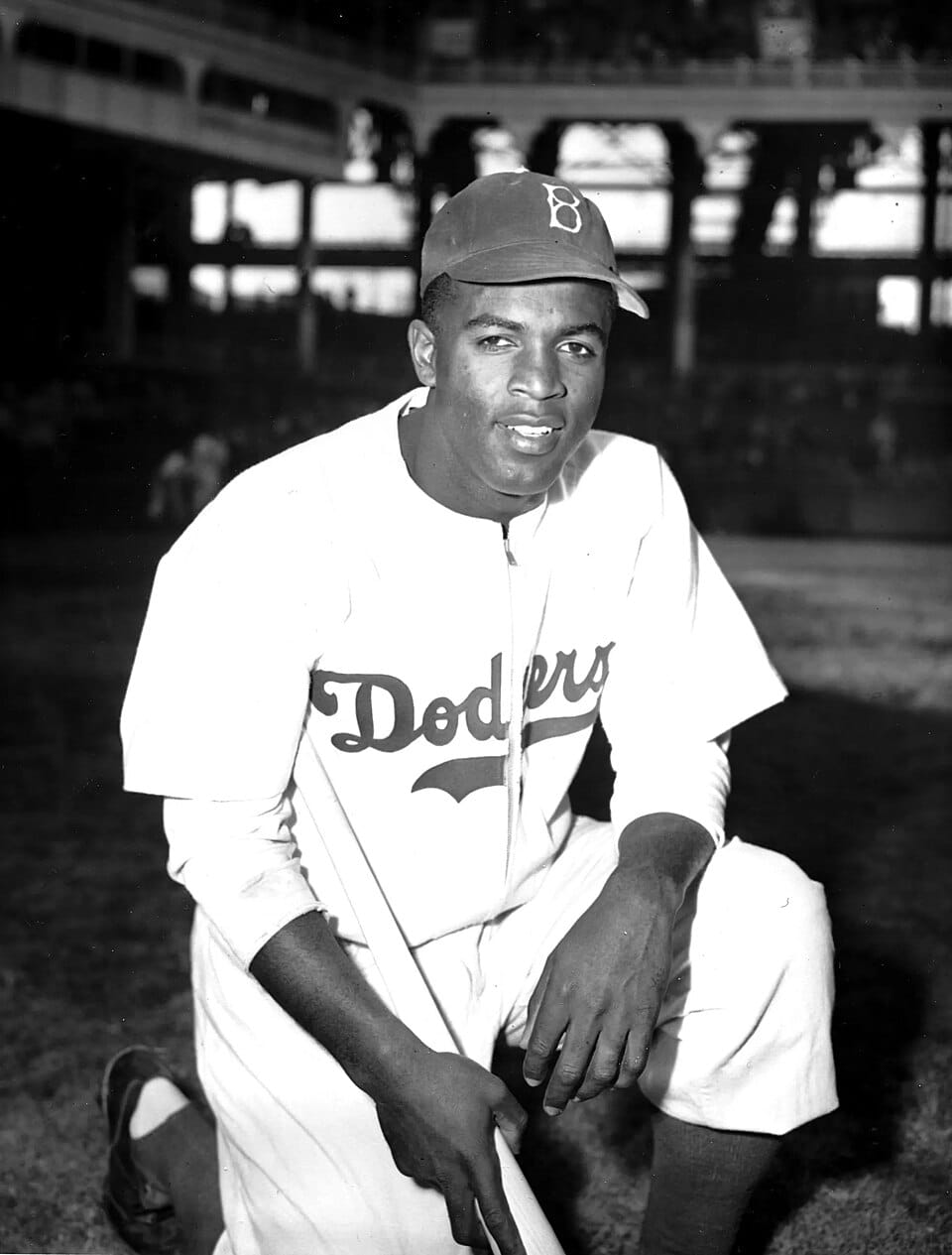
No. 1 — April 15, 1947: Jackie Robinson Steps onto the Field at Ebbets Field
This is not really a baseball story. It is an American story. But it happened at a ballpark, and it happened on Opening Day.
On April 15, 1947, Jack Roosevelt Robinson (1B, BRO) crossed the foul line at Ebbets Field in Brooklyn and took his position at first base. In doing so, he became the first Black player to appear in a major league game in the modern era, ending more than six decades of the color barrier in professional baseball. A crowd of 26,623 showed up that day, more than 14,000 of whom were Black. They came because they understood that this was bigger than baseball.
Robinson went 0-for-3 at the plate. None of that mattered. He reached second on a throwing error, scored the winning run in the Dodgers’ 5–3 victory over the Boston Braves, and spent the afternoon enduring a torrent of abuse from opponents and fans alike that most of us would have walked away from. He did not walk away.
Branch Rickey had planned every detail of that day for two years. He had scouted Robinson’s character as carefully as his bat. What Rickey could not script was the moment when Robinson stepped on the field and the roar went up from thousands of people who had never had a reason to cheer for a major league team before. For them, this Opening Day was the only Opening Day that mattered.
Robinson was named NL Rookie of the Year at season’s end. He was elected to the Hall of Fame in 1962. His No. 42 was retired league-wide in 1997, the only such honor in professional baseball history. His career slash line: .311/.409/.474, 132 OPS+, 61.5 WAR over 10 seasons.
No. 2 — April 16, 1940: Bob Feller Throws the Only AL/NL Opening Day No-Hitter in History
It was 40 degrees at Comiskey Park in Chicago. The wind was blowing in from center field. Only about 14,000 fans showed up. And yet Bob Feller (RHP, CLE) went out that afternoon and did something that, as of Opening Day 2026, no pitcher in AL or NL history has ever done again.
Feller was 21 years old. He’d already gone 24–9 the previous season and was coming off back-to-back All-Star selections. His manager, Ossie Vitt, told reporters during spring training that 1940 ought to be Feller’s greatest season. Even Vitt couldn’t have seen this coming.
He wasn’t sharp early. In the second inning, Feller loaded the bases with two out and the bullpen was already warming. He buckled down and struck out rookie Bob Kennedy (3B, CHW) on a full count to end the threat. After that, the White Sox barely had a chance. Feller retired 15 straight batters between the second and eighth innings.
The ninth inning gave everyone in the park a scare. “Old Aches and Pains” Luke Appling (SS, CHW), a career .310 hitter and future Hall of Famer, worked a brutal 10-pitch walk with two out, ending the streak. Then Taffy Wright (LF, CHW) hit a screaming grounder to the left of second baseman Ray Mack (2B, CLE), who lunged, knocked it down bare-handed off the grass, and fired a perfect throw to first. Game over. Feller had his no-hitter. He walked five, struck out eight, and let his catcher Rollie Hemsley (C, CLE) speak for everyone: “He was never a better pitcher.”
Feller was almost self-deprecating about it afterward. “I think I’ve thrown faster several times,” he said. “I couldn’t seem to throw a curve very well.” The entire White Sox lineup ended Opening Day with the exact same batting average they’d started with: .000.
He went on to win 27 games that season, leading the AL in wins, strikeouts (261), complete games (31), innings pitched (320.1), and ERA (2.61). He finished second in the MVP vote behind Hank Greenberg (OF/1B, DET). Feller finished his Hall of Fame career with 266 wins, 2,581 strikeouts, and three no-hitters. Inducted in 1962.
One postscript worth noting: in 2020, Major League Baseball officially incorporated the records of seven Negro Leagues into the major league historical record. That recognition added a second Opening Day no-hitter to the books. Leon Day (RHP, Newark Eagles) no-hit the Philadelphia Stars on May 5, 1946, which was Opening Day of that year’s Negro National League season. Day was posthumously inducted into the Hall of Fame in 1995. Feller’s gem remains the only AL/NL Opening Day no-hitter, but history is a bigger tent than it used to be.
No. 3 — April 14, 1910: Taft Throws the First Pitch, and Walter Johnson Nearly Throws a No-Hitter
Two traditions were born that afternoon at American League Park in Washington. One was the presidential first pitch. The other was the legend of Walter Johnson (RHP, WSH) on Opening Day.
Clark Griffith, owner of the Washington Senators, had lobbied for years to get a sitting president to throw out the ceremonial first pitch. On April 14, 1910, William Howard Taft finally accepted. The big man, all 300-plus pounds of him, rose from his front-row box seat, aimed at Gabby Street (C, WSH), and then unexpectedly turned and fired it straight at Johnson instead. Johnson, who had quietly declined to serve as the honorary catcher for the ceremony, had to bend down to snag the errant throw. The crowd erupted.
Then Johnson went out and nearly stole the whole show from the President of the United States. He carried a no-hitter into the seventh inning before Frank “Home Run” Baker (3B, PHA) doubled, helped as it happened by right fielder Doc Gessler tripping over a fan who had spilled out of the overflow crowd onto the outfield grass. Johnson finished with a one-hit, 3–0 shutout, striking out nine. Taft stayed for every inning.
The next day, Johnson sent the game ball to the White House and asked Taft to autograph it. Taft signed it and wrote: “To Walter Johnson, with the hope that he may continue to be as formidable as in yesterday’s game.” Johnson kept that ball for the rest of his life.
The presidential first-pitch tradition that Taft started that day has continued, in some form, for more than a century. Johnson’s Opening Day dominance would continue too. He made 14 Opening Day starts for Washington and threw nine shutouts. That record has never been matched.
No. 4 — April 4, 1974: Hank Aaron Ties Babe Ruth, First At-Bat of the Season
Commissioner Bowie Kuhn had to order Aaron’s Atlanta Braves to put him in the lineup. The Braves’ front office wanted to keep their aging star on the bench for the opening series in Cincinnati, preferring that history happen in Atlanta. Kuhn said no.
That decision gave the whole country an Opening Day moment they didn’t expect.
Henry Aaron (LF, ATL) batted fourth in the top of the first inning at Riverfront Stadium. Jack Billingham (RHP, CIN) had already walked Ralph Garr (RF, ATL) and allowed a single to Mike Lum (1B, ATL), putting runners on first and second. Darrell Evans (3B, ATL) flied out for the first out of the inning. Then Aaron stepped in. On the fifth pitch of the at-bat, he swung and sent a drive to left-center field. Home run. Career home run No. 714. Tied with Babe Ruth.
Riverfront Stadium went sideways. Aaron circled the bases at age 40, having navigated an entire off-season of death threats and FBI surveillance just to get to this moment. The Reds stormed back to tie the game in the ninth and won it 7–6 in 11 innings, a terrific ballgame in its own right. Aaron sat out Game 2 of the series. He went 0-for-3 in Game 3. Four days later, on April 8 at Atlanta-Fulton County Stadium, he hit No. 715 off Al Downing (LHP, LAD) in front of 53,775 fans.
The Opening Day homer gets overlooked in the story of 715. It shouldn’t. Aaron hit No. 714 in the first at-bat of the season, on the road, under pressure that most players couldn’t have handled at all. His career slash line: .305/.374/.555, 155 OPS+, 143.1 WAR. He retired in 1976 with 755 home runs and remains baseball’s all-time RBI leader with 2,297.
No. 5 — April 8, 1975: Frank Robinson Manages and Homers on the Same Afternoon
Cleveland general manager Phil Seghi pulled Frank Robinson (OF/DH/MGR, CLE) aside on the morning of Opening Day 1975 and joked, “Why don’t you hit a homer the first time you go to the plate?” Robinson stared at him. Then he went out and did it.
It was a cold, snowy afternoon at Cleveland Municipal Stadium. More than 56,000 fans showed up anyway. Major League Baseball had invited Rachel Robinson, widow of Jackie Robinson, to throw out the ceremonial first pitch. The symbolism was not subtle, but it wasn’t wrong either. Frank Robinson was becoming baseball’s first Black manager in the American League, and the echoes of 1947 were very much in the air.
When the PA announcer got to Robinson’s name in the lineup, the crowd went berserk. He inserted himself at DH, batting second. In the first inning, facing Doc Medich (RHP, NYY), Robinson worked the count to 2-2 and pulled a fastball low and away over the left-field wall. Solo home run. Cleveland won 5–3.
It is worth pausing to remember where Robinson started. He broke in as a 20-year-old outfielder with the Cincinnati Reds on April 17, 1956, going 2-for-3 with a double and an intentional walk against Vinegar Bend Mizell (LHP, STL) in a game the Reds lost 3–2. Nineteen years later, that same player was standing in a major league dugout as the first Black manager in AL history, with Rachel Robinson in the stands. There are not many careers that bookend a story that cleanly.
Robinson managed two respectable seasons in Cleveland (79–80 in 1975, 81–78 in 1976) and later managed the Giants, Orioles, and Expos/Nationals. Playing career: .294/.389/.537, 154 OPS+, 586 home runs, two MVP awards, a Triple Crown in 1966. Hall of Fame inducted in 1982.
No. 6 — April 18, 1950: Robin Roberts and the Whiz Kids Serve Notice
Not every great Opening Day moment is about history or social change. Sometimes it’s just about a young team showing up and telling the rest of the league to pay attention.
The 1950 Philadelphia Phillies were not supposed to be good. They had finished third in 1949 and carried a roster full of young players the baseball press had taken to calling the “Whiz Kids,” half admiring and half skeptical. On Opening Day 1950, Robin Roberts (RHP, PHI) took the ball against the Brooklyn Dodgers and the Phillies answered every question in the room with a 9–1 win.
Roberts later called it one of the greatest Opening Day thrills of his career. “We had finished well in 1949 and we had pennant hopes in 1950,” he said, “so that first game made us all proud.” It was the kind of opener that sets a tone for a season. The 1950 Phillies went on to win the NL pennant, their first since 1915, before losing the World Series to the Yankees in four games.
Roberts went on to start 12 consecutive Opening Days for the Phillies from 1950 through 1961, a record for one team that still stands today. His career numbers: 286 wins, 3.41 ERA, 104 ERA+, 1.170 WHIP, 53.6 WAR. Hall of Fame inducted in 1976.
No. 7 — 1910–1926: Walter Johnson Owns Opening Day
No pitcher in the history of baseball owned the first day of the season the way Walter Johnson (RHP, WSH) did. You could build an entire case for his greatness on Opening Day performances alone.
Over 14 Opening Day starts for the Washington Senators, Johnson went 9–5 with nine shutouts. Nine. The record has never been tied, let alone broken. He pitched a one-hitter in 1910 with Taft watching. He threw a 13-inning, 1–0 shutout against the Philadelphia Athletics in 1919. And at age 38, his arm not what it once was, he went out and beat the A’s again 1–0 in 15 innings in 1926. Fifteen innings. On Opening Day. The loss went to Eddie Rommel (RHP, PHA).
Five of Johnson’s home openers were attended by a sitting president. That’s the kind of draw he was. Early Wynn (RHP), who pitched for the Senators himself before winning a Cy Young with the White Sox, once captured what Opening Day felt like: “An opener is not like any other game. There’s that little extra excitement, a faster beating of the heart.” For Walter Johnson, Opening Day was simply his best day.
Johnson’s career numbers: 417 wins, 2.17 ERA, 147 ERA+, 164.8 WAR. Hall of Fame inducted in 1936.
No. 8 — April 25, 1901: The Detroit Tigers Erase a 9-Run Deficit in the Ninth
This one happened before most of the players on this list were born, and it still holds up as one of the most improbable games in early professional baseball.
The Milwaukee Brewers had the Detroit Tigers dead and buried, leading 13–4 heading into the bottom of the ninth at Bennett Park. April 25, 1901 was Detroit’s first American League home game. The AL had just declared itself a major league that year, and it was turning into a disaster. Then the Tigers scored nine runs in the ninth inning. Nine.
They cut the lead to 13–12 with two outs and two men on base. Then “Pop” Dillon (1B, DET) came to the plate and singled to right, driving in both runners. Detroit won 14–13. It was one of the greatest comeback wins in baseball history, and it happened the very first time Detroit played host to an American League game.
The AL was barely a recognized major league at the time. Games like this one helped change that.
No. 9 — April 11, 1967: Bob Gibson Fans 13, Outduels Juan Marichal
If you wanted a pitching duel on Opening Day, you could not have drawn up a better matchup than Bob Gibson (RHP, STL) against Juan Marichal (RHP, SF). Both would eventually reach Cooperstown. On this particular afternoon at Candlestick Park, only one of them was in command.
Gibson struck out 13 Giants and held them to five hits in a 6–0 shutout. Marichal had a career ERA+ of 123 and was one of the best pitchers of his era, but Gibson was simply better that day. The game set the stage for what was coming: Gibson’s 1968 season (1.12 ERA, 268 strikeouts, 13 shutouts, NL MVP and Cy Young Award) remains one of the most dominant single seasons in pitching history. The Cardinals won the World Series in 1967, beating the Red Sox in seven games, and Gibson was at the center of it all.
Career numbers for Gibson: 251 wins, 2.91 ERA, 127 ERA+, 9.0 SO/9, 80.9 WAR. Hall of Fame inducted in 1981.
No. 10 — April 14, 1910: The Day the Presidential First Pitch Became a Tradition
We’ve mentioned Taft already in the context of Johnson’s near no-hitter. But the tradition he started that afternoon deserves its own moment in this list. For much of the 20th century, having the President of the United States throw out the first pitch on Opening Day was a genuine statement about what baseball meant to the country. It wasn’t a photo opportunity. It was a ritual.
From Taft’s first toss in 1910 through the Eisenhower and Kennedy years and beyond, every president who threw out a first pitch was connecting the office to the game. The Washington Senators benefited from this tradition for decades. The nation’s capital got the national pastime’s most visible ceremonial moment, year after year.
Johnson himself caught first pitches from four different presidents over the course of his career: Taft in 1910, Woodrow Wilson in 1913 and 1915, Warren Harding in 1921, and Calvin Coolidge in 1924. No player in baseball history has had that distinction. The ball Taft tossed to him in 1910, signed the next day at Johnson’s request, stayed with the Big Train until the end of his life.
No. 11 — April 8, 1969: Baseball Goes to Montreal
The Montreal Expos weren’t just an expansion team. They were a statement that baseball could work in a different country, in two languages, in a city that had professional hockey in its blood and skepticism in its coffee.
On April 8, 1969, the Expos played their first game at Jarry Park in Montreal, becoming baseball’s first franchise outside the United States. The crowd of 29,184 was there to see something genuinely new. For a franchise that would eventually produce Hall of Famers Gary Carter, Andre Dawson, and Vladimir Guerrero, this Opening Day was the first chapter. The Expos were relocated to Washington in 2005 and became the Nationals, but the original Opening Day in Montreal was real, and it mattered.
Baseball’s reach was expanding that afternoon. Not every expansion works out. This one gave the game four decades of Canadian baseball history and a fan base that still mourns the franchise to this day.
No. 12 — April 10, 1980: Sixto Lezcano’s Walk-Off Grand Slam
This one is for the people who pay attention to baseball history beyond the famous names. Sixto Lezcano (OF, MIL) is not in the Hall of Fame. He had a solid career with the Brewers, Cardinals, Padres, and Pirates, posting a .271 career batting average. But on Opening Day, he was in a category by himself.
On April 10, 1980, Lezcano stepped to the plate in the bottom of the ninth at Milwaukee County Stadium with the Brewers trailing the Boston Red Sox 5–4, the bases loaded, and 53,313 fans packed into the park on a 43-degree Wisconsin spring afternoon. He hit Dick Drago’s (RHP, BOS) first pitch, a low fastball, into the right-field bullpen. Walk-off grand slam. Brewers win 9–5.
What made it more than just a great hit: Lezcano had also hit a grand slam on Opening Day in 1978, when the Brewers beat Baltimore 11–3. That made him the first player in major league history to hit grand slams on two different Opening Days. Nobody has done it since.
He came out of the dugout to take a bow. “Sixto, Sixto, Sixto,” the crowd chanted in the cold. The Brewers were two seasons away from going to the World Series.
A Final Thought
Opening Day has produced moments that belong to the whole country, Robinson’s debut and Aaron’s 714th among them, and moments that belong to the 14,000 people who showed up to a cold ballpark on a weekday afternoon to watch a guy throw fastballs nobody could hit. Both kinds matter. Both kinds show up on this list.
Bob Feller’s Opening Day no-hitter is now 86 years old. Not one AL or NL pitcher has come close to matching it. The way starting pitchers are used today, with pitch counts, five-man rotations, and opener strategies all working against it, makes it hard to imagine one ever will. That alone makes it one of the most durable records in the sport.