

The 1932 World Series Had More Future Hall of Famers Than Any October in Baseball History
The 1932 World Series was not exactly a competitive series. The New York Yankees swept the Chicago Cubs in four straight games, outscoring them 37-19. But what it lacked in suspense it more than made up for in star power. Thirteen players who would one day hang plaques in Cooperstown took the field that October — nine in Yankees pinstripes, four in Cubs blue. Add in two Hall of Fame managers, and you had a showcase that baseball has never matched, before or since.
Here is a look at each of those thirteen immortals — who they were, what they had accomplished, and what they did when history was watching.
NEW YORK YANKEES — Nine Hall of Famers
Babe Ruth (OF, NYY)
George Herman Ruth was 37 years old in 1932 and, frankly, slowing down. His .341 average and 41 home runs that season were still elite numbers, but the once-unstoppable version of Ruth was fading. The World Series gave him one last moment of theater. He went 5-for-15 (.333) with 2 home runs and 6 RBI. The second of those homers — a shot off Cubs starter Charlie Root in the fifth inning of Game 3 at Wrigley Field — became one of the most debated plays in baseball history. Did Ruth actually point to center field before crushing it? Nobody has ever settled that argument for good. Career-wise, Ruth's numbers are almost impossible to wrap your head around: a .342 lifetime average, 714 home runs, a 206 OPS+, and 162.2 career WAR. He was elected to Cooperstown in the inaugural 1936 class.
Lou Gehrig (1B, NYY)
If Ruth got the headlines, Gehrig got the last laugh in this Series. His performance was flat-out historic: 9 hits in 17 at-bats (.529), 3 home runs, and 8 RBI in just four games. His 1.718 OPS in the Series tells you everything. Gehrig was 29 years old and at the absolute peak of his powers in 1932 — he posted a .349/.451/.621 slash line during the regular season with 34 home runs and 151 RBI. Career numbers: .340 average, 493 home runs, 1,995 RBI, 179 OPS+, and 113.7 career WAR across 17 seasons. He was elected to the Hall in a special ballot in 1939, after his ALS diagnosis cut his career and eventually his life tragically short.
Bill Dickey (C, NYY)
Bill Dickey was the best catcher in the American League at the time, and he backed that up in the Series with a .438 average (7-for-16) and 4 RBI. Not bad for the guy batting behind Ruth, Gehrig, and Lazzeri. Dickey was already established as one of the most dangerous offensive catchers the game had seen, and his handling of the Yankees pitching staff was equally valued. In 1932 he hit .310 with 15 home runs and 84 RBI in the regular season, with a .843 OPS and 121 OPS+. Over his career he hit .313 with a .868 OPS and posted 56.4 WAR. He was inducted into Cooperstown in 1954. He later mentored a young Yogi Berra, passing down the tools of the trade to the next generation of Yankee catchers.
Earle Combs (CF, NYY)
Earle Combs was as good a leadoff hitter as baseball had in the 1920s and '30s. He set the table for Ruth and Gehrig, and did it with consistency. In the 1932 Series he went 6-for-16 (.375) with a home run, 4 RBI, and 4 walks — a .500 on-base percentage in four games. His 1.125 OPS in the Series was second only to Gehrig on the team. During the regular season he hit .321 with a .860 OPS and 5.2 WAR. A career .325 hitter with a .397 OBP, Combs was elected to the Hall of Fame in 1970 by the Veterans Committee. A severe outfield collision in 1934 essentially ended him as a regular player, robbing him of what might have been a few more productive seasons.
Tony Lazzeri (2B, NYY)
Tony Lazzeri was the kind of hitter you never want coming up in a big spot. He had driven in 113 runs during the regular season with a .300 average and .905 OPS. In the Series he was productive when it counted — 5 hits in 17 at-bats (.294), 2 home runs, and 5 RBI. His 1.015 OPS in four games tells you he found the right moments to do damage. Over a 14-year career, Lazzeri hit .292 with 178 home runs, a .846 OPS, and posted 47.6 career WAR. He drove in 100 or more runs seven times. Lazzeri was elected to the Hall of Fame in 1991 by the Veterans Committee. He was also one of the first prominent Italian-American players in the major leagues, a trailblazer both on and off the field.
Joe Sewell (3B, NYY)
Joe Sewell did not have a big World Series — 5-for-15 (.333) with 3 RBI and 4 walks. But his career story is one of the most remarkable in baseball history. Sewell was almost physically incapable of striking out. Over 14 seasons he went to the plate 8,333 times and fanned just 114 times total. Three different seasons he struck out fewer than five times. In 1932, he played in 125 games and struck out exactly 3 times all year. His 1932 regular season was steady if not spectacular — a .272 average with 11 home runs, a 96 OPS+, and 2.7 WAR. Career: a .312 average with a .804 OPS and 54.9 WAR. The Veterans Committee elected him to Cooperstown in 1977.
Lefty Gomez (LHP, NYY)
Vernon 'Lefty' Gomez started Game 2 and turned in a gem — a complete game, 9 innings, 9 hits, 2 runs, 1 earned run, and 8 strikeouts. His 1.00 ERA in the Series was the best among the Yankees starters. Gomez was 23 years old in 1932 and coming into his own. He went 24-7 during the regular season with a 4.21 ERA in 265.1 innings, piling up 176 strikeouts and a 1.398 WHIP. The ERA looks a little ugly by his standards — he would post much better numbers in later years — but the wins were real. Career: 189-102, 3.34 ERA, 125 ERA+, 1.352 WHIP, and 43.2 WAR. He was a seven-time All-Star and five-time World Series champion. Gomez was elected to the Hall of Fame in 1972.
Red Ruffing (RHP, NYY)
Red Ruffing drew the Game 1 assignment and earned the win — a complete game, 10 hits allowed, 6 runs, but just 3 earned, with 6 walks and 10 strikeouts. His 3.00 ERA in the Series was solid. The 27-year-old Ruffing had transformed himself into one of the American League's best pitchers after a rough stretch in Boston. In 1932 he went 18-7 with a 3.09 ERA, 190 strikeouts, and a 132 ERA+ in 259 innings — the best season of his career to that point. Career: 273-225, 3.80 ERA, 109 ERA+, and 55.3 WAR. It is worth noting he also lost parts of four toes in a mining accident as a teenager and still made it to Cooperstown. He was inducted in 1967.
Herb Pennock (LHP, NYY)
By 1932, Herb Pennock was 38 years old and clearly on the back end of his career. He started 21 games that season but posted a 4.60 ERA and just 0.0 WAR — the numbers of a pitcher running on fumes. In the Series, he came out of the bullpen in Games 1 and 3, pitched 4.0 innings, allowed just 2 hits and 1 earned run, and picked up 2 saves with a 2.25 ERA. Give credit where it is due — for a 38-year-old mop-up pitcher, he was sharp when called upon. His career numbers are what earned him his plaque: 241-162, 3.60 ERA, 106 ERA+, and 44.2 WAR over 22 seasons. The Hall of Fame inducted him in 1948.
CHICAGO CUBS — Four Hall of Famers
Kiki Cuyler (OF, CHC)
Kiki Cuyler had a decent enough regular season in 1932 — .291 average, 10 home runs, 77 RBI, a .782 OPS in 110 games. But the Series was rough on him. He went 5-for-18 (.278) with 1 home run and 2 RBI, and struck out 3 times in 18 at-bats against the Yankees' pitching. Not a disaster, but not the performance of a player at his best. Over his career, Cuyler was a legitimate star — a .321 lifetime hitter with a .860 OPS, 2,299 hits, 128 stolen bases in four seasons he led the NL, and 48.1 WAR. He posted a .474 OBP in 1930, one of the best marks of the era. The Veterans Committee elected him to the Hall of Fame in 1968.
Gabby Hartnett (C, CHC)
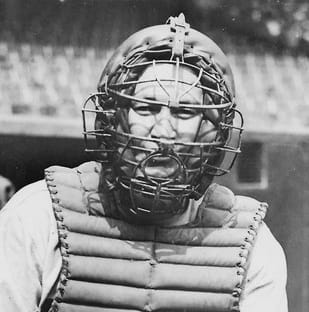
Gabby Hartnett was the best catcher in the National League during this era, and he was the one Cubs position player who actually held his own against the Yankees in the Series. He went 5-for-16 (.313) with a home run and 1 RBI, posting a .978 OPS in four games. It was not enough to matter — the pitching around him collapsed completely — but Hartnett did his job. During the regular season he hit .271 with 12 home runs and 52 RBI, a .790 OPS in 121 games. Career: a .297 average, 236 home runs, a .858 OPS, and 55.5 WAR over 20 seasons. He would later become famous for the 'Homer in the Gloamin'' in September 1938 — a walk-off home run in near-darkness that essentially won the Cubs the pennant. The Hall of Fame inducted him in 1955.
Billy Herman (2B, CHC)
Billy Herman was 22 years old in October 1932 and not yet the player he would become. The Series was an education. He went 4-for-18 (.222) with 1 RBI against the Yankees, managing just a .541 OPS in four games. But he had already shown enough during the regular season — .314 average, 206 hits, 3.5 WAR — to hint at the career ahead of him. Over 15 major league seasons, Herman hit .304 with a .774 OPS, made ten All-Star teams, and posted 57.7 career WAR. He became one of the finest contact hitters and sign-stealing second basemen of the 1930s. Two years after the 1932 Series he would put up a 7.2 WAR season. The Veterans Committee sent him to Cooperstown in 1975.
Burleigh Grimes (RHP, CHC)
No reason to sugarcoat this one. Burleigh Grimes was 38 years old in 1932 and had very little left. His regular season showed it — a 6-11 record, 4.78 ERA, and negative 1.0 WAR in 141.1 innings. The Series was worse. He appeared twice, pitched just 2.2 innings across both outings, gave up 7 hits and 7 earned runs, and finished with a 23.63 ERA. The Yankees hit him hard every time he took the mound. What earns Grimes his place in this article is his career — 270-212, 3.53 ERA, 108 ERA+, and 46.7 WAR across 19 seasons. He was also the last legal spitball pitcher in the major leagues, grandfathered in when the pitch was banned in 1920. The Veterans Committee inducted him into Cooperstown in 1964.
A Note on the Managers
Both dugouts were run by Hall of Famers, which only adds to the historical weight of this Series. Joe McCarthy (NYY) managed the Yankees to their fourth championship, running one of the great teams of the era with a firm hand and a sharp baseball mind. Charlie Grimm (CHC) had taken over the Cubs in August when Rogers Hornsby — himself a Hall of Famer — was let go. Hornsby was not in the dugout for October, but it was his club that earned the pennant before Grimm inherited it. McCarthy was elected to Cooperstown in 1957. Grimm was not, though his managerial record over three decades with the Cubs earned him deep respect. Hornsby, of course, went in as a player in 1942.