
Christy Mathewson and the Making of the American Baseball Hero

Two stories define Christy Mathewson. One lasted six days in October 1905. The other lasted six years in the mountains of upstate New York, and ended badly.
Together, they explain why a pitcher who died at forty-five, in a sanitarium, two decades before most of his contemporaries, is still considered one of the five or six greatest players the game has ever produced -- and why, in 1936, his name appeared on the very first Hall of Fame ballot alongside Babe Ruth, Ty Cobb, Walter Johnson, and Honus Wagner. He was the only one of the five inducted posthumously.
He was, in the truest sense of the word, baseball's first superstar. Not merely its best pitcher. Its first genuine public figure – the man who convinced a skeptical American middle class that baseball was worth their attention.
The World Baseball Played In
To understand what Christy Mathewson meant to the game, you have to understand what the game looked like before he arrived. Baseball in 1900 was not a respectable institution. It was a working-class entertainment populated by rough men with rough habits – drinkers, gamblers, brawlers, men who scratched their way through careers without anything resembling an education or a public persona. Newspapers covered it. Certain men followed it obsessively. But the American middle class kept its distance.
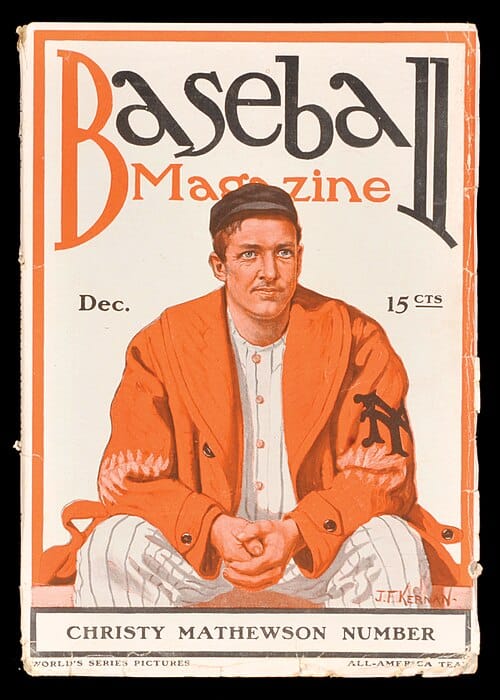
Then came a six-foot-one, 195-pound right-hander from Factoryville, Pennsylvania, who had played football and baseball at Bucknell University, refused to pitch on Sundays for religious reasons, did not drink, did not swear in public, and had the kind of looks that portrait photographers of the era considered ideal. His nickname -- "The Christian Gentleman" -- was not ironic. The newspapers meant it literally.
"Mathewson was highly regarded in the baseball world during his lifetime. As he was a clean-cut, intellectual collegiate, his rise to fame brought a better name to the typical ballplayer, who usually spent his time gambling, boozing, or womanizing." (from Wikipedia)
Boys who would never have been permitted to admire a ballplayer were suddenly permitted to admire this one. The game had found its first ambassador.
"Mathewson was the greatest pitcher who ever lived. He had knowledge, judgment, perfect control and form. It was wonderful to watch him pitch -- when he wasn't pitching against you." -- Connie Mack
The Pitch Nobody Could Hit
Mathewson's instrument was a pitch he called the "fadeaway," which modern baseball would recognize as a screwball – a delivery that broke away from left-handed hitters rather than toward them, the opposite of a conventional curveball. He had developed it in the minor leagues, where he won 21 games against 2 losses in 1899 before the Giants purchased his contract.
He delivered his fadeaway, fastball, curve, and floater with a smooth overhand motion, and the combination was devastating. In 1913, he pitched 68 consecutive innings without issuing a single base on balls. That is not a typo. Sixty-eight innings. In an era when batters crowded the plate and pitchers routinely struggled with control, Mathewson was threading the needle, inning after inning, with the precision of a man who had never been in a hurry.
At his peak in 1905, he led both leagues in wins (31-9), ERA (1.28), shutouts (eight) and ERA+ (233), while topping the National League with 206 strikeouts and a 0.93 WHIP. Over the full span of his career, he won 373 games with a 2.13 ERA, pitched 79 shutouts, and accumulated 100.6 WAR – a number almost impossible to contextualize except to note that Walter Johnson, his closest contemporary rival, posted 164.8 over a longer career, and that most modern Cy Young Award winners generate 4-6 WAR in a single season.
His 1908 season deserves its own sentence: 37 wins, a 1.43 ERA, 259 strikeouts, league leaders in starts, innings, complete games, and shutouts, with a WHIP of 0.82. That season would stand as the National League record for wins. It still stands.
Six Days in October
The two most famous narratives about Christy Mathewson require some setup to appreciate fully, but neither requires much time. Once understood, they stay with you.
The first one begins on October 9, 1905, in Philadelphia.
The 1905 World Series matched the New York Giants against Connie Mack's Philadelphia Athletics. Mathewson was coming off a stellar regular season -- 31-9, leading the National League in wins, strikeouts, and ERA. Manager John McGraw, never a man to overthink good fortune, handed him the ball for Game 1.
At the plate in Game 1, Mathewson contributed a single that ignited New York's scoring drive. On the mound, he completed a four-hit, 3-0 victory without walking a single batter. The Athletics had one runner reach third base in the entire game.
The Series moved to New York for Game 2, where the Athletics evened things with a Chief Bender shutout. Then rain wiped out Game 3, and with an extra day of rest available, McGraw brought Mathewson back for Game 3 on two days' rest.
He threw another shutout.
In Games 1 and 3, Mathewson combined for 18 shutout innings and 14 strikeouts.Joe McGinnity won Game 4 for New York, 1-0, and the Giants led the Series three games to one. Game 5 was played October 14 at the Polo Grounds. Mathewson had one day of rest.
In a blistering one hour and 35 minutes, Mathewson utilized his famed fadeaway pitch and blanked the A's, throwing his third complete game shutout in a mere six days. No pitcher has ever matched that feat in a World Series.
The final accounting: 27 innings, 14 hits, 18 strikeouts, and one base on balls. One walk. In three World Series starts, across six October days, Christy Mathewson walked one batter.
It has been called arguably the single greatest performance by any player in World Series history. ESPN later selected it as the greatest playoff performance of all time. The Series itself entered the record books as the only Fall Classic in which every single game was a shutout -- three by Mathewson, one by McGinnity, one by Bender.
The World Series MVP Award would not be created until 1955. Had it existed, there was no need for discussion.
Twenty-seven innings. Fourteen hits. Eighteen strikeouts. One walk. In six days.
1908: The Year That Got Away
Three years later, Mathewson had his greatest season by almost any measure, and still did not win a championship.
His 37 wins and 1.43 ERA in 1908 gave him a second pitching triple crown. The Giants entered the final weekend with the pennant apparently in hand. They did not win the pennant.
The reason was a baserunning mistake on September 23 by a nineteen-year-old first baseman named Fred Merkle, who failed to touch second base on what should have been a walk-off single against the Cubs. The umpires called it a force out. The game was declared a tie and replayed at season's end. The Cubs won the replay. They went to the World Series. Mathewson, who had won 37 games, went home.
The incident became known as "Merkle's Boner." It followed Fred Merkle for the rest of his life, which was not fair, because he had done nothing his teammates had not done a hundred times before. Mathewson, characteristically, never blamed him. He had that kind of character.
The Christian Gentleman, Examined
The "Christian Gentleman" reputation warrants a closer look, because it was both genuine and strategic –not in a cynical sense, but in the way that an honest man who understands the effect of his honesty can use it to build something larger than himself.
At a time when the sport was known for hellraising, devil-may-care men like Ty Cobb, Mathewson was an educated, well-educated, devout Christian who refused to play on Sunday. So honest was the New York Giants pitcher that on one occasion, he admitted that one of his own players had failed to touch second base while rounding the bases, costing his team their shot at the postseason.
He was also, against all expectation, genuinely close to his manager. John McGraw was Mathewson's near-opposite in almost every temperamental respect -- explosive, profane, combative, not particularly interested in the opinion of anyone outside his own dugout. Their friendship, which lasted the rest of their lives and included living in adjacent apartments on the Upper West Side, is one of the more quietly remarkable relationships in baseball history.
In 1912, Mathewson published Pitching in a Pinch, a first-person account of strategy, superstition, and baseball psychology that remains readable today. It was not the first sports book, but it was among the first written by an active player about the inner workings of his craft, and it was received as serious journalism. Christy Mathewson was the kind of man who could write a book and have it taken seriously by people who had never watched a baseball game.
The Gas Chambers of France
The second defining story begins in the fall of 1918, when Mathewson was thirty-eight years old and managing the Cincinnati Reds.
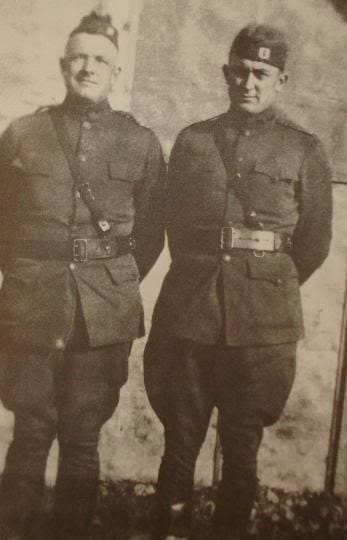
Major Branch Rickey commanded a unit in the Chemical Warfare Service that included Captain Ty Cobb, Captain Christy Mathewson, and Lieutenant George Sisler. They had volunteered. The Army wanted prominent athletes to demonstrate that working with chemical weapons was not the terrifying proposition the public imagined. Mathewson's wife Jane was strongly opposed to his going. He went anyway.
At Hanlon Field near Chaumont, France, during a routine training exercise in the gas chambers, something went wrong.
During a routine training exercise, a missed signal meant several men didn't put on their gas masks in time. Ty Cobb, who survived the incident and wrote about it decades later, recalled the chaos in detail: men screaming to get out, jamming the door, each man on his own. Cobb fixed his mask and worked toward the exit. When he got outside, he did not know the extent of his own lung damage.
Cobb recalled Mathewson telling him afterward: "Ty, I got a good dose of the stuff. I feel terrible." He was wheezing and blowing out congested matter.
His respiratory system was weakened from the exposure, causing him to contract tuberculosis, from which he died in Saranac Lake, New York in 1925. Some medical authorities disputed the direct causal link between the gas exposure and the tuberculosis -- Army doctors at the time suggested the flu he had contracted in France may have been equally responsible. The debate remains unresolved. What is not disputed is that Christy Mathewson came home from France sick, never fully recovered, and was dead before his forty-sixth birthday.
He spent his final years at a sanitarium in the Adirondacks, and then briefly as president of the Boston Braves, where he worked to rebuild the franchise from an office when he could no longer work from a pitching mound. He died on October 7, 1925 -- the opening day of the 1925 World Series between Pittsburgh and Washington. The next day, 44,000 fans stood and sang "Nearer My God to Thee" as the flag was lowered to half-staff.
His last words, to his wife Jane: "Now Jane, I want you to go outside and have yourself a good cry. Don't make it a long one; this can't be helped."
He was forty-four years old. He had been in baseball, one way or another, since he was fourteen.
"I saw Christy Mathewson doomed to die. None of us who were with him realized that the rider of the pale horse had passed his way." -- Ty Cobb
The Numbers
Christy Mathewson's career statistics read like a document someone invented to illustrate what a pitcher could be.
373 wins. 2.13 ERA. 79 shutouts. 100.6 WAR. He won 20 or more games twelve consecutive seasons, 30 or more four times. His ERA+ of 136 means he was, across his entire career, 36 percent better than the average pitcher of his era when adjusted for context. His 1905 ERA+ of 233 means he was more than twice as good as the average pitcher in the best season of his career.
He struck out 2,507 batters and walked 848 in nearly 4,800 innings -- a strikeout-to-walk ratio of 2.96 that reflected the control that defined him. In a game built on chaos and uncertainty, Mathewson almost always knew exactly where the ball was going.
In 1936, he was elected into the Baseball Hall of Fame as one of its first five members, along with Babe Ruth, Ty Cobb, Walter Johnson, and Honus Wagner. He was the only one of the five inducted posthumously.
The Hall of Fame calls him the "greatest of all the great pitchers of the 20th Century's first quarter."
What He Built
Christy Mathewson did not simply pitch well. He changed what baseball was, and what it was permitted to be.
Before him, the sport had not produced a public figure in any recognizable modern sense -- a man whose image could appear in newspapers and advertisements and be received as something motivated, something decent, something a family might want their sons to admire. Mathewson created that template, and the game has been building on it ever since.
He was a complex figure made to look simple by the legend: a genuinely religious man who also understood power, a genuinely humble man who competed with ferocious intensity, a man who wrote a book and managed a franchise and served his country and lost his health doing it, and who faced the end with the same controlled composure he brought to a two-out situation in the ninth inning with a run on third.
"Don't make it a long one," he told his wife. "This can't be helped."
Baseball has had better nicknames for its players. It has never had a better one than "The Christian Gentleman" for the man who earned it.