

Five Storylines from the Turbulent Age of 1904 and 1905
The years 1904 and 1905 occupy a peculiar place in baseball history. The game was expanding, professionalizing, and cleaning up its act — yet simultaneously tearing itself apart from the inside. Two powerful men despised each other with operatic fury. A pitcher was doing things that defied comprehension. A pennant race ended on a single wild pitch. And the institution we now call the World Series nearly died before it truly began. These are the five stories that define that extraordinary moment.
The Spite Heard Round the Baseball World
The summer of 1904 should have been a season of celebration. The American and National Leagues had finally made peace after years of open warfare, and the first modern World Series, played in 1903, had been a genuine success. The public wanted more. What it got instead was a lesson in the destructive power of personal grudges.
New York Giants owner John T. Brush announced in the summer of 1904 that his National League champions would not participate in any postseason series against an American League opponent. The language he chose was carefully contemptuous. The AL was an inferior circuit. Its champions were unworthy of the designation. His Giants, having won the NL pennant by thirteen games over Chicago, were already the world champions of the only league that mattered.
McGraw declared that his team had already won the world championship as champions of the only real major league. The AL pennant winner, whoever it turned out to be, need not apply.
Behind this institutional arrogance was something far more personal. Giants manager John McGraw had been forced out of the American League in 1902 after a series of escalating confrontations with AL president Ban Johnson. McGraw carried that grievance like a stone in his chest. Refusing the World Series was not merely a business calculation. It was revenge, served cold, with a formal press announcement attached.
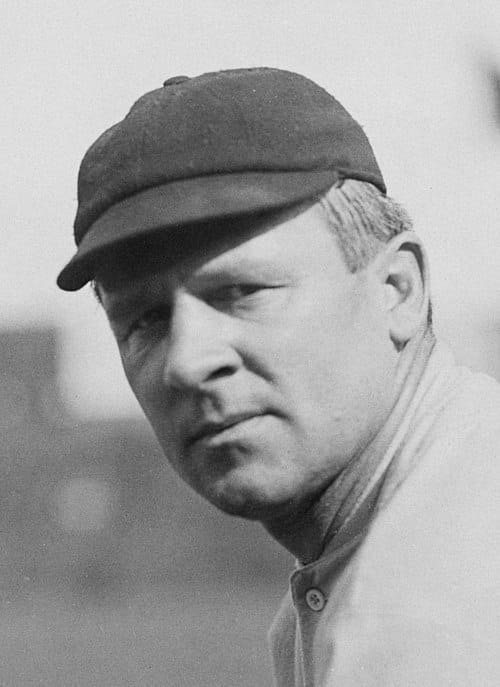
The backlash was immediate and severe. Newspapers across the country denounced Brush and McGraw. Fans who had spent the summer anticipating an October showdown felt cheated. The Boston Americans, who had ground out a 95-win season and edged the New York Highlanders by a game and a half on the final day, were left with nothing to show for it. Their pennant was legitimate. Their October was empty.
The sporting press did not let the Giants forget it. Nor did the public. What had been intended as a power play landed instead as a public humiliation, and by winter, Brush was already reversing course. He would spend the offseason drafting the formal rules that made the World Series a mandatory annual event — handing Ban Johnson the very institutional legitimacy that McGraw had spent years trying to deny him.
Happy Jack and the Pitch That Broke a Pennant Race
While the Giants were maneuvering in the front office, the American League was staging one of the most gripping pennant races the young circuit had ever seen. At the center of it stood a right-hander from North Adams, Massachusetts, known throughout the league as Happy Jack Chesbro.
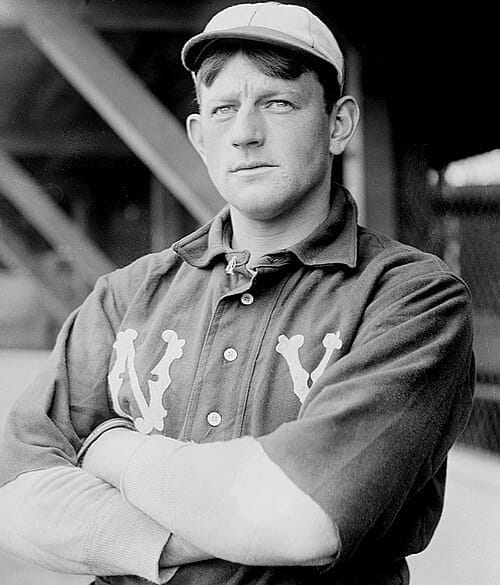
The 1904 season Chesbro assembled for the New York Highlanders belongs in a category by itself. He started 51 games. He completed 48 of them. He pitched 454 and two-thirds innings. He won 41 games — a modern era record that has stood for more than a century and almost certainly will never be broken. The weapon that made all of it possible was the spitball, which Chesbro had learned the previous spring by watching Elmer Stricklett demonstrate the pitch during an exhibition series.
Chesbro's 41 wins in 1904 remain the modern era record. No other AL pitcher that season won more than 26. He was, for one extraordinary season, in a class entirely his own.
By the final week of October, the Highlanders and the Boston Americans were separated by a single game and a half, with a five-game series at Hilltop Park set to decide the pennant. Chesbro had already won Game 1 of that series, a complete game that gave New York the lead in the standings. When manager Clark Griffith sent him back to the mound two days later with no rest, it was a gamble born of necessity. There was simply no one else to trust.
Boston tied the game in the seventh inning. The Americans led off the ninth with a single and worked their runner to third base with two outs. The count ran to two and two on Freddy Parent. Chesbro wound and delivered, and the pitch sailed over the catcher's head. Lou Criger scored from third. Boston won the game, took the pennant, and left Chesbro to sit in silence on the bench as the Highlanders failed to answer in the bottom half.
The question of whether the pitch was a wild throw or a passed ball that the catcher should have caught has been debated ever since. Chesbro himself maintained the latter until the end of his life. The official scorer disagreed. Either way, the greatest individual season any pitcher had ever assembled ended not with a celebration, but with a wet pitch skipping past a helpless catcher into baseball history.
Ban Johnson, John McGraw, and the War That Built Baseball
To understand why the 1904 World Series was never played, you have to understand two men who despised each other with a thoroughness that went beyond ordinary professional rivalry. Ban Johnson and John McGraw were not merely adversaries. They were opposites in almost every dimension, and both of them were powerful enough to act on the contempt.
Johnson had built the American League from scratch, beginning in 1900, with a specific vision: a cleaner game, better disciplined, more palatable to the middle-class audiences he was trying to attract. He enforced rules against rowdy play, protected umpires from the kind of abuse that had become standard in the older National League, and ran his circuit with the conviction of a man who believed professional baseball needed to be respectable to survive.
McGraw thought this was absurd. He had made his name as a third baseman and manager in the rough-and-tumble National League of the 1890s, where spiking baserunners, jawing at umpires, and bending every rule until it snapped were considered tactical virtues rather than violations. He was briefly persuaded to join Johnson's new league when the AL placed a franchise in Baltimore in 1901, but the arrangement was doomed from the first week. McGraw and Johnson's version of professional baseball were simply incompatible.
Johnson had moved the old Baltimore franchise to New York as a deliberate provocation, placing the Highlanders in the Giants' own city. McGraw understood exactly what it meant.
By mid-1902, McGraw had engineered his escape back to the National League, taking the Giants job and immediately helping to gut the Baltimore roster by transferring its best players to NL teams. Johnson retaliated by moving the Baltimore franchise to New York and making it a direct competitor to the Giants for the city's baseball fans. The new team, which the newspapers had begun calling the Yankees, was parked a crosstown train ride from the Polo Grounds. Every game they sold was a game the Giants did not.
The 1904 World Series refusal was the last major act of that war. Brush's decision to draft the formal World Series rules over the winter was the armistice. Johnson had won. The two-league structure and the October championship series became permanent features of the game, no longer dependent on the goodwill of whoever happened to be champions. The institution had finally outgrown the egos that built it.
The Gentleman and the Brawlers: Mathewson Among the Giants
John McGraw's 1905 Giants were, by his own later assessment, the best team he ever managed. He would say this with a particular fondness, and what he meant was not simply that they won, though they won abundantly, finishing at 105 and 48 and running away with the National League pennant by nine games. What he meant was that they fought. They were mean, contentious, and relentlessly combative, modeled in his own image.
Center fielder Mike Donlin hit .356 and placed third in the National League batting race while also managing to maintain a sideline career on the Vaudeville stage. His personal history included an assault conviction outside a Baltimore theater, which McGraw apparently regarded as a character reference rather than a disqualification. Turkey Mike, as the writers called him, was precisely the kind of talent McGraw valued: gifted, unreliable, and entirely unbothered by conventional expectations of conduct.
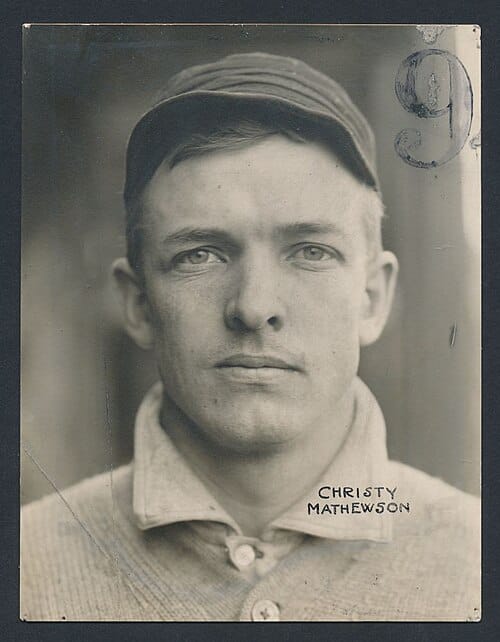
Standing apart from all of it, in temperament as thoroughly as in achievement, was Christy Mathewson.
Mathewson was 24 years old, a former class president from Bucknell University, and the most dominant pitcher in the National League. He was also, by all accounts, the least pugnacious man on the Giants' roster.
Mathewson had gone 33 and 12 in 1904. In 1905, he was better: 31 wins, 9 losses, a 1.28 earned run average, eight shutouts, 206 strikeouts. He led both major leagues in wins and ERA. His signature pitch was a delivery he called the fadeaway — a pitch that broke in the opposite direction from a conventional curve, moving away from right-handed batters with a motion that hitters described as vanishing rather than bending.
The contrast Mathewson represented was not lost on the baseball press of the era, which had been struggling to find figures the sport could market to respectable America. Here, amid a roster of brawlers and rule-benders, was a college man who refused to pitch on Sundays, who spoke in full sentences, and who was quietly, almost serenely, the best pitcher anyone had ever seen. Baseball needed exactly what Mathewson provided, whether it knew it yet or not.
Five Games, Five Shutouts, and One Unanswerable Performance
The 1905 World Series lasted five games. Every one of them ended in a shutout. It remains the only World Series in history where that has happened, and the mathematical odds against its ever happening again make the question essentially academic.
The Giants entered the series against the Philadelphia Athletics with a pitching staff that needed no introduction. Mathewson was coming off his dominant regular season. Joe McGinnity, the Iron Man, had won 21 games despite what observers described as visible signs of fatigue after six years of innings-eating service. The rotation behind them — Red Ames, Dummy Taylor, Hooks Wiltse — had posted numbers that in any other context would have commanded attention. In this context, they were barely needed.
Philadelphia was already compromised before the series began. Rube Waddell, their left-handed ace who had led the AL with 27 wins, was absent with a shoulder injury sustained in September during what was officially described as a wrestling match with a teammate. Rumors of a bribe circulated then and have never entirely stopped. Manager Connie Mack refused to believe them. Whatever the truth, Waddell was not available, and his absence stripped the Athletics of their most dangerous arm.
Five games. Five shutouts. Mathewson pitched three of them over six days, allowed 14 hits total, struck out 18, and walked one. Connie Mack, who managed against him twice, later called him the greatest pitcher who ever lived.
Mathewson started Game 1 in Philadelphia and shut the Athletics out on four hits. Chief Bender answered the next day with a shutout of his own, evening the series at one game apiece. Mathewson came back in Game 3 on two days of rest and threw another four-hit shutout, this time winning 9 to 0. McGinnity took Game 4 on one day of rest, winning 1 to 0 on an unearned run. Then Mathewson returned for Game 5, also on one day of rest, and completed the series with his third shutout in six days, winning 2 to 0.
The Athletics managed three runs across five games. All three came in their only victory, Game 2, and all three were unearned. Against Mathewson specifically, they scored nothing. In 27 innings spread across three starts, they produced 14 hits, one walk, and zero runs.
McGraw had wanted to prove something after the humiliation of 1904. He had wanted to demonstrate that his Giants were the superior team and that the refusal to play the year before had been, if nothing else, a defensible position. The 1905 World Series did not merely prove that point. It buried the argument entirely. The Giants had been better, and Christy Mathewson — the gentleman who did not fit among them, the collegian who had no business on that roster, the pitcher who simply could not be solved — had made certain that everyone knew it.