

The Body That Refused to Quit
Note: the summer schedule starts next Monday with Diamond Echos being published on Mondays: June 1, 8, 15, 22 and June 29.
Casey Stengel, who saw everything, said it plainly: Mickey Mantle was "the best one-legged player I ever saw." He meant it as the highest possible compliment. He also meant it literally.
The question that haunts Mickey Mantle's biography is not what he accomplished. The numbers make that plain enough: 536 home runs, three MVP awards, seven championships, a 172 OPS+ over eighteen seasons. The question is what he might have accomplished if his body had cooperated even moderately with his talent. No serious student of the game has ever come up with a satisfying answer.
What we know is this: Mantle played most of his career on legs that would have ended the careers of lesser men before they started. He played with a bone disease that had nearly required amputation when he was a teenager. He played for seventeen years with what was almost certainly an uncorrected torn ACL. He wrapped his legs in yards of bandages before every game for the last decade of his career just to take the field. And on the days his body simply would not comply, he played anyway, because somewhere in the stands there was a guy who had brought his kid.
The Bone Infection
The foundation was laid in 1946, when Mantle was a high school freshman in Commerce. A kick to the left shin during football practice produced osteomyelitis -- a severe bacterial infection of the bone that, only a few years earlier, had been effectively untreatable. Mantle's parents drove him overnight to Oklahoma City, where he was treated at a children's hospital with the newly available penicillin. The treatment successfully reduced the infection and saved his leg from amputation.
Penicillin had been in widespread use for only three years at that point. Mickey Mantle owed his legs, and therefore his career, to a drug that was barely out of clinical trials. The left leg never fully recovered its structural integrity. He would play his entire major league career on a foundation that had been compromised before he threw his first pitch in professional baseball.
The Drain Cover
The most famous injury in his career arrived in Game 2 of the 1951 World Series, in the Yankee Stadium outfield, at the base of a drain cover that should not have been where it was.
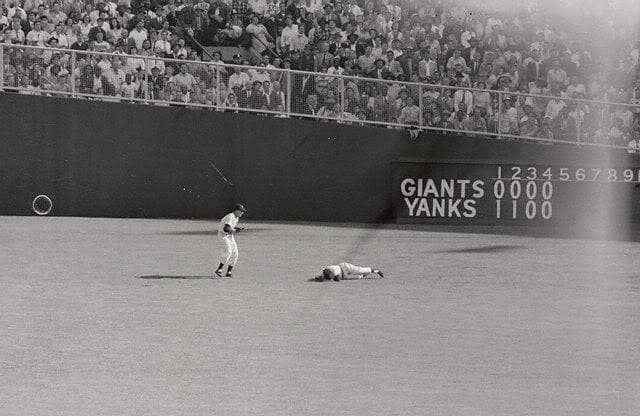
Willie Mays – a rookie himself that October, playing his first World Series – hit a fly ball to right-center. Mantle ran hard for it. DiMaggio was also running. DiMaggio, the veteran, called for the ball, and Mantle, the nineteen-year-old who had been told from his first day in New York not to get in DiMaggio's way, pulled up to yield.
His cleat caught the drain cover.
In the 1951 World Series against the Giants, Mantle suffered a torn anterior cruciate ligament after twisting his knee on a drainage hole in right-center field at Yankee Stadium when DiMaggio called him off a ball late. The initial diagnosis said torn muscle. The full picture was worse: shredded ligaments, cartilage damage, an ACL that medical practice at the time had limited ability to repair. Mantle was taken off the field on a stretcher. His father, Mutt, was in the stands. The sight of his son on the stretcher caused Mutt to collapse -- he was diagnosed at the hospital with Hodgkin's disease, the hereditary cancer that had killed Mantle men for generations.
Mutt Mantle died the following spring. Mickey played the 1952 season on a knee that had not been properly repaired.
He had seventeen more seasons to go.
The Accumulation
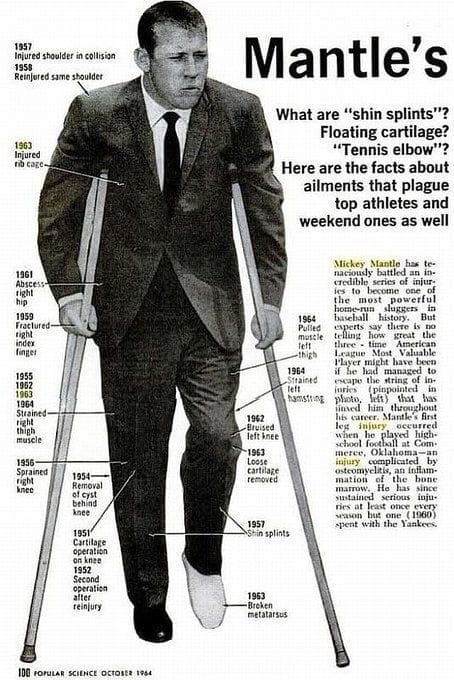
What followed was not a single injury but a sustained assault on a body that never had adequate time to recover before the next season, the next game, the next collision began.
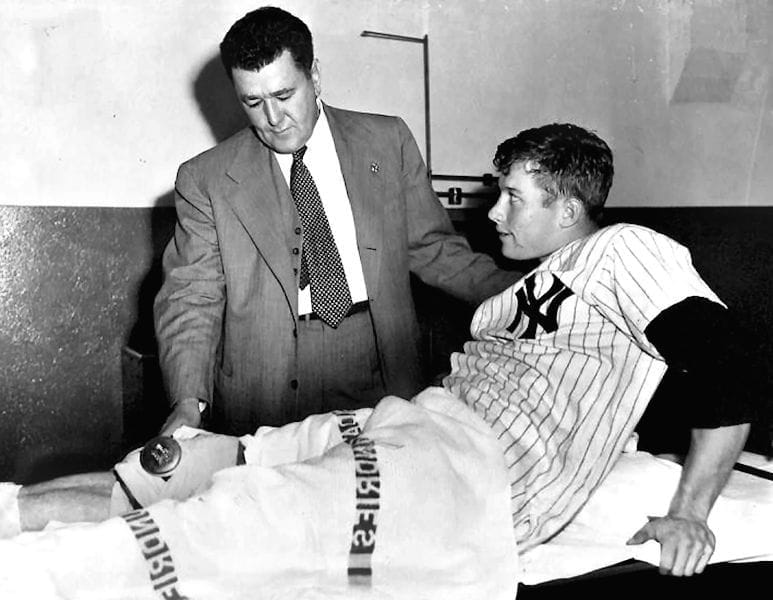
By 1952 and 1953, the knee had been re-injured multiple times. A surgery in 1953 cleaned out cartilage but did not address the underlying structural damage. He adapted -- adjusting his stance, changing his running mechanics, learning to generate power from a base that was fundamentally unstable.
In 1957, the right shoulder went. The shoulder injury during the World Series permanently affected his throwing and his power from the left side of the plate. The numbers confirm it: his left-handed OPS dropped measurably after 1957 and never returned to its pre-injury levels. He remained a devastating right-handed hitter, but the perfectly balanced switch-hitter of 1956 and 1957 existed for only two full seasons.
In 1961, chasing Roger Maris in the most-watched home run race in baseball history, Mantle absorbed a hip abscess so severe that it required surgical packing. Some sources attribute it to an injection administered by the team doctor. The wound bled through his uniform during the World Series. He was limited to 153 games and finished with 54 home runs -- the second-highest single-season total of his career -- while his teammate hit 61 and broke Ruth's record. Mantle, who had never seemed to care about individual records, appeared to feel the outcome was appropriate. Maris had been healthy. Maris had earned it.
1963 brought the broken foot. A chain-link fence in Baltimore caught his left foot while he was chasing a ball along the warning track. He played 65 games that season. His career, already redirected by the accumulating damage, turned a corner it would not come back from.
The Final Decade
The statistics from Mantle's last four full seasons – 1965 through 1968 – are not the numbers of a declining player. They are the numbers of an elite player playing on borrowed time.
In 1965, at thirty-three years old and operating on legs that had been damaged for fourteen years, he posted a .831 OPS and 1.8 WAR in 122 games. The following year he hit 23 home runs with a .927 OPS and 3.6 WAR in 108 games. In 1967, after being moved from center field to first base to minimize the running, he hit 22 home runs with a .825 OPS. His OPS+ in his final four seasons: 137, 170, 150, 143.
This is what excellence under sustained physical degradation looks like. Every one of those seasons would have been the best season of most players' careers.
But by 1967 he was wrapping both legs in heavy bandages for hours before every game. By 1968 -- his last full season -- chronic arthritis had reduced his running to what witnesses described as a cautious shuffle. He hit .237 that year, the worst batting average of his career, and it dragged his lifetime mark to .298, two points below the threshold that had seemed automatic for most of his career. He retired before the 1969 season. He was thirty-seven years old and had played as long as the legs would carry him.
What the Numbers Actually Say
The career WAR of 110.3 -- accumulated over 2,401 games spread across eighteen years -- does not fully account for what was lost. The speed metrics tell part of the story. In his first seven seasons, Mantle legged out 49 triples and stole 80 bases. In his final eleven seasons, after the body had been reshaped by injury, he managed 23 triples and 73 steals combined. He went from one of the fastest men in the American League to a man who moved through the outfield on will and memory.
His career strikeout total -- 1,710 -- led the American League at the time of his retirement and reflected in part the reality that a hitter who cannot trust his lower body cannot generate a stable swing foundation on every pitch. The strikeouts were a tax the injuries levied. He paid it and kept hitting anyway, finishing with a .421 career on-base percentage that remains one of the highest in American League history.
The OPS+ of 172, accumulated across a body that spent most of its professional life in active structural failure, is one of the most remarkable sustained achievements in baseball history. Babe Ruth produced a career 206. Ted Williams finished at 190. Lou Gehrig ended at 179. Mickey Mantle, playing his entire career with a bone-diseased left leg and an uncorrected ACL, sits at 172 and is not done impressing you yet.
The Billy Martin Stories
The injuries were not the whole of Mickey Mantle's off-field life. He had Whitey Ford and Billy Martin for that, and the three of them produced a body of literature that the Yankees organization would have preferred not to be documented.
Mantle told the story of trying to sneak back into a hotel past curfew with Martin, the two of them climbing garbage cans to reach a window. Mantle helped Martin through the window first. Then Martin shut the window and left Mantle outside. Mantle said he tore up a two-hundred-dollar suit in the process.
The duck hunting story belongs to a January trip to Minnesota, five degrees below zero, hunting ducks on a game farm. Mantle put blanks in Martin's shotgun, and Martin began to blaze away at ducks flying slightly over his head, without success. Mantle kept a straight face as long as he could but finally rolled over in the snow, laughing.
These were men who genuinely enjoyed each other's company, which is not a given among teammates and was not a guarantee among the high-pressure Yankees of that era. Mantle was uncomfortable with formal celebrity, uncomfortable with New York, occasionally uncomfortable with himself. With Ford and Martin, he was simply a man from Commerce, Oklahoma, who happened to hit a baseball farther than almost anyone who ever lived.
The Regret
In later years, after the playing was done and the damage of a lifetime of drinking had announced itself in full, Mantle was direct about what he had done to himself. He wrote in his memoir, All My Octobers, that he wished he had taken better care of the body that had tried, despite everything, to carry him.
He received a liver transplant in 1995. He died August 13, 1995, in Dallas, at sixty-three years old.
His final public message, issued after the transplant, was a request that people register as organ donors. He said he was not a role model. He said people should not live like he had lived. He said this as a man who had played seventeen seasons on a leg that should have been rested and a knee that had never been properly repaired, who had told his teammate Tony Kubek that the reason he kept taking the field, on days when the pain was genuinely disabling, was that some kid might be in the stands on the only ticket his father could afford all year.
He was right that he was not a role model. He was a man, flawed and genuine, who happened to play baseball the way very few humans ever have.
Casey Stengel said he was the best one-legged player he ever saw.
That was a compliment. It was also, as Stengel well knew, an injustice.