

Why Max Scherzer May Have Struck Out the Final Chapter on 3,500
There is a number in baseball that once felt like a reasonable milestone, a threshold a handful of dominant starters might clear in any given generation. Three thousand five hundred strikeouts. It sits on the all-time leaderboard like a velvet rope — prestigious, exclusive, and until this week, entirely attainable for the right kind of pitcher.
When Max Scherzer, wearing the uniform of the Toronto Blue Jays in what may be the final act of an incandescent career, recorded strikeout number 3,500, he joined an eleven-man club whose oldest living member could not vote when Nolan Ryan broke the all-time record in 1983. What no one was saying loudly enough in the celebration was the uncomfortable question hovering over the moment like a changeup with nowhere to go: Is Max Scherzer the last man in?
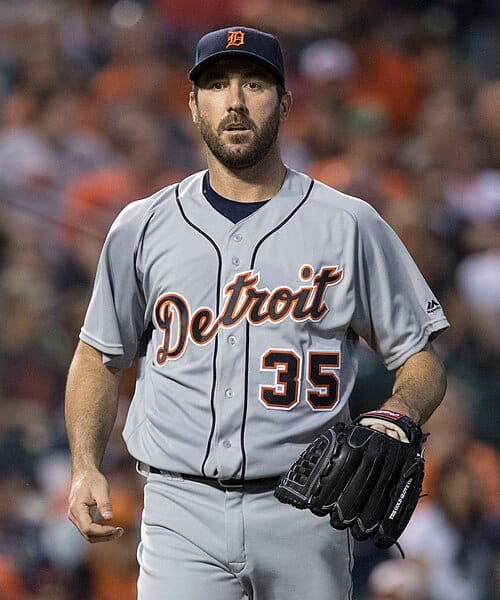
The evidence suggests he might be. And so might his contemporary, Justin Verlander, who crossed the threshold before him and now, at 43, is adding to a total that stands at 3,554. These two men — power pitchers who came of age when starters still accumulated innings the way the old guard accumulated complete games — may be the final representatives of a species the game is quietly, efficiently driving to extinction.
The Long Arm of History
To understand what Scherzer and Verlander have accomplished, you have to understand the mathematics of longevity that underpin this list.
Nolan Ryan’s 5,714 strikeouts are not merely a record. They are a monument to a different game, one in which Ryan averaged 281 innings per season through his prime decade, threw 222 complete games over 27 seasons, and still had enough gas in 1989 — at age 42 — to fan 301 batters in 239 innings. No human being will touch 5,714 again. It belongs to its era the way Cy Young’s 511 wins belongs to his.
But the names below Ryan on the list tell a subtler story. Randy Johnson needed 4,135 innings to reach 4,875 strikeouts. Roger Clemens required 4,916 innings for 4,672. Steve Carlton, in an era when starting pitchers finished what they started, threw 5,217 innings. Tom Seaver, the gold standard of craft and durability, worked 4,783 innings over 20 seasons.
Then something began to change. Pitch counts arrived. The five-man rotation became doctrine. Specialized bullpens ate away at innings that starters once owned. And the numbers tell the story precisely: Max Scherzer has thrown 2,985 innings across 18 seasons to reach 3,503 strikeouts. Verlander has needed 3,571 innings over 22 seasons to accumulate 3,554. They reached the summit via different routes — Scherzer’s 10.6 strikeouts per nine innings is the more efficient path; Verlander’s total reflects remarkable longevity — but neither could have made it without the strikeout rate revolution of the modern game.
Which brings us to the cruel irony at the heart of this story.
The Math That Kills the Dream
Today’s game produces more strikeouts per nine innings than any era in baseball history. Batters fan in record numbers. Yet the pitchers most likely to be the beneficiaries of that trend — the power arms lighting up radar guns from Fenway to Petco — will almost certainly never reach 3,500 career strikeouts. The increased per-inning yield has been overwhelmed by the catastrophic decline in innings available.
Consider the arithmetic. To reach 3,500 strikeouts at Scherzer’s elite 10.6 K/9 rate, a pitcher needs approximately 2,972 innings. At a more typical modern ace rate of 9.5 K/9, the innings requirement climbs to 3,316. And here is where the modern game delivers its verdict: the average starting pitcher in Major League Baseball today logs roughly 170 innings per season. Even a durable, healthy starter rarely exceeds 200. Which means reaching 3,316 innings demands 19.5 seasons of sustained 170-inning output — before accounting for Tommy John surgeries, oblique strains, shoulder impingements, and all the other hurdles the modern pitcher .
Bert Blyleven threw 4,970 innings. Fergie Jenkins threw 4,500. Don Sutton threw 5,282. Those men pitched in a world where 300-inning seasons were not extraordinary. That world is gone.
Scan the active roster list — the 25 most prolific strikeout artists still working today — and the picture grows bleak. Chris Sale (LHP, ATL), at 37, owns 2,671 strikeouts and arguably the most wicked cutter in the American League. He needs 829 more. At his career rate of 11.1 strikeouts per nine, that requires roughly 671 additional innings — three or four productive seasons. The arithmetic is friendly. The injury history is not. Sale has spent more time on the injured list than on the mound in some seasons, and asking him to be both healthy and productive into his early forties is a wager even the most optimistic scout would not take at even money. He is the only active pitcher with a realistic, though far from certain, shot at 3,500.
Gerrit Cole (RHP, NYY), 35, has 2,269 strikeouts and a 10.3 K/9 career rate. He needs 1,231 more. That translates to approximately 1,073 additional innings — six seasons of 179 innings — meaning he would need to pitch like an ace until age 41. Possible. Not probable.
Aaron Nola (RHP, PHI), 33, has been a model of durability, carrying 1,947 strikeouts over a steadily productive career. He needs 1,553 more. At his 9.8 K/9 rate and roughly 185 innings per season, he generates around 201 strikeouts annually. He would need nearly eight more full seasons of that output, pitching to 41. It can happen. Greg Maddux won a Cy Young at 38. But Maddux was not accumulating strikeouts; he was generating ground balls. The pitcher who reaches 3,500 strikeouts must sustain both the arm strength to miss bats and the physical durability to log innings — simultaneously — across a career approaching two decades. The game permits fewer and fewer men to do both.
The Last Two at the Gate
Which is what makes Scherzer and Verlander so extraordinary, and what makes their probable status as the final two members of this club so poignant.
Both men entered the league when the game still allowed starters to accumulate. Both developed into power pitchers — Scherzer averaging a blistering 10.6 per nine over his career, Verlander settling into his dominant mid-career groove in Detroit before reinventing himself in Houston. Both benefited from an era that prized strikeouts, from analytics that helped them sharpen their arsenals, and from careers long enough to take full advantage.
But neither would have reached 3,500 in the current environment as a young pitcher being managed the way young pitchers are managed today — with pitch limits, innings caps, cautious organizational mandates about workload. Scherzer’s 2,985 innings came over 18 seasons because he was allowed to pitch 200 innings in a year when it mattered. Verlander’s 3,571 innings came because he threw 251 innings in 2011, 238 in 2012, 218 in 2013. The current Detroit Tigers would never permit Tarik Skubal — their best pitcher — anywhere near 250 innings in a single season. The game has decided otherwise.
The Flame Thrower from Milwaukee
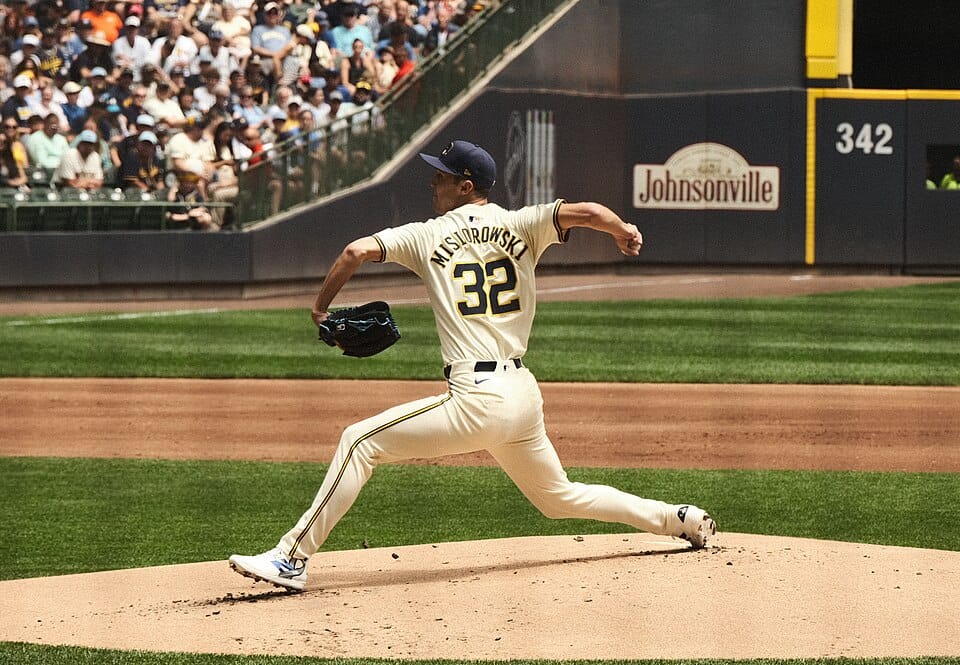
And yet baseball would be a lesser game without hope, and Jacob Misiorowski (RHP, MIL) is hope with a 101-mile-per-hour fastball.
The Milwaukee Brewers right-hander arrived in 2025 and has been setting the sport on fire in ways that recall the young Randy Johnson — raw, overwhelming, and capable of making the most sophisticated hitters look completely overmatched. Through his first year and a half of major league service, Misiorowski has struck out 218 batters in 153 innings, a rate of 12.8 per nine that would have seemed science fiction to a previous generation. His WHIP of 0.954 is elite. His ERA of 2.65 suggests he is not merely striking people out but actually retiring them.
The question — the great, unanswerable question — is whether the arrow pointing toward 3,500 strikeouts has any chance of tracing a path from Milwaukee in 2025 to wherever he is pitching in 2041.
The raw numbers are more encouraging than you might expect. In an optimistic but plausible projection, Misiorowski might average something close to 185 innings annually through his late twenties at roughly 12 strikeouts per nine — a pace of 247 strikeouts per season. As he moves through his thirties, a natural decline to 11 K/9 over 180 innings yields 220 per year. A final few seasons in the mid-to-late thirties at 10 K/9 over 165 innings adds 183 per year. Thread those numbers across a 16-season career and you arrive, somewhat astonishingly, somewhere in the neighborhood of 3,600 career strikeouts.
But every word in that projection is doing enormous work. “Plausible” hides a minefield of Tommy John surgeries, velocity decline, role changes, and the thousand other ways a pitcher’s career diverges from projection. Misiorowski throws as hard as any starter in the game, and the hardest throwers are not typically the most durable. The late work of Randy Johnson — who lasted until 45 — depended on a slider he did not fully weaponize until his thirties and a frame that absorbed the physical demands of pitching in ways few bodies can replicate. Johnson also benefited from a career that unfolded largely before the current innings-management regime took hold.
What Misiorowski must do — beyond the obvious business of staying healthy — is thread a needle that no pitcher born after 1985 has managed: maintain elite strikeout rates across enough innings and enough seasons that the arithmetic cooperates. He must pitch deep enough into his starts, for enough years, while the modern game is actively discouraging exactly that. He must persuade organizational decision-makers, probably across multiple teams, to let him throw 185 innings when every analytical impulse says 165 is safer. And he must stay healthy in an era when Tommy John surgery has become a rite of passage rather than a catastrophe.
If anyone born in this century can do it, the early evidence suggests it might be him. The word “might” has never carried so much weight.
The End of an Era
The 3,500 strikeout threshold was never democratic. Only eleven men have ever reached it, and ten of them spent significant portions of their careers in an era when starters simply accumulated more innings than they do today. The eleventh, Scherzer himself, is a product of a transition period — a man who came up when the old rules still partially applied and stayed long enough to harvest the benefits of both worlds.
The modern game is spectacular in many ways. The strikeout rates are extraordinary. The velocity is historic. The athleticism and preparation of today’s pitchers would astonish the men who drew salaries in the 1970s. But the architecture of the game — the pitch counts, the bullpen specialization, the carefully managed workloads — has made it nearly impossible for any starting pitcher to accumulate the sheer volume of work that 3,500 strikeouts demands.
Scherzer’s 3,503rd victim was the punctuation on an era. Verlander’s continued pursuit of history is the epilogue. The 3,500-strikeout club may well be closed to new members not because the talent is gone, but because the game no longer permits the kind of career those numbers require.
The dinosaurs have struck out for the last time. The meteor hit in the form of a pitch count.