

Part One: Commerce, Candlestick, and Seven Championships
Casey Stengel had managed Babe Ruth.
He had managed Lou Gehrig. He had managed Joe DiMaggio through the last years of a career that made grown men reconsider what baseball could be. He had seen everything the game produced in the first half of the twentieth century, and he said this about a nineteen-year-old shortstop from Commerce, Oklahoma who showed up in spring training 1951 hitting .402 with nine home runs:
"I know he's not a big league outfielder yet, and that he should have a year of Triple-A under his belt. That's the only logical thing. But this kid ain't logical. He's a big league hitter and base-runner right now."
Stengel kept the kid. He was right. Mickey Charles Mantle spent the next eighteen years as the centerpiece of the most consistently dominant franchise in American professional sports, won seven World Series championships, hit 536 home runs, and finished his career with a 172 OPS+ -- meaning he was, on average, 72 percent better than the typical American League hitter over a span of nearly two decades.
He also played most of those two decades on one good leg, a complication we will address at length in Part Two. For now: the baseball, which was extraordinary.
"He should lead the league in everything. With his combination of speed and power, he should win the Triple Crown every year. In fact, he should do anything he wants to do." -- Casey Stengel, spring training 1951
Commerce, Oklahoma
Mutt Mantle named his son Mickey after Mickey Cochrane, the Hall of Fame catcher, because Mutt Mantle believed his son was going to be a baseball player and that a ballplayer should have a ballplayer's name. He was right on both counts. From the day Mickey could stand, Mutt taught him to switch-hit – throwing right-handed himself while his father Charley threw left-handed, the boy in between, learning both sides of the plate the way other boys learned to tie their shoes.
Commerce was a zinc-mining town in the northeast corner of Oklahoma, small and hard and not particularly interested in producing baseball legends. It produced one anyway. The Yankees found him in 1949, a seventeen-year-old shortstop who hit a ball in a way that made scouts stop writing in their notebooks and stare. Tom Greenwade signed him for $1,100.
By the time Mantle arrived in New York for spring training 1951, the Yankees had assigned him uniform number 6 -- Ruth had worn 3, Gehrig 4, DiMaggio 5. The message from the front office was not subtle. Stengel decided to promote Mantle to the majors as a right fielder instead of sending him to the minors. His salary for the 1951 season was $7,500.
The early going was not smooth. After a slump sent him briefly back to the minors, Mantle called his father from Kansas City, defeated. "I don't think I can play baseball anymore," he said. Mutt Mantle drove to Kansas City that day and, when he arrived, began packing his son's clothes. According to Mantle, his father said: "I thought I raised a man. I see I raised a coward instead. You can come back to Oklahoma and work the mines with me." After his father's rebuke, Mantle broke out of his slump and hit .361.
He was back in New York by summer. He never went back to the minors.
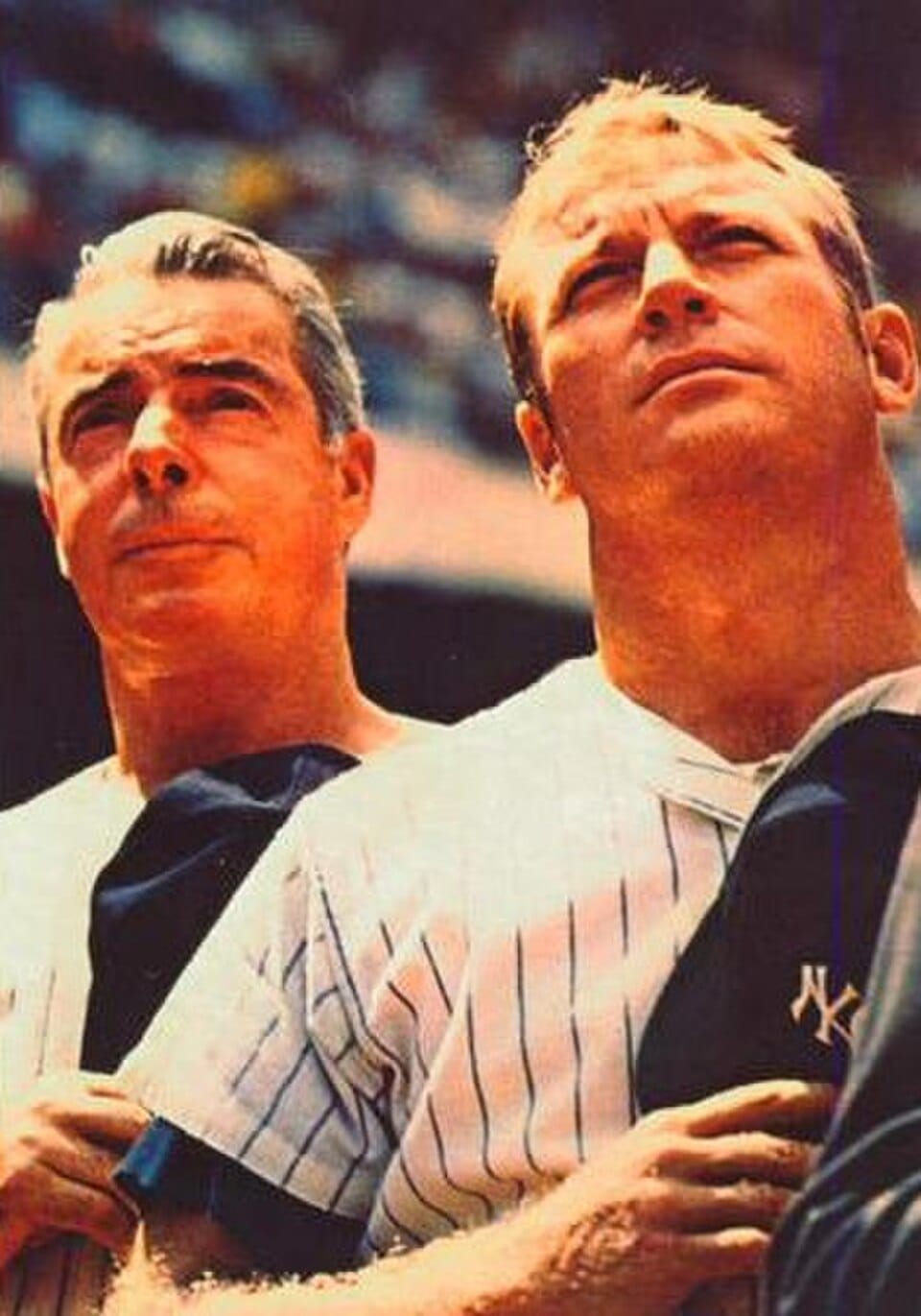
Is The DiMaggio Shadow
One detail from Mickey Mantle Day at Yankee Stadium, June 8, 1969, captures something essential about the man.
Mantle's number 7 was retired and he was presented with a bronze plaque to be hung near the monuments to Babe Ruth, Lou Gehrig, and Miller Huggins in center field. The plaque was officially presented to him by Joe DiMaggio. Mantle gave a similar plaque to DiMaggio, telling the crowd: "Joe DiMaggio's deserves to be higher." As per Mantle's request, DiMaggio's plaque was hung one inch higher than Mantle's.
It was a generous gesture from a man who had spent his entire career in DiMaggio's shadow and never, not once, seemed to resent it. The Yankee Clipper did not return the sentiment. Mickey sought Joe's respect, largely without success. They were icons of very different times. DiMaggio resented Mantle's easy popularity, resented the fact that the country boy from Oklahoma had replaced him without visible struggle, resented the drinking and carousing that DiMaggio felt dishonored the uniform. Even as Mantle was dying of cancer in 1995, DiMaggio would not relent. Their relationship was, for its entire length, ice.
And yet Mantle, who could read the situation as clearly as anyone, never stopped being gracious about it. It was that quality -- the humility of a man who genuinely did not think he was the most important person in any room -- that made New York, which had initially booed him for not being DiMaggio, eventually love him more than it had ever loved anyone except perhaps Ruth.
Unlike DiMaggio, who was so aloof that rookies dared not approach him, Mickey Mantle used to rush over to greet new players with an outstretched hand. "I'm Mickey Mantle," he would say, as if the young player didn't know.
The Dynasty Years
From 1951 through 1964, the New York Yankees appeared in twelve World Series and won seven. This is the most sustained period of dominance in modern American professional sports, and Mickey Mantle was at the center of it for all fourteen years. He was not merely a contributor. He was the instrument around which everything else was organized.
The early championship teams -- 1951, 1952, 1953 -- featured a Mantle still learning the major leagues, still developing the full force of what he would become. He was a weapon, but a young one. From 1953 to 1955, the switch-hitter averaged 28 home runs, 98 RBI and 118 runs per season. The Yankees won it all in 1952 and 1953, lost the Series in 1955 to Brooklyn, and came back in 1956 for the moment that made everything permanent.
1956: The Favorite Summer
Mantle called it his favorite summer. By any statistical measure, it was one of the finest individual seasons in the history of American League baseball.
He led the majors with a .353 batting average, 52 home runs, and 130 RBIs, winning the Triple Crown -- the only switch hitter to do so. He also led the AL with 132 runs scored, a .705 slugging percentage -- only the ninth player in history to clear that threshold -- and total bases (376). His OPS of 1.169 stood against a league average of .735. His WAR of 11.3 was the highest single-season mark produced in the American League in the second half of the twentieth century.
"Only a handful of players in all baseball history," wrote Leonard Koppett of The New York Times, "have been as important to winning teams and have been able to contribute as much to eventual victory as has Mickey Mantle."
The 1956 World Series against Brooklyn provided one of Mantle's finest October moments. In Game 5, the day Don Larsen pitched his perfect game, Mantle kept the perfect game alive by making a running catch of a deep fly ball off the bat of Gil Hodges, and had scored the first of the Yankees' two runs with a home run off Sal Maglie in the inning before. New York won the Series four games to three.
He won the AL MVP award, the first of three. He was named the Associated Press Male Athlete of the Year and awarded the Hickok Belt as the top American professional athlete of the year. He was twenty-four years old.
1957: Even Better, Somehow
The 1957 season is the one that gets undervalued in the Mantle biography because the Triple Crown numbers – .353, 52, 130 – are so vivid they overshadow what came next. In 1957, Mantle hit .365 with a .512 on-base percentage. He generated 11.3 WAR, matching his 1956 total. He walked 146 times. His OPS+ of 221 is among the highest single-season marks ever recorded.
The Yankees won the pennant again. They lost the World Series to Milwaukee in seven games, Mantle batting .263 in the Series with a shoulder injury that had arrived during Game 4. The shoulder would not fully heal. It would affect his swing from the left side of the plate for the rest of his career.
Yes, in Texas

October After October
The World Series record that Mantle owns – 18 home runs, 40 RBIs, 42 runs scored, 43 walks, 26 extra-base hits, and 123 total bases, along with the highest World Series on-base and slugging percentages in history – was not built in a single autumn. It accumulated over twelve Series appearances across fourteen years, in the biggest games, under the highest pressure, against the best pitchers in the other league.
His .400 average in the 1960 Series against Pittsburgh, delivered while playing through considerable pain, remains one of the great individual Fall Classic performances. He had 10 hits, 3 home runs, and 11 RBIs in seven games. The Yankees still lost, on Bill Mazeroski's famous walk-off in Game 7, and Mantle famously cried at his locker after the game -- offering a glimpse inside the traumatic world of stress occupied by Yankee heroes. When greatness was expected, mere excellence did not tick the box.
He came back the next year and hit 54 home runs. He won the Series again in 1961 and 1962. By the time the dynasty finally ran out in 1964 -- Mantle batting .333 with 3 home runs and 8 RBIs in a seven-game Series loss to St. Louis, his body already betraying him -- he had been a champion seven times.
The Man Behind the Number Seven
Everyday, before a game, Mickey would wrap his legs in yards of bandages. Whenever manager Casey Stengel felt he should ask him if he could play, Mickey almost always said he could.
His teammate Tony Kubek, who played beside him for nine seasons and watched him dress for games, once asked him why he kept taking the field when the pain was clearly disabling. Mantle's answer, given without theater or self-pity, has stayed in the baseball record ever since.
"Tony, maybe there's a guy out there with his kid, and it might be the only ticket he can afford all season, and he brought his kid to see me. So I better be out there."
He was not performing humility. He was constitutionally incapable of performing anything. The shy boy from Commerce who had walked into Yankee Stadium for the first time in 1951 and been handed a number that announced he was the next Ruth, Gehrig, and DiMaggio combined -- that boy never entirely relaxed into the role. He just kept showing up.
Three AL MVP awards. Twenty All-Star selections. Seven championships. He was elected to the Hall of Fame in 1974 in his first year on the ballot.
A statute of Mantle was unveiled in Oklahoma City in 1998 at Mickey Mantle Plaza, 2 South Mickey Mantle Drive.
In 2022, a 1952 Topps Mantle card in near-mint condition sold for $12.6 million -- the most valuable baseball card in history. Commerce, Oklahoma had produced something the market could not fully price.
Career: .298 BA / .421 OBP / .557 SLG / .977 OPS / 172 OPS+ / 536 HR / 110.3 WAR | Hall of Fame, 1974