
Before He Was "The Ol' Perfessor": Casey Stengel the Ballplayer

Most baseball fans know Casey Stengel as a manager. He won seven World Series titles with the Yankees. He charmed New York with the lovable, hapless early Mets. He left behind a tangle of quotes so wonderfully tangled they earned their own name: Stengelese.
But long before the dugout, the wit, and the Hall of Fame plaque, Stengel was a genuinely good ballplayer. He spent 14 seasons in the major leagues, batted .284 for his career, and delivered one of the most dramatic World Series performances of the 1920s. That part of his story tends to get buried under the legend. It deserves better.
A Left-Handed Outfielder Who Could Really Hit
Stengel broke into the majors in 1912 with the Brooklyn Dodgers at age 21, and he stuck. Over the next 14 years he played for five National League clubs: Brooklyn, Pittsburgh, Philadelphia, the New York Giants, and Boston. He was a left-handed hitter with a good eye and surprising pop for the era.
The numbers back it up. His career on-base percentage was .356, well above league average for his time, and his OPS+ of 120 means he was 20 percent better than the average hitter once park and league effects are factored in. His best individual season came in 1922 with the Giants, when he hit .368 with a .564 slugging percentage in 84 games, good for a 154 OPS+. The following year, 1923, he hit .339. These were not the numbers of a marginal role player. They were the numbers of a quality everyday hitter who happened to platoon often, a strategy he later turned into a managerial weapon.
Stengel was also a smart, aggressive baserunner and a capable defender in the outfield corners. He played alongside legends of the Dead Ball and early Lively Ball eras and held his own.
October 1923: The Defining Moment
If one stretch of baseball crystallizes Stengel the player, it is the 1923 World Series between his Giants and the Yankees.
By then Stengel was 32-years-old and no longer an everyday player, used mostly against right-handed pitching. None of that mattered once the Series started. Across six games he hit .417 with a .563 on-base percentage and a .917 slugging percentage, numbers that would be remarkable for any hitter in any era, let alone a part-time fourth outfielder.
The signature moments came in two home runs, both hit inside the park, both against the Yankees, and both, in their own way, legendary.
The first came in Game One, a 5-4 New York Giants win. Stengel's homer was the decisive blow in a tight ballgame, the kind of swing that turns a close World Series game into a signature memory.
The second, in Game Three, is the one that has lived on. Stengel ran the bases at full speed, the legend says one shoe came loose as he rounded third, and he came home with the only run of a 1-0 victory over Yankees starter Sam Jones. As he crossed the plate, Yankees players in the dugout reportedly heckled him, and Stengel, never one to let a moment pass quietly, answered with a gesture of his own toward their bench. It became one of the most retold scenes of that era's World Series coverage.
The advanced metrics confirm just how much those games mattered. Stengel's Championship Win Probability Added for the 1923 Series sits at 20.9 percent, the largest share of any series in his playing career and a figure that reflects just how often his bat swung the outcome of close games. For comparison, his 1922 World Series, a Giants sweep of the Yankees, produced a far smaller 1.0 percent mark, since the games themselves were rarely in doubt.
In other words, the 1923 Series was not just a nice personal moment for an aging outfielder. It was, by the numbers, the most impactful postseason performance of his playing career, and one of the most memorable in World Series history up to that point.
The Long Apprenticeship
Stengel's playing career ended quietly in 1925 with the Boston Braves. What followed was nearly two decades of unglamorous managerial work, first in the minor leagues, then in difficult major league stints with Brooklyn and Boston from 1934 to 1943. Those Brooklyn and Boston teams never finished higher than fifth place, and Stengel built a reputation as something of a clown rather than a serious tactician.
It was in those long, losing seasons that he sharpened ideas he had absorbed as a player, particularly the value of platooning hitters by matchup, a tactic he had experienced firsthand under managers like John McGraw with the Giants. He was, in a real sense, training for the job that would define him.
The Yankees Dynasty and the Mets Renaissance
When the Yankees hired Stengel in 1949, many in baseball were skeptical of a 58-year-old with a losing managerial record and a reputation for comedy. The skepticism did not last. Over 12 seasons, Stengel led New York to 10 American League pennants and seven World Series championships, including a record five consecutive titles from 1949 to 1953. His .623 winning percentage with the Yankees remains one of the great managerial runs in the sport's history.
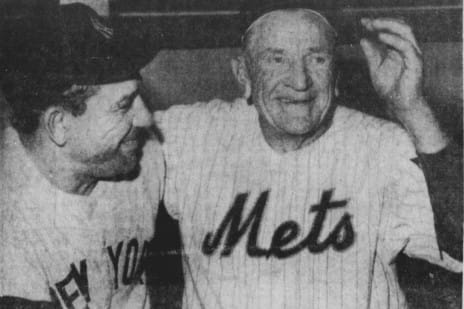
After his release following the 1960 season, Stengel took on a very different challenge: managing the expansion New York Mets. The teams were dreadful, losing 120 games in their first season alone, but Stengel's humor and showmanship turned the Mets into a beloved civic story even as they lost. He gave the franchise its early personality and helped build the foundation of affection that would carry the Mets through the lean years.
Cooperstown and the Last Word
Casey Stengel was elected to the Baseball Hall of Fame in 1966, recognized for a career that spanned more than half a century as both player and manager. His quotes have outlived nearly everyone who heard them firsthand. "There comes a time in every man's life, and I've had plenty of them," he once said, a line that captures his entire approach to baseball and to life: equal parts wisdom and nonsense, delivered with a wink.
But before the one-liners, before the pennants, before he became "The Ol' Perfessor," Casey Stengel was a .284 hitter who, for one unforgettable week in October 1923, was the best player on the biggest stage in baseball.