
The Impossible Dream: Carl Yastrzemski's Legendary September of 1967

July 13, 2026. My apologies to Diamond Echoes subscribers for the lack of communication in the last week or so. I started the Fourth of July/All-Star game break/summer break without informing you of the editorial schedule. We will return in early August. In the meantime, enjoy my write up of Carl Yastrzemski. Yaz, was my baseball hero growing up. When I played sandlot baseball, he was the player I emulated, all the time, sort of. I batted right hand he hit left-handed. Never did a baseball player in Boston ignite a region like Yaz did in 1967. Sorry Ted Williams.
Legendary September of 1967
Replacing a legend is close to impossible. In 1961, a 23-year-old Carl Yastrzemski took over left field for Ted Williams, one of the greatest hitters the game has ever seen. Nobody would have blamed him for shrinking under that pressure. Instead, Yaz spent the next 23 years building his own legacy in Boston, one that eventually earned him a plaque in Cooperstown right alongside Williams.
No season defined that legacy more than 1967.
A Team With Nothing to Lose
To understand what Yastrzemski did in 1967, you first need to understand where the Red Sox had been. In 1966, Boston finished in ninth place, a brutal 26 games out of first. Fenway Park sat mostly empty. Few fans expected anything different heading into 1967.
Something changed. Under rookie manager Dick Williams, a young and scrappy Red Sox team found itself locked in one of the tightest pennant races in baseball history. Four teams, the Red Sox, Detroit Tigers, Minnesota Twins, and Chicago White Sox, battled for the American League crown deep into the season's final days. Boston fans started calling it the “Impossible Dream.”
Yastrzemski became the heartbeat of that dream. He did not just lead the Red Sox that year. He carried them.
A Triple Crown Season
By the end of 1967, Yastrzemski had put together one of the most complete offensive seasons in baseball history. He won the American League Triple Crown, leading the league in batting average at .326, home runs with 44, and RBIs with 121. He also led the league in runs scored, hits, on-base percentage, and slugging percentage.
It was a performance so dominant that Yastrzemski won the AL Most Valuable Player award by nearly a unanimous vote, falling just one vote short of a perfect ballot. His Triple Crown would stand alone for 45 years. Nobody else won one until Miguel Cabrera did it in 2012.
Those numbers alone would have made 1967 a career-defining season. But the way Yastrzemski delivered them, especially in the final stretch, is what turned him into a Boston legend.
The Greatest September in Red Sox History
With the pennant race tightening in September, Yastrzemski somehow got even better. Over the final 12 games of the regular season, he batted an almost unbelievable .523. He collected 23 hits in 44 at-bats, added 5 home runs, and drove in 16 runs. Players simply do not hit like that with a championship on the line. Yastrzemski did.
The stretch reached its peak on the final weekend of the season. The Red Sox hosted the league-leading Minnesota Twins for a two-game series that would decide the American League pennant. Win both games, and Boston would clinch. Lose either one, and the miracle season would end in heartbreak.
Yastrzemski went 7-for-8 across those two games.
In the deciding game, with the Red Sox trailing, Yastrzemski singled home the tying run. He came around to score the go-ahead run later in the same inning. Then, with the game and the pennant hanging on every pitch, he made a spectacular throw from left field to gun down Minnesota's Bob Allison at second base, snuffing out a potential Twins rally.
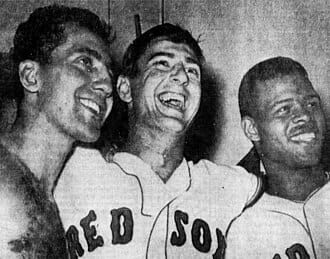
When the final out was recorded, Fenway Park fans stormed the field and hoisted Yastrzemski onto their shoulders. The Impossible Dream had come true. Boston was headed to the World Series.
Carrying the Fight to St. Louis
The World Series brought the powerhouse St. Louis Cardinals and their ace, Bob Gibson, who was pitching some of the best baseball of his career. The Red Sox ultimately fell in seven games. But Yastrzemski's bat never went quiet.
Across the seven-game series, Yastrzemski hit .400, with 10 hits in 25 at-bats. He launched 3 home runs and drove in 5 runs. His on-base percentage sat at .500, and his OPS, which combines on-base percentage and slugging percentage into one number, reached a staggering 1.340. Even in defeat, Yastrzemski proved that his September surge was no fluke. He simply refused to stop hitting.
Boston did not win the championship in 1967. But nobody who watched that October walked away doubting Carl Yastrzemski's greatness.
A Career Built to Last
Yastrzemski's brilliance did not end with the Impossible Dream season. In May 1972, he suffered a severe knee injury in California. Doctors on the West Coast told him his season was over and that he needed surgery. Yastrzemski ignored that advice, returned to the lineup, and helped push the Red Sox into another thrilling late-season division race.
He was also one of the finest defensive left fielders the game has ever seen. Yastrzemski won seven Gold Gloves, thanks largely to his mastery of Fenway's tricky left-field wall, the Green Monster. He turned deep, difficult drives into routine outs so often that opposing hitters learned to fear hitting the ball anywhere near him. His defensive masterpiece came in 1977, when he played 150 games in left field and did not commit a single error.
In 1979, Yastrzemski reached two career milestones in the same magical season. He collected his 3,000th career hit on a sharp grounder against the Yankees, then later blasted his 400th career home run. He became the first player in American League history to reach both the 3,000-hit club and the 400-home run club.
When Yastrzemski retired in 1983, he held the Red Sox all-time franchise records in games played, at-bats, runs, hits, doubles, total bases, and RBIs. His 3,308 career games played still stands as an American League record.
The Baseball Hall of Fame welcomed Carl Yastrzemski on his first year of eligibility in 1989, a fitting final chapter for the man who followed Ted Williams and made Fenway Park his own.