

A Poem Nobody Expected to Last@
On July 12, 1910, a New York sportswriter named Franklin Pierce Adams had a hole to fill in his column. He was a Giants fan. His team had just lost to Chicago — again. In a flash of frustration — or maybe just professional craft — he dashed off eight lines of verse for his “Always in Good Humor” column in the New York Evening Mail. He titled it “That Double Play Again.” Editors later retitled it “Baseball’s Sad Lexicon.”
Nobody expected it to outlive the ballparks where it was born.
These are the saddest of possible words:
“Tinker to Evers to Chance.”
Trio of bear cubs, and fleeter than birds,
Tinker and Evers and Chance.
Ruthlessly pricking our gonfalon bubble,
Making a Giant hit into a double—
Words that are heavy with nothing but trouble:
“Tinker to Evers to Chance.”
Eight lines. Three names. One Dead Ball Era infield. And “gonfalon” — a word almost nobody uses anymore, meaning a pennant flag — aimed squarely at the New York Giants. Over a century later, those eight lines remain the most famous piece of writing in baseball history. They put three men in Cooperstown, too, though not everyone agrees they belonged there. More on that shortly.
Who Were These Men?
Before the poem, most fans outside Chicago knew the names. After it, everyone did. But let’s back up and meet them properly.
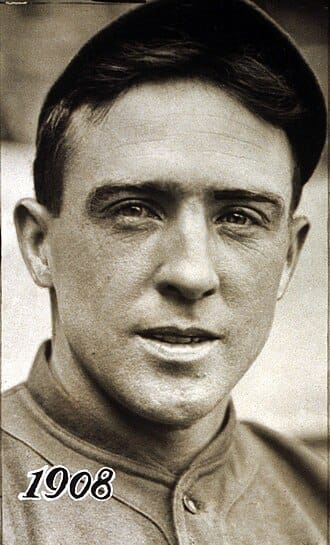
Joe Tinker (SS, CHC) was born July 27, 1880, in Muscotah, Kansas. Quiet, steady, and almost impossible to rattle, Tinker spent the core of his career patrolling shortstop for the Chicago Cubs with an efficiency that felt almost mechanical. His bat was modest — a career .262 average, .308 OBP, .353 SLG, and an OPS+ of 96, meaning he hit right around league average by that adjusted metric.His ISO (isolated power; slugging minus average) came in at just .091, which tells you power wasn’t part of the package. But none of that is why people remember him.
Tinker’s glove was something else. His career WAR sat at 52.7, and his defensive WAR of 34.3 ranks 5th all-time at the shortstop position. He moved with a calm grace in the field that made hard plays look routine. That’s a harder skill to see in a box score.
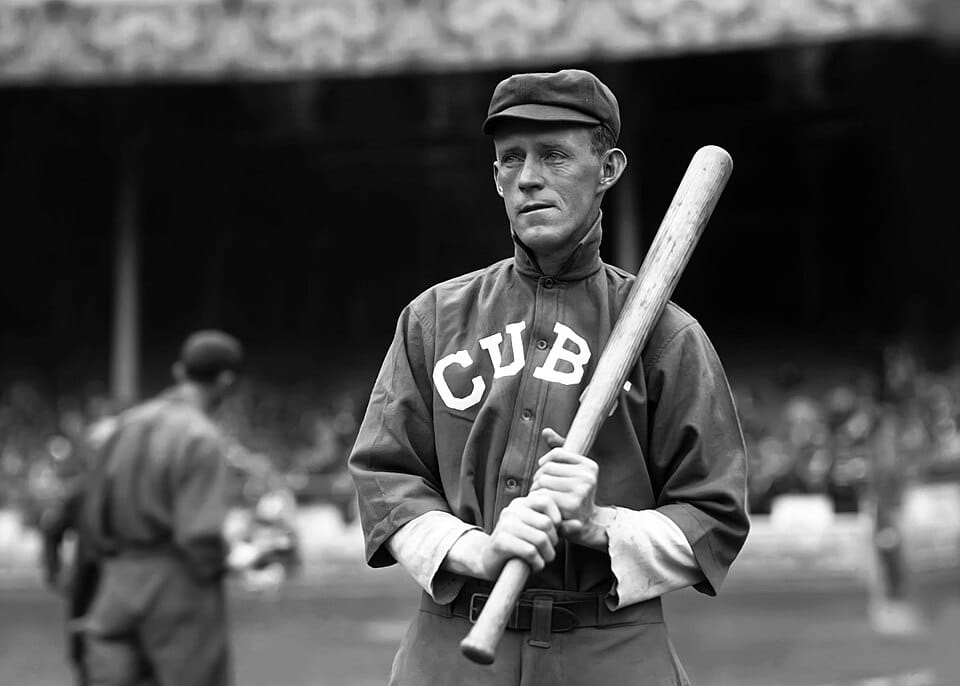
Johnny Evers (2B, CHC) came from Troy, New York, born July 21, 1881. They called him “The Crab.” He earned it. Evers was intense, hair-trigger competitive, and completely absorbed by the game at all times — on the field or off. His career slash line reads .270/.356/.334 with an OPS+ of 106 and an ISO of just .064.[1] He wasn’t a power threat. He was a situational hitter who got on base, turned double plays, and studied the rulebook the way some men study scripture. His career WAR of 48.0 owes as much to his glove and his baseball brain as it does to anything he did at the plate.[2]
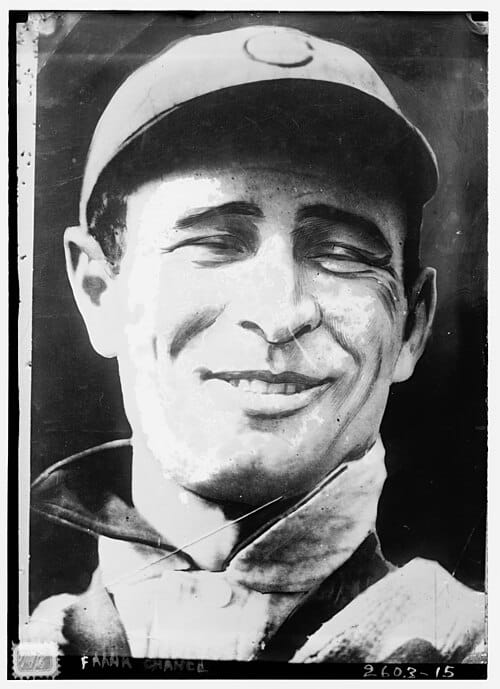
Frank Chance (1B/MGR, CHC) was born September 9, 1876, in Fresno, California, and was by every statistical measure the most talented player of the three. His career slash line of .296/.394/.394 produced an OPS+ of 135, well above league average. He stole 403 bases over his career — a figure that speaks to both his speed and his instincts. His career WAR was 46.7. They called him “The Peerless Leader,” and not as a courtesy. He managed the Cubs from the field, calling the game and executing it simultaneously. His managerial record in Chicago produced a .664 winning percentage — the best in franchise history.
The Dynasty They Built
The 1906–1910 Chicago Cubs were one of the best teams the National League has ever put on a field. In 1906, they went 116–36, posting a .763 winning percentage — one of the most dominant single-season records in baseball history. They lost the World Series that year to the crosstown White Sox in six games — the so-called “Hitless Wonders” — one of the era’s genuine upsets. But they came right back.
In 1907, the Cubs won 107 games and swept the Detroit Tigers in the World Series. In 1908, they went 99–55, ground through one of the messiest pennant races of the Dead Ball Era, and beat Detroit again — this time in five games. Two straight World Series titles. Frank Chance led them to four NL pennants in five years (1906, 1907, 1908, 1910). The 1910 pennant run ended in a World Series loss to the Philadelphia Athletics, but the body of work from those five seasons is hard to argue with.
This was not a one-trick team. The Cubs had real pitching — Mordecai “Three Finger” Brown was a legitimate ace, supported by Ed Reulbach and Orval Overall. But the defense anchored by Tinker, Evers, and Chance gave Chicago something no manager can conjure on demand: a middle infield that turned would-be rallies into outs before they could breathe. For Giants fans, watching that infield work was genuinely demoralizing. Adams wasn’t wrong about the sadness.
The Dead Ball Era rewarded exactly what the trio offered — defense, base running, situational hitting, and game awareness. This was not an era where you simply waited for someone to clear the bases with a fly ball. Runs had to be manufactured. Outs had to be stolen back. Tinker, Evers, and Chance played the game that style demanded.
The Day Johnny Evers Won the Pennant with a Rulebook
If you want to understand Evers as a player, you need to know what happened on September 23, 1908.
The Cubs and Giants were in the middle of one of the tightest pennant races of the century. They met at the Polo Grounds with the score knotted at 1–1 in the bottom of the ninth. Giants center fielder Moose McCormick stood on third base. Fred Merkle — a 19-year-old rookie playing in just his second major league game — was on first. Al Bridwell stepped up and laced a single into center field. McCormick scored. Giants fans poured onto the field in celebration. The game appeared to be over.
Evers was watching Merkle.
With the fans flooding the grass, Merkle — following common practice at the time — jogged toward the Giants dugout without touching second base. Evers screamed for the ball. Center fielder Solly Hofman threw it in. Evers got it — or some ball, as the exact sequence is still debated — stepped on second, and loudly claimed the force out on Merkle.
Home plate umpire Hank O’Day, who had seen this exact type of play come up earlier in the season, called Merkle out. The run didn’t count. The game was declared a tie. The pennant race came down to a replayed game on October 8th. The Cubs won. Then they beat Detroit in the World Series.
That’s Evers in full — not a slugger, not an athlete who wowed you with physical gifts, but a player who knew the rules better than most of the game’s own participants. The pennant that year, you could argue, came from a brain, not a bat.
They Couldn't Stand Each Other
Here’s what the poem doesn’t tell you. For roughly three decades, Joe Tinker and Johnny Evers did not speak to each other.
The exact source of the feud is genuinely unclear. Some accounts point to an on-field fight in 1905. Evers himself told a different story — he said it traced back to Tinker taking a cab to the ballpark one day without waiting for the rest of the guys. Whatever the cause, the silence hardened into something close to permanent.
Evers put it plainly: “Tinker and myself hated each other. But we loved the Cubs. We wouldn’t fight for each other, but we’d come close to killing people for our team.”
Think about what that means practically. These two men turned thousands of double plays together. They relayed throws, called off each other on pop flies, flashed signs in tight situations. They worked in physical proximity every single game for years — and off the field, they were strangers who actively disliked each other. It’s one of the stranger professional relationships in baseball history.
The reconciliation came in 1938. A radio station invited them to broadcast together. After roughly 30 years of not exchanging a word, the story goes that when they finally saw each other in the studio, neither could find much to say. They put their arms around each other and that was that.
Baseball can close a lot of distance.
The Hall of Fame Question
Let's be direct: the debate over whether Tinker and Evers earned their Hall of Fame plaques is a fair one.
All three were elected by the Veterans Committee in 1946. Frank Chance had died in September 1924, so his plaque was accepted posthumously.
The case for Chance is easy. An OPS+ of 135, a career WAR of 46.7, four NL pennants as a player-manager with a .664 win percentage — that’s a real Hall of Fame career by most reasonable standards.
Tinker is a harder sell at the plate, but his defensive value was genuinely elite. A dWAR of 34.3 ranking 5th all-time at shortstop is not an accident. Voters who looked past the batting line and credited his defense weren’t wrong to do so.
Evers remains the most debated of the three. His OPS+ of 106 and that .064 ISO don’t leap off the page. His supporters point to Merkle’s Boner as evidence of a baseball mind that simply operated on a different level than most. Critics have argued for decades that Adams’ poem did more work in Cooperstown than Evers’ bat ever did. That’s probably a little harsh. But it’s not entirely off base either.
What is clear is that all three were central figures on one of the finest teams in National League history. Being part of a 116-win season, back-to-back World Series titles, and a five-year dynasty that changed how the NL played defense — that history doesn’t disappear because two of them had modest isolated power numbers.
The End of the Line
By 1912, the dynasty was winding down. Frank Chance (1B/MGR, CHC) moved on to manage the New York Yankees in 1913, but his health was deteriorating. He had been hit by pitches so many times during his playing career that he developed blood clots and serious circulatory problems. He managed the Yankees for two seasons, then managed the Boston Red Sox in 1923 for one difficult season. He died September 15, 1924, at 47 years old.[1] Way too young.
Joe Tinker (SS, CHC) spent time with the Cincinnati Reds and the Chicago Whales of the Federal League before his playing days ended. He died July 27, 1948 — on his 68th birthday.[2]
Johnny Evers (2B, CHC) went on to win another World Series ring in 1914 with the Boston Braves — that team went from last place on July 4th to the World Series title, a run baseball still calls the “Miracle Braves.” He died March 28, 1947, in Albany, New York.[3]
The last World Series these three helped the Cubs win came in 1908. Chicago would not win another until 2016 — 108 years later.
Three men, one infield, eight lines of verse, two world championships. Not bad for a trio of guys who, in at least two cases, weren’t even on speaking terms.