

How the 1959 Go-Go White Sox Broke Forty Years of Silence and Shook a Dynasty
I. BREAKING THE CURSE
The ghosts had been squatting at 35th and Shields for forty years. They wore the tattered wool of 1919, and their names, Jackson, Cicotte, Weaver, were spoken on the South Side in the same hushed, rueful tones that Catholics reserve for mortal sin.
The Black Sox scandal had not merely cost Chicago a World Series; it had poisoned the well, branding the franchise with a shame so complete that the very act of contention seemed to court fresh catastrophe. For four decades, the White Sox had not returned to the Fall Classic. The curse was unwritten, unofficial, and absolute.
Then, on the afternoon of September 22, 1959, a siren wailed across the city of Chicago. Fire departments flooded their switchboards with panic calls. Citizens rushed to their windows expecting catastrophe. What they found instead was jubilation. Mayor Richard J. Daley had ordered the city's civil defense sirens triggered in celebration. The Chicago White Sox had clinched the American League pennant for the first time since the year Woodrow Wilson occupied the White House.
The forty-year drought was over. The ghosts had been, at long last, exorcised.
The 1959 White Sox finished 94-60, five games ahead of the Cleveland Indians, in an American League race that had seemed, for most of the summer, genuinely open. They did it without the bludgeoning home-run bats that characterized the era's great clubs. They did it without prodigious offensive stars or cavernous Pythagorean luck. They did it the way a master craftsman builds a cabinet: methodically, precisely, with each joint fitted so tight that no daylight could pass through. Their team batting average of .250 ranked them squarely in the middle of the league. Their 97 home runs were among the fewest of any pennant winner in a generation. What they had instead was something rarer, and in many ways more beautiful: an almost organic coherence, a ball club so well-engineered that the whole was vastly greater than the sum of its parts.
II. THE BARKER AT THE GATES — BILL VEECK'S INFLUENCE
No honest account of the 1959 White Sox can begin without Bill Veeck, the carnival ringmaster who had purchased the club in March of that year and immediately set about transforming Comiskey Park into the most rollicking ballpark in the American League. Veeck had already set baseball ablaze in Cleveland (his 1948 Indians drew over two million fans) and in St. Louis, where he had sent three-foot-seven Eddie Gaedel to the plate in one of the game's most glorious acts of calculated lunacy. Now he brought his particular genius to Chicago.
Veeck was not merely a promoter; he was an evangelist. He believed, with the fervor of a revivalist preacher, that baseball was theater, and that the audience deserved a show worthy of their evening. He expanded Comiskey Park's capacity, built an exploding scoreboard that detonated in fireworks and pinwheels after White Sox home runs (an innovation so audacious that opposing players initially stared in bewilderment), and launched a relentless campaign of promotions, giveaways, and pageantry that turned the ballpark into a destination rather than a venue. Season attendance jumped to 1,423,144, a franchise record at the time.
But Veeck's greatest contribution to the 1959 pennant was not the scoreboard or the sirens or the free nylon stockings on Ladies' Night. It was the culture he installed: an infectious, aggressive, anything-is-possible mentality that the players absorbed and amplified. He called it "Go-Go," a phrase that became the team's rallying cry and eventually its identity. The Go-Go Sox were not merely a baseball team. They were a philosophy made flesh, a repudiation of the wait-for-the-three-run-homer orthodoxy that governed the game.
Veeck also inherited, with considerable wisdom, the structure assembled over the prior decade. General manager "Frantic Frankie" Lane had begun dismantling the moribund White Sox of the late 1940s in 1951, making eighteen deals in his first year alone. Manager Paul "Popoff" Richards had installed the discipline and defensive principles. And now skipper Al Lopez, the quiet Spaniard from Tampa who had managed the only two teams in the American League to interrupt the Yankee dynasty between 1949 and 1964, had taken the reins. Lopez was the anti-Veeck in temperament, measured, methodical, and unflamboyant, but their partnership was a study in complementary virtues. Veeck sold the dream; Lopez delivered it.
III. THE GO-GO MACHINE — SPEED, DEFENSE, AND PITCHING
What made the 1959 White Sox so compelling to watch, so maddening to face, was the way they manufactured runs in an era of blunt offensive power. When Mickey Mantle and Roger Maris were taking their enormous cuts at Yankee Stadium, the White Sox were stealing bases, hitting-and-running, advancing runners with the bunt, and squeezing home the margin that their pitching staff would protect like a medieval garrison.
At the fulcrum of everything stood Luis Aparicio, the twenty-five-year-old Venezuelan shortstop who was already, in just his fourth major league season, the most electrifying base runner in the game. Aparicio stole 56 bases in 1959, leading the American League for the fourth consecutive year, a reign he would extend to nine, with a surgical judgment that distinguished him from mere speedsters. He did not simply run; he calculated, read pitchers, exploited catchers, and arrived safe with a low, slithering slide that seemed to defy physics. At shortstop he posted a 4.99 range factor per nine innings in a league where 4.87 was the standard, won his fourth consecutive Gold Glove, and accumulated 3.3 wins above replacement in a season where he turned 25 in April. His OBP of .316 understated his true value immeasurably; no number captures what it meant to have Aparicio on base with the lineup behind him fully aware that he was already two-thirds of the way home.
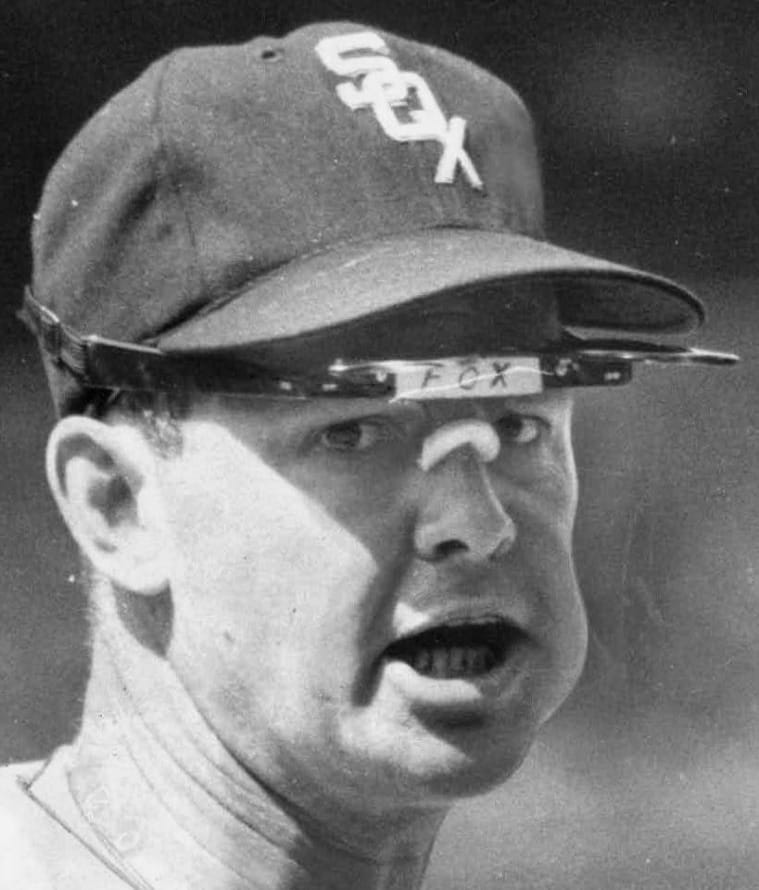
Beside him at second base was the man who took the American League's Most Valuable Player award that autumn, and who deserved every syllable of it.
Nellie Fox, the compactly built Pennsylvanian with the enormous chaw of tobacco perpetually distending his left cheek, hit .306 with a .380 on-base percentage, committed just 10 errors across 156 games, and generated a staggering 6.1 wins above replacement, tops on the club. Fox did not strike out. Literally: in 624 at-bats, he went down looking or swinging only 13 times, a figure so implausible in the modern game as to seem like a misprint. He made contact the way a surgeon makes incisions: deliberate, precise, never wasted. His Gold Glove that year was his third in a row.
The double-play combination Fox and Aparicio formed was not merely excellent; it was, in the judgment of many contemporaries, the finest up-the-middle defensive partnership the American League had seen since the days of Joe Cronin and Bobby Doerr.
In center field, Jim Landis was producing one of the most underappreciated seasons by any Chicago outfielder in the postwar era. Landis hit .272 with a .370 on-base percentage, his walk total of 78 extraordinary for an era that did not prize patience as a virtue. He stole 20 bases and posted 5.7 wins above replacement, second only to Fox on the roster. His range factor of 2.97 per nine innings dwarfed the league average of 2.22; he was, in the estimation of the Total Zone system, worth 25 runs above average in the field alone. The Comiskey Park outfield that surrounded him was no liability, either. Al Smith in left field contributed a solid .237 average with 17 home runs, second-highest on the club, and provided the left-handed balance that Lopez valued in constructing lineups against right-handed pitching.
Behind the plate, Sherm Lollar gave the club something even rarer than offensive production from the catcher position: genuine two-way excellence. Lollar hit .265 with 22 home runs and 84 runs batted in, both tops on the club, while operating as the field general for a pitching staff that needed intelligent handling above all else. His 42.2% caught-stealing rate was elite. He won his third Gold Glove. In a season defined by pitching and defense, Lollar was its quiet cornerstone.
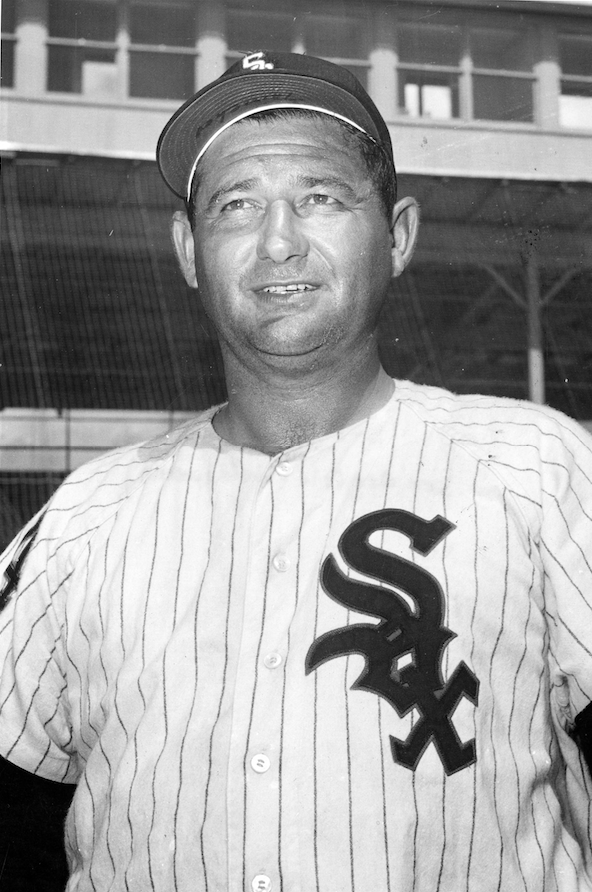
That pitching staff deserves its own monument. Early Wynn, the barrel-chested Alabaman who had been pitching in the major leagues since Franklin Roosevelt's third term, went 22-10 with a 3.17 ERA across 255 and two-thirds innings. He won the American League Cy Young Award at age thirty-nine with an authority that seemed to dare anyone to question whether a pitcher of his vintage belonged among the game's elite. Wynn's ERA+ of 120 confirmed what the eye test suggested: he was not merely accumulating wins on a good team; he was, game after game, genuinely better than the league.
Bob Shaw, the young right-hander acquired from Detroit in the Don Mossi trade, was arguably even more efficient. Shaw went 18-6 with a 2.69 ERA across 230 and two-thirds innings, finishing third in the Cy Young voting and compiling 4.8 wins above replacement, the most of any pitcher on the staff. His WHIP of 1.175, his control (just 54 walks in 230-plus innings), and his 8-to-1 ratio of quality starts transformed a rotation that also featured Billy Pierce and Dick Donovan into something approaching a murderers' row of arms.
But the spine of the bullpen may have been the most tactically shrewd element of Al Lopez's construction. Gerry Staley, thirty-eight years old and pitching to contact with a sinker that generated ground balls on an industrial scale, appeared in 67 games, saved 15, and posted a 2.24 ERA with 169 ERA+. Turk Lown, thirty-five, matched Staley's 15 saves with a 2.89 ERA and 9 wins in 60 appearances. Together they formed a late-inning bridge that converted close games into victories with a reliability the club's offense alone could never guarantee. The team's staff ERA of 3.29 was second lowest in the American League and translated to a stellar 115 ERA+.
IV. THE ART OF THE NARROW VICTORY
There is a school of thought in sabermetric circles, reasonable and well-supported, that performance in one-run games is essentially random, that no team has a sustained ability to win close contests above what chance would dictate, that the clubs who lead the league in one-run victories one year will regress toward .500 the next. The 1959 White Sox pose an interesting challenge to that orthodoxy.
They went 35-15 in one-run games, outperforming their Pythagorean expected record by a margin that was, depending on one's model, somewhere between remarkable and astonishing. Their actual run differential (669 runs scored against 588 allowed) suggested a team that should have finished closer to 87 or 88 wins. They won 94. The gap is explained almost entirely by those fifty-one-run contests, where the White Sox converted an .700 winning percentage.
How much of this was skill, and how much fortune? The honest answer is some mixture of both, tilted in ways that matter toward skill. A bullpen posting the kind of ERA figures that Staley and Lown generated did not squander leads. A defense of the caliber Fox, Aparicio, Landis, and Lollar provided did not allow the opposition's last gasp to find the gaps. And a manager of Al Lopez's subtlety, one who weighed his platoon decisions, his early hooks, and his willingness to burn a reliever for a single batter in a 2-1 game, made the kinds of marginal choices that, aggregated over 154 games, added victories the Pythagorean calculator could not fully account for.
The 1959 White Sox were not lucky. They were a team architecturally engineered for close victories, built from the bullpen out, constructed around the twin pillars of defense and pitching control, managed by a man who understood that a single run was worth protecting with the same ferocity as a five-run lead. The one-run record was a reflection of character, not coincidence.
V. DEFYING THE EMPIRE — THE CHALLENGE TO NEW YORK
To understand what the 1959 Chicago White Sox meant to the American League, it is necessary to appreciate what the New York Yankees had been doing to it for the better part of a decade. Between 1949 and 1958, the Yankees had won eight American League pennants and six World Series. They were not merely dominant; they were existentially dispiriting to their rivals, a franchise so wealthy in talent, tradition, and institutional advantage that competing against them required a kind of calculated audacity that most organizations lacked the nerve to attempt.
Al Lopez was the rare manager who did not flinch. He had beaten the Yankees in 1954 with his Cleveland Indians (that absurdly talented team went 111-43) and now, in Chicago, he had assembled another club capable of making the argument. The 1959 Yankees finished 79-75, their worst record since 1925, plagued by injuries to Mickey Mantle and a rotation that could not sustain the burdens placed upon it. Their decline was real and the White Sox were its principal beneficiary. But it would be a disservice to the Go-Go Sox to frame their championship as merely a function of Yankee misfortune.
Chicago's 94 wins were earned against a competitive American League field that included Cleveland at 89-65, Detroit and Baltimore in contention through the summer, and the lingering threat of a Yankee resurgence that loomed over every series. The White Sox went 12-10 against New York, a respectable accounting against a franchise that still carried Mantle, Yogi Berra, Whitey Ford, and the institutional depth that made the Yankees the standard against which all American League teams measured themselves.
What made the White Sox's challenge credible, and what distinguished them from the many clubs that had failed to dislodge the Bronx dynasty, was the coherence of their roster philosophy. The Yankees built from the corner positions out: sluggers at first base, left field, and right field, home run hitters who could carry a lineup through a cold stretch with a single swing. The White Sox inverted the logic. They built from the middle of the field, from the battery and the keystone, and they dared the Yankees to beat them at a brand of baseball that required a different kind of execution.
The World Series that autumn brought the Los Angeles Dodgers, transported from Brooklyn just two years prior, to Chicago for the first two games, then west to the Coliseum. The Sox won the opener behind Early Wynn's complete authority, then dropped four of the next five as the Dodgers' pitching, led by Larry Sherry out of the bullpen, proved more than Chicago's modest offense could overcome. The Series ended in six games, a defeat that stung but did not diminish what had been accomplished in the regular season.
The 1959 White Sox had broken forty years of silence. They had introduced a generation of South Side fans to pennant baseball. They had demonstrated that in an era of power and primacy, a club built on speed, defense, and pitching, grounded in the daily, accumulating discipline of doing the small things correctly, could stand at the summit of the American League and look the Yankees in the eye without blinking.
The Go-Go Sox were never merely a baseball team. They were a proof of concept. And forty years of ghosts, appeased at last by Luis Aparicio's flying cleats and Nellie Fox's indestructible bat and Gerry Staley's ground balls on the grass of Comiskey Park, finally, gratefully, departed.
1959 CHICAGO WHITE SOX • KEY STATISTICS
Final Record: 94–60 (.610) | AL Pennant Champions
Team ERA: 3.29 (115 ERA+) | 2nd in American League
Team Batting Average: .250 | 97 HR | 113 SB
One-Run Games: 35–15 (.700)
Luis Aparicio: .257 / .316 / .332 • 56 SB • 3.3 WAR • GG
Nellie Fox (MVP): .306 / .380 / .389 • 6.1 WAR • GG
Jim Landis: .272 / .370 / .379 • 5.7 WAR • 20 SB
Sherm Lollar: .265 / .345 / .451 • 22 HR • 84 RBI • GG
Early Wynn (CY Young): 22–10 • 3.17 ERA • 255.2 IP
Bob Shaw: 18–6 • 2.69 ERA • 230.2 IP • 4.8 WAR
Gerry Staley: 8–5 • 15 SV • 2.24 ERA • 169 ERA+
Turk Lown: 9–2 • 15 SV • 2.89 ERA