
Holy Cow! The One and Only Harry Caray

Voices of the Game | No. 1
How a kid from the streets of St. Louis became the most beloved voice in baseball history.
Harry Caray was not the smoothest broadcaster who ever worked a game. He mispronounced names. He went off on tangents. He was occasionally wrong about what was happening on the field. And he absolutely did not care, because neither did the fans.
That was the whole point.
From his first Cardinals broadcast in 1945 until his final Cubs season in 1997, Caray's singular gift was making every person in the ballpark or listening at home feel like they were sitting right next to him. You could be in your living room in Peoria or in the Wrigley Field bleachers with a cold beer, and Harry made you feel like you were part of the same crowd. Over a 53-year career, he called more than 8,300 major league games for five teams, and he never once broadcast a game like it was a job.
He was born Harry Christopher Carabina on March 1, 1914, in St. Louis, Missouri, one of the poorest neighborhoods in the city. His father left for World War I and never really came back. His mother died when Harry was around 14. He was raised by an aunt and uncle. Baseball was his escape. He played it as a teenager and dreamed of playing professionally, but was rejected for military service because of bad eyesight, so he turned to radio instead.
That bad eyesight turned out to be baseball's gain.
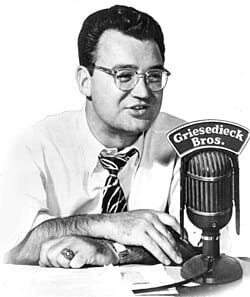
Twenty-Five Years in St. Louis (1945-1969)
Caray broke into Cardinals broadcasting in 1945 and was immediately different from anyone else on the air. Where other announcers stayed neutral and professional, Harry editorialized. If a player made a bad throw, Harry told you it was a bad throw. If the Cardinals blew a lead, Harry told you they blew it. He wasn't a cheerleader and he wasn't a critic for the sake of being one. He was a fan, and he talked like a fan.
That honesty made him enormously popular with the St. Louis public. For two seasons, 1945 and 1946, he called games for both the Cardinals and the St. Louis Browns simultaneously. The Browns faded as a franchise and Caray eventually focused solely on the Cardinals, building a 25-year run that included broadcasting Stan Musial's 3,000th hit in 1958 and the Cardinals' World Championship season of 1964.
Then, after the 1969 season, the Cardinals declined to renew his contract. The stated reason was vague. Caray had his own theory: he believed the firing was tied to rumors of a personal conflict with team ownership. Whatever the real reason, he was done in St. Louis after 25 years.
His response at the termination press conference? He arrived holding a can of Schlitz, a direct competitor to Anheuser-Busch, the Cardinals' sponsor. That said everything you needed to know about Harry Caray.
One Season in Oakland, Then Chicago (1970-1981)
Caray spent the 1970 season with Charlie Finley's Oakland Athletics. Finley called him "the finest baseball announcer in the country" when he hired him. It lasted one year. Caray grew tired of Finley's interference and accepted a job with the Chicago White Sox.
He arrived on the South Side in 1971 and immediately fit in. Chicago had blue-collar grit and so did Harry. He broadcast games shirtless from the bleachers. He handed beers to fans. He was as likely to criticize a White Sox miscue as he was to praise a great play. Fans loved him for it.
His most consistent broadcast partner in those years was Jimmy Piersall (OF, various clubs), the former outfielder known for his own colorful personality. The Caray-Piersall team was unpredictable and fun, which fit the ballpark perfectly.
Harry Caray’s last “Take Me Out to the Ballgame”
How "Take Me Out to the Ballgame" Became His Signature
During the 1976 season, White Sox owner Bill Veeck noticed that Harry liked to sing "Take Me Out to the Ballgame" during the seventh-inning stretch, usually just for the benefit of whoever was in the booth with him. Veeck quietly placed a public address microphone in the booth so the crowd could hear him.
Caray had no idea it was happening. He started singing, then heard his own voice booming back at him from the Comiskey Park speakers. The fans in the stands loved it and started singing along. Harry walked out of the booth afterward and asked Veeck what the heck that was about.
Veeck told him: "I have been looking for 45 years for the right man. The first time I heard you, I knew you were the right man." Then Veeck added the kicker: he explained that if Harry had a good singing voice, the fans would be intimidated and stay quiet. Because Harry sang like a man who was happy to be alive but had no business being on a stage, fans felt comfortable joining in. Caray later said he responded, "Thank you, I think."
The tradition moved with him to Wrigley Field in 1982. There, broadcast on WGN-TV's nationwide cable signal, it became one of the most recognizable moments in baseball. Harry leaning out of the booth, waving his microphone like a conductor who'd had a couple of beers, leading 38,000 people in song. Every single game.
He reportedly said once that "Take Me Out to the Ballgame" was the only song he knew all the words to. That tracks.
The Cubs Years and a National Stage (1982-1997)
Caray joined the Cubs before the 1982 season, replacing retiring Jack Brickhouse. The move came partly because new White Sox ownership wanted to shift games to a pay subscription TV channel, and Harry felt strongly that charging fans to watch games on TV was wrong. He contacted the Cubs, and they were more than happy to have him.
Cubs Win
The timing was good. WGN-TV had become one of the country's first cable superstations, reaching 30 million homes by the late 1980s. Cubs games on WGN were seen all over the country, and Harry Caray was suddenly a national figure rather than a regional one.
He worked alongside Steve Stone (RHP, CHW/BAL/CHC/SFG) on WGN television for 14 seasons. Stone handled the analysis. Harry handled everything else. The Cubs weren't always good in those years, but the broadcasts were consistently entertaining.
In February 1987, Caray suffered a stroke and missed the first six weeks of the season. The Cubs had a rotating cast of guest broadcasters fill in. When Harry came back, President Ronald Reagan made a special point of welcoming him on the air. That's the kind of cultural footprint he had.
Great Harry Caray Calls (4:51)
Six Stories That Tell You Everything About Harry Caray
1. The Name Butcher
Harry was famously bad at pronouncing player names. Not occasionally bad. Reliably, consistently, wonderfully bad. Steve Stone has described a practice of writing out difficult names phonetically in the scorebook ahead of time, spelling out something like Grudzielanek or Hector Villanueva letter by letter, hoping Harry would get through it cleanly.
Harry would look at it, nod, and then proceed to pronounce it a different way every single time it came up. Stone's standard assessment of this: "Well, that's just Harry." Fans started to look forward to which version they'd get each inning. Nobody called it a problem. It was a feature.
2. Disco Demolition Night: July 12, 1979
On July 12, 1979, Comiskey Park hosted one of the most chaotic nights in baseball history. DJ Steve Dahl and White Sox promotions director Mike Veeck organized Disco Demolition Night, offering 98-cent admission to anyone who brought a disco record to be blown up between games of a doubleheader against the Detroit Tigers. They expected maybe 5,000 extra fans. Instead, over 47,000 people showed up, with thousands more outside who couldn't get in.
The White Sox lost Game 1 to Detroit, 4-1. Then Dahl rolled out in a military Jeep, set off the explosion in center field, and roughly 7,000 fans stormed the field. They ripped up the pitching rubber. They stole bases. They started bonfires. A batting cage was knocked over. The field was so badly damaged that the second game had to be forfeited to the Tigers.
Through all of it, Harry was at the microphone. He and Piersall had been commenting all night on the marijuana smell drifting up to the press box. When the field was invaded, Caray took to the PA system and tried to get fans to go back to their seats. Nobody listened. He even attempted to sing "Take Me Out to the Ballgame" to try to shift the mood. That didn't work either.
Howard Cosell later blamed Caray for contributing to the chaos. Harry's response was characteristically blunt: he said the people who caused the trouble "were not typical baseball fans." He wasn't wrong.
3. Harry in the Bleachers
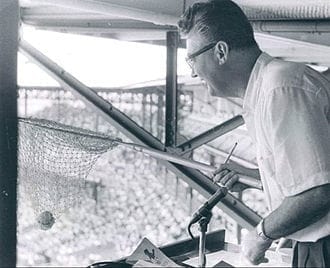
One of Caray's most consistent habits throughout his career was leaving the broadcast booth and going out among the fans. He was one of the first announcers to regularly set up in the outfield or in the bleachers and call games from there. He'd hand out beers, sign autographs, swap stories, and generally make himself impossible to ignore.
The Cubs statue outside Wrigley Field was moved to the bleacher entrance in 2010 for this exact reason. Cubs owner Tom Ricketts explained: "As a real fan, he was always comfortable in the bleachers." Harry would have agreed completely. He once said, "I don't mind being known as a fan. I'm a fan, a fan's announcer."
He also liked broadcasting shirtless during White Sox games in hot weather, which probably does not happen in the modern era of professional sports broadcasting.
4. His Uncanny Ability to Sell Beer
The Caray-Budweiser connection was well established across most of his career. Harry was the face of the beer in the booth and in advertising, and he was enthusiastic about it in a way that never felt forced because it clearly wasn't. He loved beer. He drank it at games. He handed it to people in the stands. He referenced it constantly.
When he was fired by the Cardinals, he showed up to the press conference with a can of Schlitz, the Budweiser competitor. That was his statement. Nobody needed a translator.
The SABR biography on Caray quotes him from 1979 saying, "You have to have a sense of humor and believe me, there's nothing like having fun at the old ballpark." That covered everything from the game itself to the beer he was drinking while calling it.
5. The Schlitz Press Conference and the St. Louis Exit
This one deserves its own category. After 25 years with the Cardinals, Caray was let go following the 1969 season. The team gave a vague explanation involving Anheuser-Busch's marketing department. Harry had his own suspicions about the real reason, which he aired publicly.
He walked into the press conference, sat down, and started drinking from a can of Schlitz. In front of reporters. Sponsored by Anheuser-Busch. In a city where Anheuser-Busch was an institution.
It was exactly the kind of move that told you who Harry Caray was: opinionated, unafraid, and unwilling to pretend anything he didn't feel. Some people in that situation swallow their pride and give polite quotes. Harry drank competitor beer in front of the cameras.
He said later that being fired from the Cardinals actually helped him, because it forced him to realize that his true loyalty was to the game and the fans, not to any one franchise.
6. The Kissing Couple
[Note: Despite appearing on numerous Cubs fan sites and message boards over the years, this story could not be independently verified. Steve Stone has denied on multiple occasions that it ever happened. It is presented here as part of the Caray legend that fans have kept alive, not as a confirmed account.]
Harry loved pointing the camera at fans in the stands, and he loved commenting on what he saw. During a Cubs broadcast, he noticed a couple in the seats who were kissing constantly, seemingly on every pitch. He kept coming back to it, inning after inning.
Eventually, he offered his theory on what was going on. The exchange with Steve Stone that followed is the version fans have passed around for years: Harry observed that the guy seemed to be kissing her on the strikes, and she was kissing him on the balls. Stone, who had apparently learned to handle these moments, smoothly redirected to whoever was coming up to bat next.
"A Fan's Announcer"
Caray received the Ford C. Frick Award from the Baseball Hall of Fame on July 23, 1989, joining the broadcasters wing in Cooperstown. Over his career he broadcast more than 8,300 major league games across five teams without missing a game in his first 41 seasons. He was honored by the National Radio Hall of Fame in 1990 and received a star on the St. Louis Walk of Fame in 1993.
He died on February 18, 1998, in Rancho Mirage, California, four days after collapsing at a Valentine's Day dinner with his wife, Dutchie. He was 83 years old, 11 days short of his 84th birthday.
The Cubs players who attended his funeral included Sammy Sosa, Mark Grace, and Ryne Sandberg. Thousands of fans left flowers, candles, and beer bottles at his star on the Cubs Walk of Fame outside Wrigley Field. That particular combination probably would have made Harry very happy.
His son Skip Caray went on to broadcast for the Atlanta Braves for more than 30 years. Grandson Chip Caray took over Cubs broadcasts after Harry's death, and has since moved on to the Cardinals. The Caray family has now produced four generations of broadcasters, which is remarkable by any measure.
Stan Musial once called Harry Caray "baseball's greatest salesman." That's a fair description, as far as it goes. But there's a simpler version. In 1975, Harry said: "I'm a fan, a fan's announcer." That's probably all you really need to know.