

Forty-three years after Harvey's Wallbangers captured hearts across Wisconsin, a new generation of Brewers has written its own incredible story. The 2025 Milwaukee Brewers didn't just win games—they dominated baseball from July onward, posting the best record in the major leagues and cruising to the National League Central title.
With 97 wins, they actually topped the legendary 1982 team's win total by two games. But this squad did it differently. Where the Wallbangers bludgeoned opponents with home runs, the 2025 Brewers won with pitching, defense, and a more balanced offensive attack. They proved you don't need to hit 200 homers to be great—you just need to play complete baseball.
Now they're heading into the postseason with a week off to rest and prepare. The question everyone in Milwaukee is asking: Can this team finally bring home the World Series championship that slipped through the Wallbangers' fingers in 1982?
The Nightmare Start: 0-4 and Counting
Let's be honest—nobody saw this season going the way it did after the first week. The 2025 Brewers opened the season in New York against the Yankees and got absolutely hammered. They lost the opener 4-2, then got destroyed 20-9 in the second game. The third game? Another blowout loss, 12-3.
Coming home to Milwaukee didn't help. The Royals crushed them 11-1 on Opening Day at American Family Field. The Brewers were 0-4, getting outscored 47-15. Fans were panicking. Radio talk shows were melting down. Was this team actually good, or had we all been fooled by spring training hype?
Manager Pat Murphy didn't panic. He kept telling his players to trust the process, trust their preparation, and trust each other. Slowly, the message started getting through.
Finding Their Identity: April and May
The Brewers finally got in the win column on April 1st, beating Kansas City 5-0 behind brilliant pitching from Abner Uribe (RHP, MIL). The next day, they won in 11 innings. Suddenly, they were playing close games and finding ways to win them.
April was a roller coaster. They'd win a few, lose a few, never really getting on a sustained run. By April 14th, they were 8-9 and looking like a .500 team. But then something started to click.
The Brewers showed flashes of their potential throughout late April and early May. They swept Oakland at home. They won series against Detroit and took two of three from the Reds. The offense started producing more consistently, and the pitching staff—led by ace Freddy Peralta (RHP, MIL)—started shutting teams down.
The real turning point came in late May. After a rough stretch where they fell to 21-25, the Brewers hosted the Red Sox for a three-game series. They swept Boston, winning all three games by a combined score of 14-8. Then they went to Philadelphia and swept the Phillies, outscoring them 28-11 over three games.
That six-game winning streak turned into eight straight victories after they won the first two games in Cincinnati. By June 2nd, the Brewers were 33-28 and had completely turned their season around. They had gone from being a team fighting for .500 to a legitimate contender.
The July Surge: Taking Control of the Division
If May was when the Brewers found their identity, July was when they announced to the baseball world that they were for real.
Coming out of the All-Star break, Milwaukee went on an absolute tear. From July 6th through July 13th, they won seven straight games. First they took the series finale in Miami. Then they swept the Dodgers at home. Then they swept Washington. During that stretch, they outscored opponents 40-14. The pitching was dominant, and when they needed a big hit, someone always came through.
But the real magic happened on the West Coast. From July 18th through July 23rd, the Brewers played six games against the Dodgers and Mariners—two of the best teams in baseball. They won five of those six games, taking two of three in Los Angeles and then winning the series opener in Seattle.
By July 21st, the Brewers were 60-40 and had taken over first place in the NL Central. They weren't giving it back.
The August Dominance: A Historic Winning Streak
August 2025 will go down as one of the most dominant months in Brewers history. The team put together a winning streak that would define their season and cement their status as World Series contenders.
From July 28th through August 13th, the Milwaukee Brewers won 14 consecutive games—the longest winning streak in franchise history.
It started at home against the Cubs. The Brewers won 8-4 on July 28th, then took the next two games of the series as well. That three-game sweep was just the beginning.
The team went to Washington and swept the Nationals, winning 16-9, 8-2, and 14-3. They were scoring runs in bunches and the pitching staff was shutting teams down.
Then came a massive three-game sweep in Atlanta. The Braves were supposed to be World Series contenders, but the Brewers went into Truist Park and took all three games, outscoring Atlanta 15-7. Quinn Priester (RHP, MIL), Freddy Peralta, and Jose Quintana (LHP, MIL) all pitched brilliantly.
The streak continued with a homestand from heaven. The Brewers hosted the Mets and Pirates for six games and won them all. Against New York, they took all three games, including a wild 7-6 walkoff thriller on August 10th. Then Pittsburgh came to town, and the Brewers absolutely destroyed them, winning 7-1, 14-0, and 12-5.
That's right—the Brewers beat Paul Skenes (RHP, PIT) and the Pirates 14-0. Freddy Peralta was untouchable, and the offense exploded for 14 runs. It was the kind of statement game that sent a message to the entire league: Milwaukee was a juggernaut.
The 14-game winning streak finally ended on August 15th in Cincinnati, but by then the damage was done. The Brewers had gone from comfortable division leaders to runaway favorites. At one point during the streak, their division lead ballooned to nine games. The race was over. Milwaukee had run away with the NL Central.
The Brewers continued their dominance through mid-August, winning five straight games from August 11th through August 16th before finally losing. By the time they cooled off, they were 85-53 with a massive cushion in the standings.
The Lineup: Balance and Production
The 2025 Brewers didn't have the same kind of raw power as the 1982 squad, but they had something just as valuable: depth and balance. This was a lineup with no easy outs, where every hitter could hurt you in different ways.
The team posted a collective 105 OPS+, meaning they were 5% better than league average offensively. Their 26.9 position player WAR showed solid depth, though not quite at the '82 level. What they lacked in pure slugging, they made up for in balanced production.
Christian Yelich (DH, MIL): The veteran leader put together a classic Yelich season at age 33. He hit .264 with 29 home runs and 103 RBIs, posting a 121 OPS+ and .188 ISO. His 3.1 WAR showed he was still an impact player, providing consistent production from the DH spot. Yelich was the steady presence in the middle of the order who could change a game with one swing.
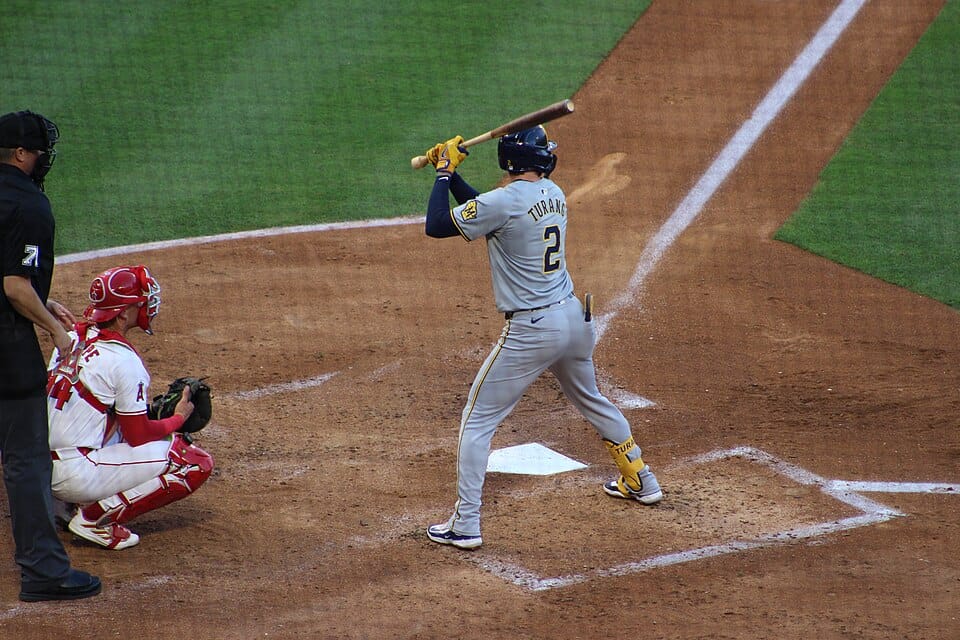
Brice Turang (2B, MIL): The 25-year-old had a breakout season, hitting .288 with 18 homers, 81 RBIs, and 24 stolen bases. His 121 OPS+ matched Yelich's production, and his .147 ISO showed developing power. Most impressively, Turang posted 5.5 WAR—making him the team's most valuable position player. His 97 runs scored led the team and sparked the offense all season.
Jackson Chourio (CF, MIL): At just 21 years old, Chourio showed why he's considered one of baseball's brightest young stars. He hit .270 with 21 homers and 78 RBIs while posting a 112 OPS+ and .193 ISO. His 2.2 WAR was solid, and playing outstanding defense in center field showed his complete skill set. The kid has swagger, confidence, and unlimited potential.
Sal Frelick (RF, MIL): Frelick had a quietly excellent season, hitting .288 with 12 homers and 63 RBIs. His 111 OPS+ and .117 ISO showed he was an above-average hitter, and his 3.0 WAR came from combining solid offense with Gold Glove-caliber defense. Every contender needs a player like Frelick—consistent, professional, reliable.
William Contreras (C, MIL): Contreras was the heart of this team. He hit .260 with 17 homers and 76 RBIs while posting a 111 OPS+ and .139 ISO. His 3.9 WAR made him one of the most valuable catchers in baseball. More so, he called a brilliant game behind the plate and developed incredible chemistry with the pitching staff.
Andrew Vaughn (1B, MIL): Acquired from the White Sox mid-season, Vaughn was exactly what Milwaukee needed. In 64 games, he hit .308 with 9 homers and 46 RBIs. His ridiculous 141 OPS+ and .185 ISO showed elite production, and his 1.3 WAR in limited time proved his value. He gave the lineup another dangerous left-handed bat.
Isaac Collins (LF, MIL): Collins provided solid production, hitting .263 with a 118 OPS+ and .148 ISO, posting 2.1 WAR. His ability to get on base (.368 OBP) and play solid defense made him a valuable piece.
Joey Ortiz (SS, MIL): While his .230 average and 66 OPS+ showed offensive struggles, Ortiz's defense kept him in the lineup. Every team needs steady glove work up the middle.
Caleb Durbin (3B, MIL): Durbin hit .256 with a 101 OPS+ and 2.9 WAR, providing solid all-around play at the hot corner.
This wasn't a lineup that would lead the league in home runs—they finished with 166 as a team, exactly 50 fewer than the '82 Wallbangers. But they scored 806 runs by grinding out at-bats, taking walks (564 as a team), and stringing together hits. They played modern, analytical baseball while maintaining an old-school toughness.
The Pitching Staff: The Real Difference
If the 1982 Brewers won with offense, the 2025 Brewers won with pitching. Their team ERA of 3.59 translated to a 116 ERA+, meaning they were 16% better than league average. The pitching staff posted 20.6 WAR—more than double the 8.7 WAR from the '82 pitching staff. This was the real difference between these two teams.
Freddy Peralta was the ace, and he pitched like it all season. The 29-year-old went 17-6 with a 2.70 ERA (154 ERA+) and struck out 204 batters in 176.2 innings. His elite 10.4 K/9 and stellar 3.65 FIP showed he was dominating based on skills, not luck. Peralta's 5.5 WAR made him one of the best pitchers in baseball. When Peralta took the mound, you felt confident the Brewers would win.
Quinn Priester emerged as a legitimate number-two starter. The 24-year-old went 13-3 with a 3.32 ERA (125 ERA+) and a 4.01 FIP. His 3.0 WAR showed he was a quality starter, winning key games all season long. Priester has the stuff to be a frontline starter for years to come.
Brandon Woodruff (RHP, MIL) returned from injury and gave the Brewers exactly what they needed. In 12 starts, he went 7-2 with a 3.20 ERA (130 ERA+) and an excellent 3.17 FIP. His 1.3 WAR in limited action was valuable. Having Woodruff back for the stretch run gave Milwaukee another ace-caliber arm with an outstanding 11.6 K/9.
Jose Quintana provided veteran stability, going 11-7 with a 3.96 ERA (105 ERA+) and 1.4 WAR. The 36-year-old lefty knew how to pitch and gave the team innings when they needed them most.
Jacob Misiorowski (RHP, MIL) was the rookie sensation. The 23-year-old showed electric stuff in his 14 starts with an impressive 11.9 K/9, though his 4.36 ERA (95 ERA+) showed he's still developing. His 0.5 WAR in limited time showed promise.
The bullpen was just as impressive. Trevor Megill (RHP, MIL) took over as closer and saved 30 games with a 2.49 ERA (168 ERA+) and 1.5 WAR. His dominant 11.5 K/9 made him nearly unhittable.
Abner Uribe was the real revelation—nearly unhittable out of the pen with a 1.67 ERA (249 ERA+) and 2.7 WAR in 75 appearances. His exceptional 10.8 K/9 and 2.75 FIP showed elite stuff.
Jared Koenig (LHP, MIL) posted a 2.86 ERA (145 ERA+) and 1.6 WAR. Grant Anderson (RHP, MIL) had a 3.23 ERA (129 ERA+). Nick Mears (RHP, MIL) contributed a 3.49 ERA (119 ERA+). All three gave Pat Murphy reliable late-inning options.
Aaron Ashby (LHP, MIL) returned from Tommy John surgery and was excellent, posting a 2.16 ERA (193 ERA+) and 2.0 WAR in 43 appearances. Having Ashby back gave the Brewers yet another weapon with a 10.3 K/9.
This pitching staff could beat you in multiple ways. They had power arms who could blow it past hitters. They had crafty veterans who could change speeds and hit spots. And they had a shutdown closer who could nail down wins in the ninth inning.