
The Iron Men: Everret Scott, The Forgotten Pioneer + Plus the 200k Club

When baseball fans discuss consecutive games played, the conversation inevitably turns to Cal Ripken Jr. and Lou Gehrig. Ripken's 2,632 straight games and Gehrig's 2,130 stand as monuments to durability and commitment. But a third name deserves recognition in this conversation: Everett Scott, baseball's original iron man, whose 1,307 consecutive games seemed unbreakable when established a century ago.
Scott: The Forgotten Ironman
Before Gehrig and before Ripken, there was Everett Scott. A slick-fielding shortstop who played from 1914–1926, Scott established baseball's first significant consecutive games streak, appearing in 1,307 straight contests from June 20, 1916, to May 5, 1925.
Scott's streak began quietly with the Boston Red Sox, where he served as the team's regular shortstop during their 1916 and 1918 World Series championship seasons. After being traded to the Yankees in 1922, Scott continued his remarkable run of durability, playing alongside a young first baseman named Lou Gehrig, who would eventually surpass his record.
What made Scott's streak particularly impressive was the era in which he played. The 1910s and early 1920s featured rough playing conditions, primitive medical treatment, and travel by train rather than chartered flights. Teams played doubleheaders frequently, and the concept of "load management" would have been laughed out of dugouts across America.
"Scott never made excuses," teammate Waite Hoyt later recalled. "Broken fingers, bad backs, twisted ankles—the kind of injuries that would sideline players for weeks—Scotty would just tape up and play through. We didn't think much about it at the time, but looking back, it was pretty remarkable."
The Streak Begins: Almost by Accident
Unlike Gehrig and Ripken, who became associated with their streaks early on, Scott didn't set out to establish a record. His run of durability began almost accidentally when Red Sox manager Bill Carrigan penciled him into the lineup day after day simply because he was the team's best option at shortstop.
Scott wasn't a star by traditional measures. He hit just .249 for his career with little power, posting a career OPS+ of only 82. But his defense at shortstop was exceptional, and in an era before advanced metrics, his sure-handed play earned him the trust of his managers.
By 1920, when Scott had played in over 500 consecutive games, the baseball world began taking notice. The Boston Globe reported: "Scott's remarkable record of consecutive games continues to grow. The steady shortstop has not missed an inning, much less a game, in over three years. While other players request days off for minor ailments, Scott simply reports to the park and plays."
Defensive Wizard in an Offensive Era
What's often overlooked in Scott's story is that he maintained his streak while playing elite defense at a demanding position. During baseball's offensive explosion of the early 1920s—the beginning of the live-ball era—Scott remained one of the game's premier defensive shortstops.
Between 1919 and 1924, Scott led American League shortstops in fielding percentage four times. In 1922, he handled 971 chances with just 27 errors for a .972 fielding percentage—exceptional for his era, when infields were poorly maintained and gloves were primitive by today's standards.
"Scott was as steady as they come," Yankees manager Miller Huggins said in 1924. "You could set your watch by his play at shortstop. Never flashy, but he made all the plays he should and many that seemed impossible."
Scott's defensive prowess is supported by modern analysis as well. His career 25.3 defensive WAR ranks among the top 50 all-time for position players, highlighting his significant value with the glove.
THE STREAK ENDS: A QUIET CONCLUSION
The Streak Ends: A Quiet Conclusion
After joining the Yankees, Scott became part of their first great dynasty alongside Babe Ruth and Bob Meusel. He appeared in three straight World Series from 1922–1924, adding to his two earlier championships with Boston.
But by 1925, at age 32, Scott's skills had begun to decline. His range at shortstop diminished, and his already modest offensive production fell further. On May 6, 1925, Scott's streak ended at 1,307 games when manager Miller Huggins started Pee Wee Wanninger at shortstop against the Athletics. Unlike the fanfare that would accompany the end of Gehrig's and Ripken's streaks decades later, Scott's historic run concluded with little celebration.
The New York Times noted simply: "Scott's remarkable streak of consecutive games has ended at 1,307, a record unlikely to be approached, much less broken, in the foreseeable future."
On June 1, 1925, less than a month after Scott's streak concluded, a young Lou Gehrig began his own iconic streak when he pinch-hit in a game. The very next day, he started at first base in place of the ailing Wally Pipp, and the rest is history.
The Forgotten Pioneer
When Gehrig broke Scott's record on August 17, 1933, by playing in his 1,308th consecutive game, Scott sent a congratulatory telegram: "I'm glad a real ballplayer broke my record. Keep going, Lou."
Scott's graciousness reflected his character. While Gehrig's streak would capture the public's imagination—especially after his tragic diagnosis with ALS—Scott's pioneering achievement gradually faded from baseball's collective memory.
After retiring, Scott worked as a bowling alley proprietor in his native Indiana. When he died in 1960 at age 67, his obituaries mentioned his consecutive games record, but by then, it had been thoroughly overshadowed by Gehrig's. The man who first showed what was possible in terms of baseball durability had become a footnote.
The Evolution of the Iron Man
The progression from Scott to Gehrig to Ripken shows how the consecutive games streak evolved from a curiosity to a cherished record:
- Scott (1,307 games): The pioneer who established durability as a valuable trait, though his streak was treated more as an interesting statistic than a celebrated achievement.
- Gehrig (2,130 games): Transformed the streak into baseball mythology. His "Luckiest Man" speech forever connected his durability with his profound character and courage.
- Ripken (2,632 games): Brought the streak into the modern era, breaking Gehrig's supposedly unbreakable record and celebrating the journey with fans, turning it into a shared national experience.
Scott's Legacy: More than a Number
Though his record was eventually broken, Scott's achievement remains remarkable. His 1,307 consecutive games still rank third all-time, behind only Ripken and Gehrig. When considering the position played, Scott's accomplishment at shortstop—one of baseball's most physically demanding positions—becomes even more impressive.
While Ripken and Gehrig received deserved acclaim, Scott's pioneering role as baseball's first true iron man should be remembered alongside them. He set the standard that others would follow.
As Scott himself reportedly told The Sporting News, "Records are made to be broken. But I'm proud to have been the first to show it could be done. Baseball's a tough game, and showing up ready to play every day for years on end isn't easy. Lou deserves all the credit he gets, and I'm happy to have played my small part in baseball history."
That small part—being the original iron man—deserves more recognition than it typically receives. Before Ripken and before Gehrig, Everett Scott showed what was possible, setting a standard of durability that seemed unbreakable until two of baseball's greatest legends came along to surpass it.
The 200k Club: Baseball's Elite Strickeout Artists
Justin Verlander (RHP, SF) and Max Scherzer (RHP, TOR) approaching the end of their legendary careers. Both have recorded nine, 200 K seasons in their careers. With the advent of shorter stints by starting pitchers and work load restrictions, we may ever see another pair like these two.
The 200-strikeout season stands as one of pitching's most impressive benchmarks. It represents sustained dominance, requiring both exceptional stuff and the durability to accumulate enough innings. As we reflect on the season, several pitchers reached this exclusive club, while others have already cemented their legacy with multiple 200K campaigns.
The All-Time Leader's: Ryan's Untouchable Mark
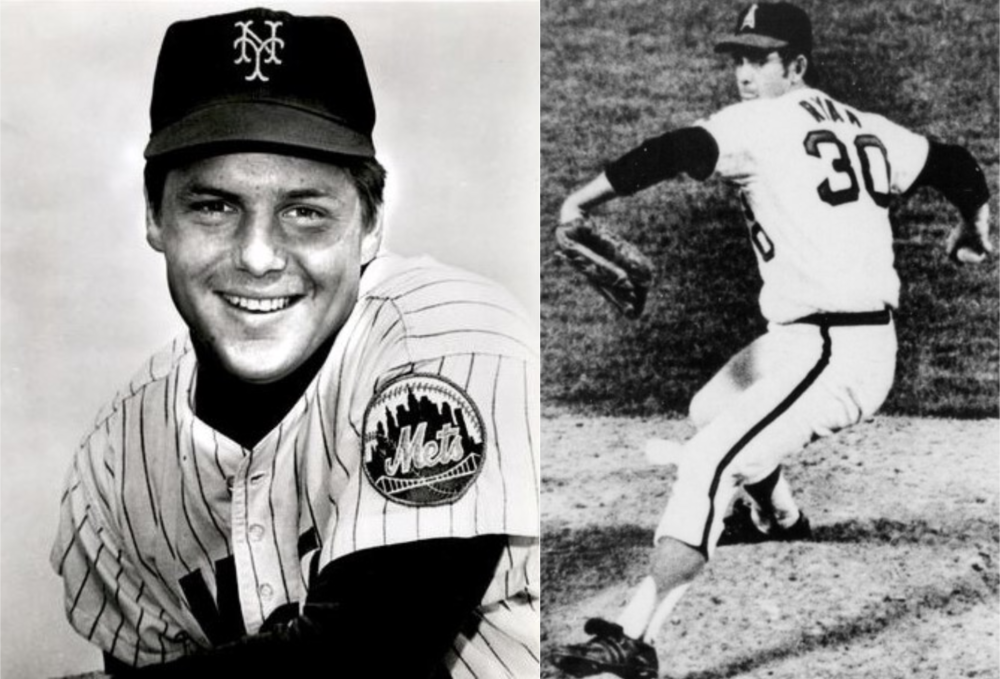
No discussion of strikeout dominance can begin anywhere but with Nolan Ryan. The Express racked up an astounding 15 seasons with 200+ strikeouts, a record that may never be broken. What's most remarkable about Ryan's achievement isn't just the total, but the longevity -- his first 200K season came in 1972 and his last in 1990, spanning an incredible 19 years.
Randy Johnson sits second with 13 such seasons, including a stretch of eleven consecutive 200K campaigns from 1992-2002. The Big Unit's peak may have been even more dominant than Ryan's -- Johnson recorded six 300-strikeout seasons, tying Ryan's record, but often did it in fewer innings per season.
Roger Clemens rounds out the top three with 12 seasons of 200+ strikeouts. The Rocket's first came in his breakout 1986 season (24-4, 2.48 ERA, 238 Ks) and his last in 2004 at age 41 with Houston (218 Ks in 214.1 innings).
Tom Seaver stands alone in fourth place with 10 such seasons, all coming in an 11-year span from 1968-1978. Tom Terrific was the model of consistency, posting nine consecutive 200K seasons from 1968-1976, a major league record.
2024'S Top Performers
The 2024 season saw several pitchers excel in the strikeout department:
Garrett Crochet (LHP, BOS) was one of the season's biggest surprises. After working exclusively as a reliever, Crochet exploded as a starter with strikeouts through 146.0 innings (12.9 K/9). His 30.5% strikeout rate was among the league leaders for starting pitchers.
Tarik Skubal (LHP, DET) reached the 200K threshold for the second time in his career, notching strikeouts through innings (10.7 K/9). Skubal combined elite strikeout stuff with remarkable control (a 1.64 BB/9 walk rate), posting a league-leading 2.39 ERA and winning the AL Cy Young Award.
Paul Skenes (RHP, PIT) in his rookie season recorded strikeouts in just innings (11.5 K/9). The rookie phenom became just the seventh rookie since 1901 to record a 200K season in college the year prior. Skenes' impressive performance earned him NL Rookie of the Year honors.
Logan Webb (RHP, SF) had another strong year, finishing with strikeouts, just shy of the 200-mark. This would have been his first 200K season despite being one of baseball's most consistent starters in recent years.
Dylan Cease (RHP, SDP) recorded his third career 200K season, finishing with strikeouts. This followed his previous 200K campaigns in 2021 (226) and 2022 (227).
Zack Wheeler (RHP, PHI) had a dominant season, registering strikeouts, marking his third career 200K campaign.
The Modern Masters: Scherzer and Verlander
Two active pitchers tied at nine 200K seasons each are Max Scherzer and Justin Verlander. Both have been models of consistency and dominance throughout their careers.
Scherzer's run of eight consecutive 200K seasons from 2012-2019 includes a 300-strikeout campaign in 2018 (300 Ks in 220.2 innings). During this stretch, Mad Max posted an incredible 2.89 ERA, 150 ERA+, and 11.3 K/9 while winning three Cy Young Awards.
Verlander's nine 200K seasons include his dominant 2019 campaign where he recorded 300 strikeouts exactly while posting a 0.80 WHIP and winning his second Cy Young Award. JV's ability to maintain elite strikeout rates even as his velocity declined demonstrates his exceptional adaptability.
With both pitchers now in their late 30s/early 40s and dealing with injuries, they're unlikely to reach the 10-season mark, leaving Tom Seaver's position safe for now.
The 200k Season Through History
The 200-strikeout season hasn't always been viewed with the same significance. In baseball's early days, pitchers threw so many innings that 200 strikeouts wasn't considered exceptional.
Tim Keefe recorded six 200K seasons in the 1880s, including a then-record strikeouts in -- achieved by throwing innings with a modest 7.5 K/9 rate. Similarly, Rube Waddell's six 200K seasons in the deadball era came when strikeout pitchers were rare, making his achievement stand out more.
The modern era of 200K significance began with high-strikeout pitchers of the 1960s. Sandy Koufax recorded six such seasons consecutively from 1961-1966, while contemporaries like Don Drysdale and Bob Gibson elevated the standard for power pitching.
The introduction of the five-man rotation and decreasing pitcher workloads has actually made 200 strikeouts more difficult to achieve in some ways. While today's pitchers strike out batters at much higher rates (K/9), they throw fewer innings, creating an interesting balance where 200 strikeouts remains an achievement that separates elite arms from the merely good.
The k/9 Revolution
What's changed dramatically is how pitchers achieve 200 strikeouts. Walter Johnson recorded seven 200K seasons from 1910-1916, but needed 300+ innings in each campaign to do it, with K/9 rates typically around 7.0.
Compare that to modern pitchers like Crochet (12.9 K/9), Skenes (11.5 K/9), or Spencer Strider's 2023 season (13.5 K/9), and we see how the path to 200 strikeouts has transformed. Today's elite strikeout pitchers can reach the mark in 150-160 innings -- something unimaginable in earlier eras.
This evolution is clear when comparing the innings required for 200 strikeouts across different eras:
- 1910s: ~300 innings (6.0-7.0 K/9)
- 1960s: ~250 innings (7.0-8.5 K/9)
- 1990s: ~200 innings (9.0-10.5 K/9)
- 2020s: ~160 innings (11.0-13.5 K/9)
Looking Ahead: Who Might Climb the List?
Several active pitchers have a chance to move up
he career 200K seasons leaderboard:
Chris Sale (LHP, ATL) already has seven such seasons, tied for 12th all-time. Though injuries derailed several prime years, Sale has bounced back with Atlanta in 2024, posting strikeouts in 180.1 innings. At 35, he could potentially add another 200K season or two if he stays healthy.
Gerrit Cole (RHP, NYY) has six 200K seasons, with five coming consecutively from 2018-2022. Though injuries limited his 2024 campaign, Cole is just 34 and could challenge for the top five with a few more healthy seasons.
Clayton Kershaw (LHP, LAD) has seven 200K seasons, but hasn't recorded one since 2017. At 36 and dealing with recurring injuries, he's unlikely to add to his total.
Among younger pitchers, Spencer Strider (RHP, ATL) has already recorded two 200K seasons by age 25 and has the highest K/9 rate (13.3) in history among pitchers with 300+ career innings. Corbin Burnes (RHP, BAL) has two such seasons at age 29 and could add several more.
The Rarity of the 200k Season
The benchmark of a 200-strikeout season remains a significant indicator of an elite pitcher in Major League Baseball. While the number of pitchers reaching this milestone fluctuates annually, it consistently represents the upper echelon of talent. In 2023, nine pitchers reached the 200-strikeout mark. The number of pitchers achieving this feat in the completed 2024 season included standouts like Tarik Skubal, who led the league with 228 strikeouts, and Dylan Cease with 224. As of early September in the current 2025 season, two pitchers, Garrett Crochet and Tarik Skubal, have already surpassed 200 strikeouts, with several others on pace to join them before the season's end.
Reaching the ten 200k season level is even more rare. One that may not be reached in the next decade, let alone ever.