
Urban Shocker: The Forgotten Ace Who Belongs in Cooperstown

The baseball record books are filled with names etched in our collective memory—Ruth, Gehrig, Johnson, Mathewson. Yet for every immortal enshrined in Cooperstown, there are players whose remarkable careers have faded from public consciousness. Urban Shocker may be the most compelling case among forgotten aces still waiting for a plaque in Cooperstown.
A glance at Shocker's career numbers—187 wins, a sparkling .615 winning percentage, and an impressive 3.17 ERA across 13 seasons—begs the question: How does a pitcher of this caliber remain on the outside looking in? But Shocker's story goes far beyond statistics. His was a tale of extraordinary talent, quiet determination, and a man who pitched with a courage that defied a fatal diagnosis, giving his life to the game.
The Making of an Ace
Born Urbain Jacques Shockcor in Cleveland on September 22, 1890, he later simplified his name to Urban Shocker. His path to baseball stardom wasn't immediate. Shocker spent several years bouncing around the minors before getting his first real shot with the New York Yankees in 1916 at age 25.
After two partial seasons in New York, Shocker was dealt to the St. Louis Browns prior to the 1918 season—a move that would launch him into stardom. While the Browns were typically cellar-dwellers during this era, Shocker emerged as one of the American League's elite pitchers.
From 1920-1923, Shocker was nothing short of brilliant. During this four-year peak, he won 91 games while losing just 51, posted ERAs significantly better than league average, and established himself as one of the premier workhorses in baseball.
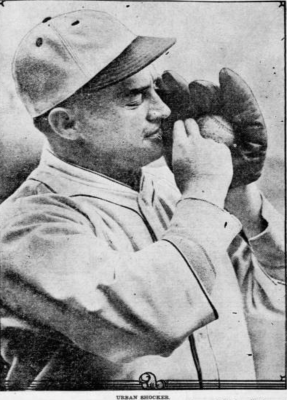
The Spitball Exception and Pitching Wizardry
Shocker's rise to prominence coincided with a pivotal moment in baseball history. After the 1919 season, MLB banned the spitball and other "freak" pitches but allowed 17 active pitchers, including Shocker, to continue using the pitch throughout their careers via a "grandfather clause."
What made Shocker so effective wasn't just his legal spitter—it was his complete arsenal and pitch control. As his Yankees manager Miller Huggins once remarked, "Shocker can put the ball where he wants to. If he tells a batter where he's going to throw it, the batter still can't hit it."
His best pitch was indeed his spitball, which he controlled better than almost anyone in the game. But Shocker complemented it with excellent breaking pitches and pinpoint control, walking just 2.2 batters per nine innings over his career. His WHIP (walks plus hits per inning pitched) of 1.255 was outstanding for his era.
The St. Louis Years: A Star on a Struggling Team
With the Browns, Shocker became the ace of a generally mediocre staff. His best season came in 1921, when he won 27 games and pitched an astounding 326.2 innings. His 8.0 WAR (Wins Above Replacement) that season ranks among the best pitching seasons of the decade.
Looking at his advanced metrics during his Browns tenure:
- 126-80 record (.612 winning percentage) for a typically sub-.500 team
- 3.19 ERA (127 ERA+, meaning he was 27% better than league average)
- 39.0 WAR accumulated over just seven seasons
"Playing behind Shocker was a treat," Browns shortstop Wally Gerber once said. "He worked fast, threw strikes, and kept you in the game. We weren't much of a team most days, but with Urban on the hill, we always had a chance."
The 1922 season might have been Shocker's finest all-around campaign. He went 24-17 with a 2.97 ERA over an incredible 348 innings. His control that season was impeccable—just 1.5 walks per nine innings—and he completed 29 of his 38 starts. By WAR, it was worth 7.1 wins above replacement, and he finished 17th in MVP voting.
Return to New York and Championship Glory
After the 1924 season, Shocker was traded back to the Yankees, where he would join one of baseball's greatest dynasties. Though no longer in his absolute prime, Shocker remained highly effective. In 1926, at age 35, he went 19-11 with a 3.38 ERA, helping the Yankees win the pennant.
The following year, Shocker was part of the legendary 1927 Yankees—often considered the greatest team in baseball history. Though dealing with increasingly severe health problems, he contributed an impressive 18-6 record with a 2.84 ERA. His 137 ERA+ shows he was still performing at an elite level despite his deteriorating physical condition.
The Silent Battle: Pitching with Heart Disease
What many fans and even teammates didn't realize was that Shocker was pitching through a serious heart condition. He had been diagnosed with heart disease, likely what we now know as arrhythmogenic right ventricular cardiomyopathy, in the early 1920s.
As his condition worsened, Shocker adapted. He slept sitting up because lying down caused fluid to build up in his lungs. By 1927, he could barely breathe during games and would often appear blue-lipped in the dugout between innings.
Yankees teammate Waite Hoyt later recalled, "None of us knew how sick he really was. He never complained, never asked for special treatment. He'd just go out there and pitch, then sit in the dugout trying to catch his breath. I've never seen courage like that."
The 1928 season would be Shocker's last. He appeared in just one game before his health forced him from the field for good. He died on September 9, 1928, just two weeks before his 38th birthday and barely a month after his final appearance in a Yankee uniform.
The Hall of Fame Case: By the Numbers
Despite his shortened career, Shocker's statistical case for Cooperstown is compelling:
- 187-117 record (.615 winning percentage)
- 3.17 ERA (124 ERA+)
- 55.1 career WAR
- 200 complete games in 317 starts (63% completion rate)
- Seven seasons of 16+ wins
- Four consecutive 20-win seasons (1920-1923)
Let's compare Shocker's career WAR of 55.1 to some Hall of Fame pitchers from similar eras:
- Dazzy Vance: 61.0 WAR (inducted 1955)
- Waite Hoyt: 53.3 WAR (inducted 1969)
- Herb Pennock: 44.1 WAR (inducted 1948)
- Lefty Gomez: 43.1 WAR (inducted 1972)
- Rube Marquard: 34.2 WAR (inducted 1971)
- Jesse Haines: 32.6 WAR (inducted 1970)
Among his contemporaries already enshrined in Cooperstown, his numbers stand up exceptionally well. In fact, his career WAR exceeds that of several pitchers from his era who have already been inducted.
As baseball historian Bill James has argued, Shocker's pure dominance during his peak rivaled the very best of his era. His numbers would be even more impressive if his heart condition hadn't cut his career short.
Dominating in Two Different Eras
What makes Shocker's career particularly impressive is that he excelled during both the Dead Ball Era and the offense-heavy Live Ball Era that followed. When offensive numbers exploded in the early 1920s, many pitchers struggled to adapt. Shocker, however, remained among the American League's best.
His best seasons coincided with the offensive explosion that came with Babe Ruth's emergence. From 1920-1927, when offense reached unprecedented levels, Shocker posted an ERA significantly lower than the league average, which often hovered near 4.00.
The Statistical Profile of a Hall of Famer
Bill James's Hall of Fame Monitor assigns points for various achievements that have historically led to Hall of Fame induction. A score of 100 represents a likely Hall of Famer. Shocker scores 98 on this scale—right on the borderline despite his abbreviated career.
His Black Ink Test score (measuring how often a player led the league in important categories) is 19, where the average Hall of Famer scores 40. However, pitching in the same era as legends like Walter Johnson and Lefty Grove naturally suppressed his ability to lead the league.
The Gray Ink Test (measuring how often a player placed in the top ten in key categories) gives Shocker a score of 167. This is well within the range of respectability, as the average Hall of Famer's score is 144 (a lower score is better), and it reflects his consistent excellence even when not leading the league outright.
Beyond the Numbers: Reputation and Respect
Statistics tell only part of Shocker's story. His contemporaries regarded him as one of the game's best pitchers. Ty Cobb, arguably the greatest hitter of the era, called Shocker "one of the smartest pitchers I ever faced."
Yankees manager Miller Huggins, who managed legends like Ruth and Gehrig, considered Shocker one of the most valuable pitchers he ever had. "He knew how to pitch when it mattered most," Huggins once said. "The bigger the game, the better Urban pitched."
Sportswriter Fred Lieb, who covered baseball for over 70 years, wrote in 1977: "It's been almost fifty years since Urban Shocker left us, and I still can't understand why he isn't in the Hall of Fame. He was as good as many who are enshrined there, and better than quite a few."
Why Has Shocker Been Overlooked?
Several factors have contributed to Shocker's Hall of Fame omission:
- Shortened career: His death at 37 cut short what might have been several more productive seasons.
- Playing for the Browns: Spending his prime years with the perennially unsuccessful St. Louis Browns limited his national exposure.
- Overshadowed teammates: When he did join the Yankees, he was surrounded by bigger stars like Ruth, Gehrig, and Hoyt.
- Quiet personality: Shocker wasn't known for self-promotion or flashy behavior that might have enhanced his reputation.
- Timing of death: He passed away just as the first Hall of Fame discussions were beginning in the late 1920s and early 1930s.
The Forgotten Ace Who Pitched Until His Heart Gave Out
Urban Shocker's story is more than just numbers on a page. It's about a man who pitched at an elite level while his heart was literally failing him. In an era before advanced medical treatments, Shocker competed through a condition that would have immediately ended an athlete's career today.
As teammate Waite Hoyt later wrote, "Urban never wanted anyone to know how sick he was. He'd be gasping for breath between innings, and when you'd ask if he was okay, he'd just nod and say, 'I'm fine.' Then he'd go out and get three more outs."
That 1927 season, when Shocker went 18-6 with a 2.84 ERA while barely able to breathe, represents one of the most courageous performances in baseball history. He was pitching himself to death but refused to quit on his team.
The Hall of Fame Verdict
When we evaluate Hall of Fame candidates, we look at peak performance, career value, and historical significance. Shocker checks all these boxes:
- Peak value: Four consecutive seasons of 20+ wins with an ERA+ well above 120.
- Career value: A 55.1 WAR that ranks above numerous Hall of Fame pitchers.
- Historical significance: One of only 17 "legal" spitballers and a key member of the legendary 1927 Yankees.
If we factor in the circumstances of his shortened career—pitching at an elite level while battling a terminal illness—the case becomes undeniable.
Baseball writer Joe Posnanski once wrote that the Hall of Fame "should tell the story of baseball." Urban Shocker's story—his excellence on mediocre Browns teams, his triumphant return to the Yankees, his quiet courage in the face of a failing heart—is exactly the kind of story that belongs in Cooperstown.
The Final Pitch
Urban Shocker won't be found on many casual fans' lists of all-time greats. His name doesn't roll off the tongue like Koufax or Mathewson. But for 13 seasons, he was one of baseball's premier pitchers—a master craftsman who could paint the corners with a spitball that dipped and dived, baffling the game's best hitters.
He won 187 games despite not becoming a regular starter until age 27. He posted a winning record in every full season of his career. He pitched the Browns to respectability and the Yankees to championships. And he did it all while his heart was giving out.
Perhaps his most famous teammate, Babe Ruth, put it best after Shocker's death: "That man had more guts than any of us. We all knew he was dying, but he never said a word about it. Just went out there and pitched his heart out—literally."
Urban Shocker belongs in the Hall of Fame. His numbers make a compelling case; his story makes it an undeniable one. It's time for Cooperstown to right this wrong and give Shocker the plaque he earned through sheer performance and breathtaking courage.
The next time you visit the Hall of Fame and walk among the plaques of baseball's immortals, remember that there's a space missing—a space for a pitcher who thrived in two different eras, who dominated for both cellar-dwellers and champions, and who literally gave his life to the game he loved.
That space belongs to Urban Shocker.