
Which is the Greatest Milwaukee Brewers team: the 1982 edition or 2025?

The 1982 Harvey’s Wallbangers: A Season for the Ages
The crack of the bat echoed through County Stadium all summer long in 1982. Home runs, doubles, triples—the Milwaukee Brewers (MIL) hit everything that moved. They didn’t just win games; they demolished opponents with an offensive attack so powerful that fans started calling them “Harvey’s Wallbangers.” It was the greatest season in franchise history, a magical ride that took Milwaukee to its first and only World Series.
But here’s the question that Brewers fans have debated for decades: Was that 1982 team the best squad to ever wear the blue and gold? With the 2025 Brewers heading into the postseason with 97 wins and the best record in baseball, we’re about to find out. Let’s take a deep dive into what made the ’82 Wallbangers so special.
The Slow Start and the Manager Who Changed Everything
The 1982 season didn’t start like a championship run. Manager Buck Rodgers had the team sitting at a 23-24 record on June 1st (MIL), struggling to find their identity. The talent was there—future Hall of Famers Robin Yount (SS, MIL), Paul Molitor (3B, MIL), and Rollie Fingers (CL, MIL) wore Brewers uniforms. But something wasn’t clicking.
Then Brewers management made a move that seemed crazy at the time: they fired Rodgers and promoted hitting coach Harvey Kuenn to manager. Kuenn was a former batting champion who had never managed before. He was overweight, chewed tobacco, and walked with a limp after having part of his leg amputated due to circulation problems. He didn’t look like your typical field general.
But Harvey had a simple philosophy: let the boys play. No complicated signs, no overthinking. Just get up there and swing the bat. The team responded immediately. Under Kuenn, the Brewers (MIL) went 72-43 the rest of the way, turning their season completely around.
An Offensive Juggernaut Unlike Any Other
The numbers the 1982 Brewers (MIL) put up were absolutely insane. They led all of Major League Baseball in runs scored (891), home runs (216), RBIs (843), slugging percentage (.455), and total bases (2,606). Think about that—they led the entire sport in every major power category. Nobody could touch them.
Looking at advanced metrics, the offense was even more impressive. The team posted a collective 121 OPS+ (MIL), meaning they were 21% better than league average at getting on base and hitting for power. Their team ISO (Isolated Power) would have been astronomical, showing the pure slugging ability that made them so feared.
This wasn’t a team with one or two stars carrying the load. The Wallbangers had seven players who hit 19 or more home runs (MIL). Seven! Even their leadoff hitter, Paul Molitor (3B), smacked 19 bombs while stealing 41 bases and scoring a league-leading 136 runs. That’s the most runs scored in the American League since 1949.
Let’s break down the lineup, spot by spot, because this was one of the most feared batting orders ever assembled:
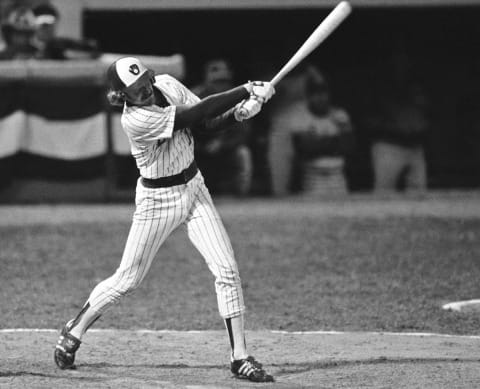
• Robin Yount (SS, MIL): At just 26 years old, Yount had the season of his life and won the American League MVP award. He hit .331 with 210 hits, 46 doubles, 29 home runs, and 114 RBIs. His sabermetric profile was elite across the board: 166 OPS+ (66% better than league average), .247 ISO showing tremendous power, and 10.5 WAR—an MVP-caliber season by any measure. Yount led the league in hits, doubles, slugging percentage (.578), and total bases (367). Oh, and he won a Gold Glove at shortstop too. Yount was the complete package—a guy who could beat you with power, average, speed, and defense.
• Paul Molitor (3B, MIL): “Molly” was the spark plug at the top of the order. His 136 runs scored were the most in the American League in 33 years. He hit .302 with an impressive 129 OPS+, showing he was 29% better than league average. With a .148 ISO and 6.2 WAR, Molitor provided elite production from the leadoff spot. He stole 41 bases and drove pitchers crazy with his ability to beat you in multiple ways.
• Cecil Cooper (1B, MIL): Steady and reliable, “Coop” hit .313 with 32 homers and 121 RBIs. His 142 OPS+ ranked among the best in baseball, and his 5.6 WAR showed he was an elite first baseman. Cooper combined a .215 ISO with excellent contact skills, making him one of the most feared hitters in the American League.
• Gorman Thomas (CF, MIL): With his beer belly and bushy mustache, “Stormin’ Gorman” looked like he belonged in a tavern, not center field. But the guy could mash. He crushed 39 home runs with a massive .261 ISO, posting a 137 OPS+ and 5.0 WAR. Thomas struck out 143 times, but when he connected, the ball went a long way.
• Ben Oglivie (LF, MIL): Oglivie added another 34 homers and 102 RBIs from the left side of the plate with a .209 ISO. His 118 OPS+ and 3.4 WAR made him a legitimate middle-of-the-order threat. That gave the Brewers three outfielders who all hit 30-plus home runs with elite power numbers.
• Ted Simmons (C, MIL): The switch-hitting veteran provided 23 homers and 97 RBIs while posting a 112 OPS+ and 3.4 WAR. Simmons was the steady presence who kept everything together behind the plate.
• Jim Gantner (2B, MIL): “Gumby” was the glue guy who hit .295 with a solid 99 OPS+ and 2.6 WAR. Every great team needs role players who do the little things right, and Gantner was that guy, playing flawless defense up the middle alongside Yount.
Even the bench was loaded. Don Money (DH/3B, MIL) provided veteran leadership and crushed 16 homers in limited at-bats, posting a ridiculous 148 OPS+. Roy Howell (DH/3B, MIL) and Charlie Moore (RF/C, MIL) gave Harvey options off the bench. This team had no weak spots in the lineup.
The team’s collective 38.7 WAR from position players (MIL) was exceptional, showing depth throughout the roster.
The Eight-Game Winning Streak That Changed the Season
After Harvey Kuenn took over on June 2nd, the Brewers (MIL) went on an absolute tear. From June 9th through June 18th, they won eight straight games. On June 6th, they beat the A’s 7-2 behind Pete Vuckovich (SP, MIL). The next night against Baltimore, they lost 2-7. Then they swept a four-game series against Detroit, including a 13-5 thrashing on June 13th where the offense exploded in front of 48,424 fans at County Stadium.
But the real magic happened on the road. From June 25th through June 30th, the Brewers (MIL) went to Boston and New York—two of the toughest places to play—and won five out of six games. They took three of four from the Red Sox at Fenway Park, including an 11-10 slugfest on June 26th and a 9-7 victory the next day. Then they headed to Yankee Stadium and took two out of three from the defending world champions, including a wild 9-7, 12-inning victory on June 30th.
By the All-Star break, Milwaukee (MIL) was in first place. The team that had been three games under .500 in early June had become the hottest team in baseball.
The July Surge: Five Straight Wins Against the White Sox
The Brewers (MIL) came out of the All-Star break on fire. From July 15th through July 18th, they played five games in three days against the Chicago White Sox (including a doubleheader) and swept all five. They outscored Chicago 32-16 during that stretch and extended their winning streak to eight games.
On July 15th, they played a makeup doubleheader and won both games, 8-4 and 5-4. The next day, they edged Chicago 5-3. On July 17th, they won 5-2 in front of 52,959 fans—the second-largest crowd of the season. And on July 18th, they completed the sweep with a 9-3 victory.
That five-game stretch against the White Sox showed everyone that the Wallbangers (MIL) were for real. They had moved into first place for good and were starting to pull away from the pack.
Pitching: Good Enough to Win
Let’s be honest—the 1982 Brewers weren’t winning any awards for pitching. Their team ERA was 3.99, which gave them a 96 ERA+ (4% below league average). But they had just enough arms to support that powerful offense.
• Pete Vuckovich (SP, MIL): The hard-throwing right-hander went 18-6 with a 3.34 ERA and won the American League Cy Young Award. His 114 ERA+ showed he was 14% better than league average, and his 2.8 WAR made him a legitimate frontline starter. Vuckovich was tough, competitive, and knew how to pitch in big games. He completed nine games and gave Harvey quality starts all season long.
• Mike Caldwell (SP, MIL): Caldwell was the crafty lefty who kept hitters off balance. He went 17-13 with a 3.91 ERA and a 97 ERA+, posting 2.1 WAR. Caldwell led the team with 12 complete games. He wasn’t overpowering, but he knew how to pitch and gave the Brewers innings.
• Moose Haas (SP, MIL): Haas added 11 wins with an 85 ERA+ and 0.7 WAR, while Bob McClure (SP, MIL) chipped in with 12 victories and a 90 ERA+ (0.5 WAR). Neither was spectacular, but both ate innings and gave the team a chance to win.
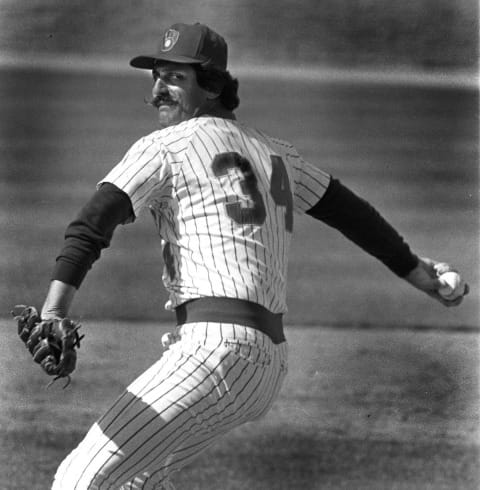
The real question mark was the bullpen. Rollie Fingers (CL, MIL), the mustachioed future Hall of Famer, saved 29 games with a spectacular 147 ERA+ and 2.3 WAR before an arm injury sidelined him in September. Losing Fingers down the stretch was a huge blow, and it raised questions about whether the Brewers could close out games in October.
In late August, the Brewers made a huge move, trading for Don Sutton (SP, MIL), a 37-year-old future Hall of Famer. Sutton went 4-1 in seven starts with a 116 ERA+ and 1.0 WAR, providing veteran leadership when the team needed it most. His presence stabilized the rotation heading into October.
The pitching staff’s collective 8.7 WAR was modest compared to the offense’s 38.7 WAR, showing this team won primarily with their bats.
The Final Week: Drama and Heartbreak
The Brewers (MIL) clinched the AL East on the final day of the regular season in one of the most dramatic finishes in baseball history. They entered the last weekend tied with the Baltimore Orioles, and the two teams would play a four-game series in Baltimore to decide the division.
It didn’t start well. The Brewers (MIL) lost the first three games of the series, getting outscored 26-7. On Friday, October 1st, they played a doubleheader and lost both games, 8-3 and 7-1. The next day, they got blown out 11-3. The Wallbangers suddenly looked dead in the water.
But they had one more chance. On Sunday, October 3rd, the Brewers and Orioles met in a winner-take-all showdown in front of 51,642 fans at Memorial Stadium. Don Sutton (SP, MIL) took the mound for Milwaukee and pitched brilliantly. The Brewers jumped out to an early lead and never looked back, winning 10-2 to capture the AL East title.
Robin Yount (SS, MIL) went 3-for-4 with 2 HRs.. Cecil Cooper (1B, MIL) drove in three runs. The offense came alive when it mattered most, and the Brewers were heading to the playoffs for the first time in franchise history.
The Playoffs: So Close to Glory
In the American League Championship Series, the Brewers (MIL) faced the California Angels. Milwaukee dropped the first two games at County Stadium, and it looked like their magical season might end early. But just like they had all year, the Wallbangers fought back.
They won three straight games in California, with the offense exploding for 21 runs. Then they returned home and closed out the Angels with a victory in Game 5. The Brewers were American League champions.
The World Series against the St. Louis Cardinals was a classic. In Game 1, Paul Molitor (3B, MIL) set a World Series record with five hits, and Robin Yount (SS, MIL) added four as Milwaukee won 10-0. The Series went back and forth, with each team trading victories.
Game 7 was played at Busch Stadium in St. Louis. The Cardinals jumped out to a 6-0 lead, and despite a late rally, the Brewers (MIL) fell short, losing 6-3. It was a heartbreaking end to a magical season.
The Legacy of Harvey’s Wallbangers
The 1982 Brewers (MIL) finished 95-67 and remain the only team in franchise history to reach the World Series. They set franchise records for runs scored, home runs, and wins. Four players from that team—Robin Yount (SS, MIL), Paul Molitor (3B, MIL), Rollie Fingers (CL, MIL), and Don Sutton (SP, MIL)—are in the Baseball Hall of Fame.
More importantly, they captured the hearts of Wisconsin. County Stadium rocked all summer long, with fans packing the old ballpark to watch their Wallbangers (MIL) pound the ball. It was a team that played with joy, swagger, and a blue-collar toughness that Milwaukee embraced.
The stats tell part of the story: 891 runs, 216 home runs, a .279 team batting average, 121 OPS+, and 38.7 position player WAR (MIL). But numbers can’t capture what it felt like to watch that lineup. Every at-bat felt dangerous. Every inning felt like the Brewers might blow the game open. They didn’t manufacture runs—they bludgeoned opponents into submission.
Harvey Kuenn’s (MGR, MIL) laid-back approach created a loose, confident clubhouse. The players loved playing for him because he trusted them. He didn’t overmanage or second-guess. He just let his talented roster do what they did best: hit the ball hard and often.
The Question Remains
So here’s what we’re left with: Were the 1982 Harvey’s Wallbangers (MIL) the greatest team in Milwaukee Brewers history? They have the World Series appearance, the Hall of Famers, and the incredible offensive numbers. They captured an entire city’s imagination and came within one game of winning it all.
But now the 2025 Brewers (MIL) have posted 97 wins—two more than the ‘82 team—and have the best record in Major League Baseball. They’re heading into the playoffs with momentum and a chance to finish what the Wallbangers couldn’t: bring home a championship.
Over the next few weeks, we’ll break down the 2025 team’s incredible season and compare them head-to-head with the legends of 1982. Can this modern squad match the raw power of Harvey’s crew? Do they have the pitching depth the ’82 team lacked? And most importantly, can they go all the way and finally give Milwaukee its first World Series title?
The debate is just getting started. But one thing is certain: 1982 set the bar impossibly high. The Wallbangers (MIL) were special, a once-in-a-generation team that made baseball fun again in Milwaukee. Any team that wants to claim the title of “greatest in franchise history” has to measure up to Harvey’s legendary squad.
Stay tuned for Part 2, where we’ll dive deep into the 2025 Brewers (MIL) and see how they stack up against the legends of ’82. The answer might surprise you.
Go Brewers (MIL)!