

Only once has Chicago sent both its pennant winners to the same World Series. This is the story of how it happened, and what it meant.
Both Chicago teams reached the postseason again this year. That kind of overlap happens rarely enough that it is worth a look back. Only once in baseball history have the Cubs and the White Sox both won their league in the same season and met in the World Series. That happened in 1906. It remains one of the most lopsided upsets the sport has ever produced.
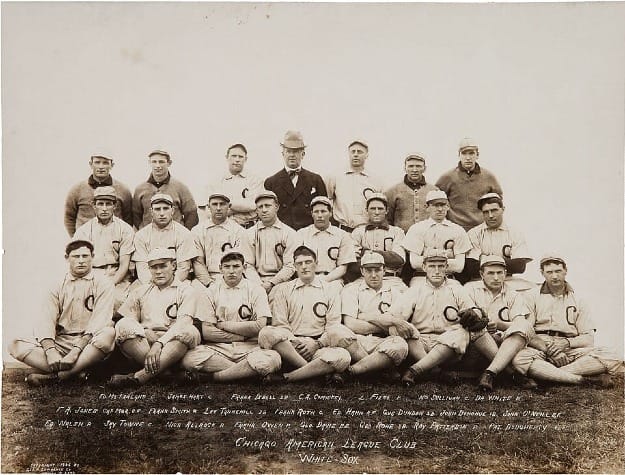
Chicago in 1906 was already a booming, brash American city, and baseball split it in two. The Cubs played at West Side Park and drew support from the city's more established, wealthier residents. The White Sox played at South Side Park. Their fans were stockyard workers, laborers, and recent immigrants building new lives in the city's industrial neighborhoods. The two clubs rarely crossed paths on the field before October 1906. That October, they had no choice.
Chicago newspapers printed hourly bulletins during the series. Fans without tickets packed downtown streets to watch mechanical scoreboards relay each pitch from blocks away. For six days, the entire city stopped to watch itself play baseball, even as the series exposed just how divided that city really was.
The two clubs also had very different leaders. Frank Chance managed the Cubs from first base and played with such intensity that Chicago writers nicknamed him the Peerless Leader. Fielder Jones did much the same for the White Sox, patrolling center field while running the club from the dugout. Both men built teams that reflected their own personalities: disciplined, patient, and unwilling to beat themselves.
THE HITLESS WONDERS
On paper, the series should not have been close. The Cubs won 116 games that season and lost only 36. Their winning percentage, .763, still stands as the highest in major league history. Chicago's National League pitchers posted a league-best 1.75 ERA. Mordecai “Three Finger” Brown anchored the staff with a 26-6 record and a 1.04 ERA, one of the finest single seasons any pitcher has thrown.
The White Sox, meanwhile, hit just .230 as a team, the worst mark in the American League. Sportswriters nicknamed them the “Hitless Wonders,” and the label stuck for good reason. A team that light with the bat had no business beating a club as dominant as the 1906 Cubs.
But the White Sox found other ways to win. Their pitching staff nearly matched Chicago's National League club, posting a 2.13 team ERA of their own. Ed Walsh, only 25 that season, and veteran Doc White anchored a rotation built on control and defense rather than power hitting. Shortstop George Davis, a 35-year-old veteran by then, quietly had one of the best seasons of his long career, worth 6.4 wins above replacement by modern accounting. It was enough to win the pennant. Whether it would be enough against Chicago's other team was still an open question.
Frank Owen carried much of the workload for the White Sox that season, going 22-13 with a 2.33 ERA across 293 innings, the most on the staff. Nick Altrock added 20 wins of his own. Neither man threw especially hard by modern standards. Both survived on location, movement, and a defense that rarely gave away an extra base. That formula, more patience than power, was the entire blueprint of the Hitless Wonders.
A CUBS TEAM FOR THE AGES
The 1906 Cubs are still remembered as one of the greatest regular-season teams ever assembled. Player-manager Frank Chance hit .319 with a .419 on-base percentage and led the club from first base. Third baseman Harry Steinfeldt quietly hit .327 and drove in 83 runs, numbers often overshadowed by his more famous double-play partners. Joe Tinker, Johnny Evers, and Chance formed the combination that a newspaper poem would later immortalize as Tinker to Evers to Chance, though that poem was still four years away in 1906.
Behind Brown, the Cubs rotation ran deep. Jack Pfiester went 20-8 with a 1.51 ERA. Ed Reulbach finished 19-4 with a 1.65 mark of his own. On paper, Chicago's National League club looked unbeatable, and some historians still call it the best team never to win a World Series.
The Cubs offense ran deeper than Chance and Steinfeldt alone. Outfielders Jimmy Sheckard, Frank Schulte, and Jimmy Slagle gave the club speed and gap power across the whole lineup, and all three topped 60 walks or better on-base skill for the era. Johnny Kling handled the pitching staff behind the plate and hit .312 himself, a rare combination of defense and offense at catcher in 1906. It is easy to see why so few expected a team this complete to lose the World Series at all.
None of this happened in a vacuum. Baseball in 1906 was deep in what historians now call the dead-ball era. The ball itself was softer and grew mushier as a game wore on, since umpires kept the same ball in play for as long as possible. Home runs were rare even for good hitters. Games were won on bunts, stolen bases, and pitching that could go the distance. Both Chicago clubs fit that mold perfectly, which is exactly why their meeting produced such tight, low-scoring baseball.
SIX GAMES, ONE CITY
Game 1 opened in a snowstorm at West Side Park. White Sox starter Nick Altrock outdueled Brown, and Chicago's South Siders stole a 2-1 win that few had predicted. The Cubs answered immediately in Game 2, as Ed Reulbach threw a one-hitter in a 7-1 win. The White Sox did not manage a hit off him until the seventh inning.
Game 3 belonged to Ed Walsh. He struck out 12 Cubs batters, a World Series record at the time, and allowed only two hits in a 3-0 shutout. Brown answered in Game 4 with a one-hit shutout of his own, tying the series at two games apiece. Through four games, the two Chicago clubs had allowed a combined five runs between them. It was as tight and as tense as postseason baseball got in the dead-ball era.
Game 5 broke the pattern. The Hitless Wonders suddenly found their bats, piling up 12 hits in an 8-6 win that pushed the Cubs to the brink of elimination. Chicago's South Siders built an early lead, watched the Cubs claw back within two runs, and then held on. It was exactly the kind of outburst nobody expected from a team that had hit .230 all season long, and it left the Cubs one loss from an ending nobody in Chicago had imagined in April.
THE SOUTH SIDE CORONATION
Game 6 settled it. Back at South Side Park, the White Sox jumped ahead 7-1 early against a tired Cubs pitching staff and cruised to an 8-3 win. Chicago's American League club, built on pitching, defense, and a lineup with almost no power, had beaten the most dominant regular-season team the National League had ever fielded.
The upset stunned the baseball world. At the time, National League officials still viewed the American League, only five years old, as a lesser, upstart operation. The Hitless Wonders' win forced a change in that thinking almost overnight. Chicago's South Siders had proven that grit, pitching, and defense could beat a far superior lineup, even one as historically great as the 1906 Cubs.
WHAT IT MEANT
The 1906 World Series did not unite Chicago. If anything, it hardened the city's divide between its wealthier West Side and its working-class South Side for years to come. Newspapers aligned with each side kept score of more than just the games, framing the series as a referendum on which Chicago, old money or new labor, truly represented the city's future. But the series did something larger for the sport itself. It proved that both of Chicago's teams, and both of baseball's still-young leagues, belonged on the same stage.
For Ed Walsh, the series was also a preview. He was only 25 in 1906, and his Game 3 strikeout performance hinted at the workload and dominance he would show for the rest of the decade. Walsh went on to a Hall of Fame career built on the same combination of control and durability the whole White Sox staff relied on that October. In many ways, his career mirrored the team around him: overlooked at first, impossible to ignore by the end.
More than a century later, no other city has matched what Chicago did in October 1906. Both of a city's teams reaching the postseason in the same year is rare enough on its own. Both meeting in the World Series remains, so far, a once-in-a-lifetime event, and one this city has never quite forgotten.
That is worth remembering every time both Chicago clubs make a run in the same October, this year included. The 1906 Cubs remain one of the greatest teams never to win it all. The Hitless Wonders remain proof that a World Series is won with more than a batting average. Chicago is still the only city that has ever had to find out what happens when both its teams get there together.
| Metric | White Sox (AL) | Cubs (NL) |
|---|---|---|
| Regular Season Record | 93-58 | 116-36 |
| Winning Percentage | .616 | .763 (all-time MLB record) |
| Team Batting Average | .230 (league low) | .262 (league leader) |
| Team ERA | 2.13 | 1.75 (league leader) |
| World Series Outcome | Won, 4 games to 2 | Lost, 2 games to 4 |
1906 season comparison, White Sox and Cubs.