

Babe Ruth filled every room he entered. He was loud, larger than life, and impossible to ignore. Standing next to him in the Yankees lineup for over a decade was a quiet first baseman from Manhattan named Lou Gehrig. History remembers Ruth as the showman. It remembers Gehrig as something rarer: a great man who never needed the spotlight to prove it.
A Quiet Kind of Great
Gehrig joined the Yankees in the mid-1920s and found himself batting behind the most famous athlete in America. Pitchers lost sleep over Ruth. They studied his swing, feared his power, and pitched around him whenever the game was close. That fear created opportunities, and Gehrig made pitchers pay for every one of them.
He never complained about batting fourth behind the Babe. He never seemed to want Ruth's fame either. Gehrig was raised by German immigrant parents in a household that valued hard work over attention. He carried that same quiet discipline onto the field every single day. While Ruth signed autographs and worked the crowd, Gehrig went home to his mother.
The numbers tell the real story. Over his career, Gehrig hit .340 with 493 home runs and 1,995 runs batted in, according to Baseball Reference. Those figures rank among the best in baseball history, Ruth included. Gehrig proved that greatness does not always need a microphone. Sometimes it just needs a bat and a lineup card.
The two men were friendly for most of their careers, though never especially close. Ruth liked nightlife and attention. Gehrig preferred quiet dinners and time with family. Despite the different personalities, the two formed one of the most feared batting combinations the sport has ever seen. Opposing pitchers often said facing one of them was hard enough. Facing both in the same inning felt nearly hopeless.
The Day Wally Pipp Sat Down
Every great streak needs a beginning, and Gehrig's began with a headache. On June 2, 1925, Yankees first baseman Wally Pipp asked out of the lineup. Manager Miller Huggins turned to his young backup and told him to grab a glove. Gehrig started that day and never left.
What followed was one of the most remarkable feats in sports history. Gehrig did not simply fill in for a game or a week. He stayed in the New York lineup for the next fourteen years, playing in 2,130 consecutive games. That streak would stand as the record for more than half a century, until Cal Ripken Jr. broke it in 1995.
The streak earned Gehrig his famous nickname, the Iron Horse. It was not just about showing up. Gehrig played through broken fingers, back spasms, and a case of lumbago so severe he had to be helped off the field. He once played an entire game with a fractured thumb and never told anyone until X-rays revealed it later. Teammates recalled him getting hit by pitches, spraining wrists, and battling fevers, then taking the field the very next afternoon.
That kind of toughness was not about stubbornness. It was about a deep sense of duty to his teammates and to the game itself. Gehrig believed a healthy player who could still contribute belonged in the lineup, no matter how much pain came with it. The streak also required something less visible than physical grit: the mental discipline to fight through slumps without ever asking for a day off to clear his head.
A Peak Season for the Record Books
People remember Gehrig for his durability, but 1934 proved he was also one of the greatest pure hitters the game has ever seen. That season, Gehrig captured the American League Triple Crown, a feat achieved by leading the league in batting average, home runs, and runs batted in during the same season. He hit .363, launched 49 home runs, and drove in 166 runs, per Baseball Reference.
Winning a Triple Crown is rare enough on its own. Fewer than twenty players in major league history have done it even once. Gehrig managed it while sharing a clubhouse with Ruth and while grinding through the middle of his consecutive games streak. His 1934 season stands as proof that his greatness was never just about showing up. It was about performing at an elite level year after year, no matter who batted ahead of him.
By the time he retired, Gehrig had piled up more career RBIs than games played, a nearly unthinkable ratio for a player who appeared in over 2,100 contests. His lifetime .340 batting average places him among the finest hitters in the sport's history. The Iron Horse nickname captured his durability, but it undersold his bat.
Gehrig also drove in over 150 runs in a season seven separate times, a level of consistent production that few sluggers in any era have matched. He walked often, struck out rarely for a power hitter, and rarely slumped for long. Modern analysts who study his numbers still marvel at how well his game would translate to any era of baseball.
The Streak Ends
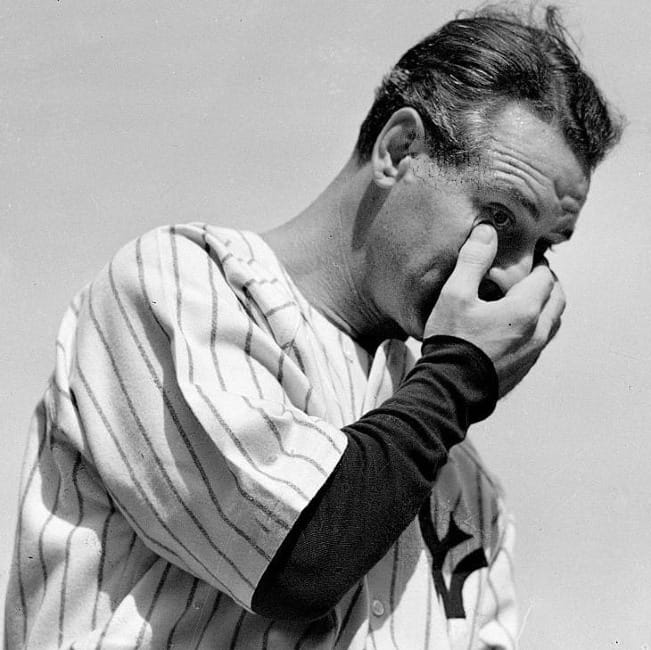
By the spring of 1939, something was clearly wrong. Gehrig looked slower on the base paths and struggled with routine plays at first base. He later admitted he had to consciously think through basic actions that once came naturally. His timing at the plate had vanished, and his batting average sat below .150 through the season's first eight games.
On May 2, 1939, in Detroit, Gehrig made a decision that stunned the baseball world. He walked the lineup card to home plate himself and told the umpires that Babe Dahlgren would play first base that day. For the first time in over fourteen years, Gehrig's name was missing from the Yankees lineup.
The Detroit crowd rose and gave him a standing ovation as he sat quietly on the bench. Teammates later said he looked as though he understood, even before any diagnosis, that something serious was happening to his body. Gehrig did not fight to stay in the lineup out of pride. He recognized that his struggles were hurting the team, and he stepped aside for the good of the Yankees. It was the same quiet selflessness that had defined his career from the very beginning.
The Luckiest Man on the Face of the Earth
Weeks later, doctors at the Mayo Clinic delivered devastating news. Gehrig had amyotrophic lateral sclerosis, a rare and fatal disease that attacks the nerve cells controlling muscle movement. At the time, almost nothing was known about ALS, and there was no treatment. Doctors gave him only a few years to live.
On July 4, 1939, Yankee Stadium held Lou Gehrig Appreciation Day. More than 61,000 fans packed the ballpark, alongside former teammates and old friends, including Babe Ruth himself. Gehrig had not planned to speak. Overwhelmed by the tribute, he stepped to the microphones almost as an afterthought.
What he said next became the most famous speech in American sports history. Gehrig told the crowd that despite everything he had just learned about his own body, he considered himself the luckiest man on the face of the earth. He thanked his teammates, his family, and the fans who had supported him for so many years. There was no bitterness in his words and no self-pity, only gratitude.
Gehrig passed away less than two years later, on June 2, 1941, at just 37 years old. His death shocked a country that had watched him play through pain for over a decade without complaint. In the decades since, ALS has become widely known as Lou Gehrig's disease, a permanent link between the ballplayer and the illness that ended his life.
The Yankees retired his number 4 immediately after his final game, making Gehrig the first player in major league history to receive that honor. His life story reached an even wider audience in 1942 with the release of "Pride of the Yankees," a film that brought his farewell speech to millions who never saw him play. Decades later, his name still carries weight far beyond the record books.
A Legacy Beyond the Numbers
Lou Gehrig's story resists easy summary because it holds so many layers. He was the quiet star who thrived in Ruth's shadow. He was the Iron Horse who played through injuries that would sideline most players for weeks. He was a Triple Crown winner whose bat matched anyone's in the sport's history. He was the captain who benched himself for his team, and the dying man who called himself lucky.
Nearly a century after he first took the field for the Yankees, Gehrig remains a symbol of quiet dignity, extraordinary durability, and grace under the worst circumstances imaginable. Baseball has produced louder legends. It has never produced a steadier one.