

The Hall of Fame Careers of Ernie Banks and Billy Williams
Ernie Banks and Billy Williams are widely considered two of the greatest players in baseball history to never play in a World Series. Despite their Hall of Fame careers, legendary individual accolades, and enduring status as the definitive icons of the Chicago Cubs, they spent their entire primes trapped in an era of strict postseason formats where only the pennant winner advanced. Baseball's biggest stage never called their names.
Banks arrived first. He signed with the Cubs in 1953 after starring for the Kansas City Monarchs in the Negro American League. He became their everyday shortstop the next year and quickly turned Wrigley Field into his personal stage. He won back-to-back National League MVP awards in 1958 and 1959, an almost unheard-of feat for a player on a losing team. Those Cubs teams finished with losing records both years. Banks hit the ball anyway, becoming the first infielder to win consecutive MVPs.
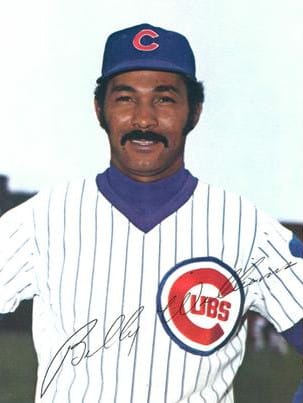
Williams broke in a few years later. Born in Whistler, Alabama, he signed with the Cubs organization in 1956 and worked his way up through the minor leagues. He won NL Rookie of the Year in 1961 and quickly became the steadiest bat in the Cubs lineup. He earned six All-Star selections and built a reputation as one of the smoothest left-handed swings in the game. Teammates and opponents called him a natural hitter, someone who made a hard job look simple. Writers eventually gave him the nickname Sweet Swinger, a nod to how effortless his stroke appeared even against the toughest pitching in the league.
Mr. Cub's Full Career
Banks played his entire 19-year career with the Cubs, from 1953 through 1971. He started at shortstop, where his power was especially rare for the position in the 1950s. Knee problems eventually pushed him across the diamond to first base in 1962, and he adjusted without complaint. He simply kept hitting.
He reached 500 career home runs in 1970, becoming just the ninth player in major league history to do so. He finished with 512, along with 2,583 hits and 1,636 RBI over his career. Banks earned the nickname Mr. Cub and became famous for his sunny outlook, often greeting reporters and teammates with the line, “let's play two”. The phrase captured how much he simply loved being on a baseball field, win or lose.
The Cubs Never Got There
For most of Banks and Williams' careers, only two teams made the postseason each year. The American League and National League champions met directly in the World Series. There were no division series, no wild cards, and no second chances. A great season on a good-but-not-great team meant nothing in October, because October never came.
The format changed in 1969, when both leagues split into two divisions and added a League Championship Series. By then Banks was 38 years old and in his final season, so the new round of playoffs arrived too late to matter for him.
The Cubs came agonizingly close that same year. Chicago led the NL East for most of the summer behind Banks, Williams, Ron Santo, and pitcher Fergie Jenkins. Then the team collapsed in September as the Mets caught fire, going 23-7 over the season's final weeks while the Cubs stumbled. New York finished eight games ahead and went on to win the World Series. Banks retired two years later, in 1971, without ever appearing in one.
Williams stayed in Chicago through 1974, playing alongside Santo and Jenkins in some of the most talented, and most snakebitten, lineups the franchise ever fielded. His career year came in 1972, a season that stands among the finest ever posted at Wrigley Field.
The 1972 Season
Williams hit .333 that year, winning the NL batting title. He posted a .606 slugging percentage and a 1.005 OPS, both easily his career best. His OPS+ of 172 meant he was 72 percent better than a league-average hitter, a mark few players in Cubs history have matched. He finished second in NL MVP voting to Cincinnati's Johnny Bench.
Over 18 major league seasons, Williams batted .290 with 426 home runs, 1,475 RBI, and 2,711 hits. He also set the NL record for consecutive games played, appearing in 1,117 straight contests between 1963 and 1970, a streak later broken by Steve Garvey. The record spoke to his reliability as much as his talent. Managers could simply pencil him in every day and trust the results. He played mostly left field but also logged real time at first base, giving Cubs managers flexibility without ever costing the lineup offense.
A Final Chance in Oakland
he Cubs traded Williams to the Oakland Athletics after the 1974 season, sending him to a franchise that had just won three straight World Series titles under owner Charlie Finley. He spent his final two years mostly as a designated hitter, no longer the everyday force he had been in Chicago. In 1975, Oakland won the AL West and gave Williams his only true taste of postseason baseball.
The Athletics fell to the Boston Red Sox in the ALCS, swept in three straight games. Williams reached the postseason at last, but the World Series stayed out of reach. He retired after the 1976 season having played 2,488 career games without ever suiting up in a Fall Classic.
A Postseason That Kept Growing
It is worth remembering how narrow the path to October used to be. From 1903 through 1968, only two teams reached the playoffs in any given season, the pennant winner from each league. Baseball added the League Championship Series in 1969, doubling the field to four teams. The Wild Card arrived in 1994, and by the 2020s the postseason had grown to twelve teams across three rounds before the World Series even began.
Players active today reach the playoffs far more often than Banks or Williams ever could, simply because so many more doors are open. A team that finishes second in its division now might still play into November. In their era, second place meant an early trip home, no matter how good the roster was.
Cooperstown Remembers
Both men reached the Hall of Fame despite the missing ring. Banks was elected in 1977, his first year of eligibility, a testament to how completely he had won over voters and fans alike. Williams followed a decade later, inducted in 1987 after six years on the ballot. The Cubs retired both of their uniform numbers, and statues of each now stand outside Wrigley Field, greeting fans on their way into games.
Neither man got to see the Cubs finally break their championship drought while still active on the roster. Banks passed away in January 2015, less than two years before the Cubs won the 2016 World Series and ended 108 years without a title. Williams lived to see it, watching from a suite as a new generation of Cubs finally finished what his own teams could not.
Life After the Uniform
Both men stayed close to the Cubs organization long after their playing days ended. Banks worked for the team in various front office and community roles for decades, remaining one of the most beloved public faces in franchise history. He threw out ceremonial first pitches, greeted fans at Wrigley Field, and never seemed to tire of talking baseball with anyone who asked.
Williams also returned to the Cubs, serving as a hitting instructor and coach through the 1980s and beyond. He passed his approach at the plate down to younger players, the same patient, compact swing that made him one of the toughest outs of his generation. Both men became fixtures at Cubs alumni events, forever linked by the years they spent chasing a pennant that never quite arrived.
Banks and Williams remind us that greatness and championships do not always arrive together. Their bats did everything asked of them. The calendar and the format simply never gave them the stage their careers deserved.
Source: Baseball-Reference.com