
Harry Heilmann: The Hitter Who Saved a Life Before He Ever Won a Batting Title

Harry Heilmann spent seventeen seasons carving out one of the best right-handed swings the American League has ever seen. He won four batting titles in the 1920s, hit .403 in 1923, and finished his career with a .342 average. But long before Detroit Tigers fans knew him as "Slug," he was a teenager who dove into the Detroit River to save a drowning stranger, then walked home without telling anyone his name.
That mix of quiet decency and loud talent defined Heilmann's career. He was a devastating hitter, a favorite drinking companion of Babe Ruth, and a locker room prankster who once talked an umpire into calling a balk just to win a bet with a friend. This is his story, built from his career record and the anecdotes that have followed him for a century.
From Bookkeeper to Ballplayer
Heilmann's path to professional baseball started almost by accident. At eighteen, he was working as a bookkeeper in San Francisco when he filled in for a friend at a semi-pro game. He delivered a game-winning double in the 11th inning and walked away with a ten-dollar stipend. A scout in the stands took notice, and within a few years Heilmann was wearing a Detroit Tigers uniform.
He debuted with Detroit in 1914 at nineteen years old and struggled, batting just .225 in 68 games. It took several seasons for his swing to develop into the weapon it became. By 1921, at age 26, Heilmann was hitting .394 with 139 RBI. He had arrived, and he would stay near the top of the American League batting race for most of the decade.
A Hero on Belle Isle
The defining moment of Heilmann's early life came in July 1916, when he was 21 years old and still an unproven outfielder. He was at a popular swimming spot on Belle Isle, a park along the Detroit River, when a young woman named Marie De Schepper slipped off the pier into deep water. She could not swim, and she began to go under while a crowd gathered on the boardwalk. Nobody moved to help her.
Heilmann did not hesitate. He dove into the river fully clothed, fought through the current, and pulled the unconscious woman back to the pier. Once he was sure she was safe, he slipped away from the gathering crowd without giving his name. He walked home soaked, saying nothing. It took local reporters a full day of digging to figure out that the mystery rescuer was the Tigers' young outfielder.
The story never became part of Heilmann's public persona the way his batting titles did, mostly because he wanted it that way. He was 21 years old, three seasons into a career that had not yet taken off, and he chose to disappear rather than take credit. It is worth remembering that as one of the first things Detroit fans should know about him, not a footnote to his stats.
Life Alongside Babe Ruth
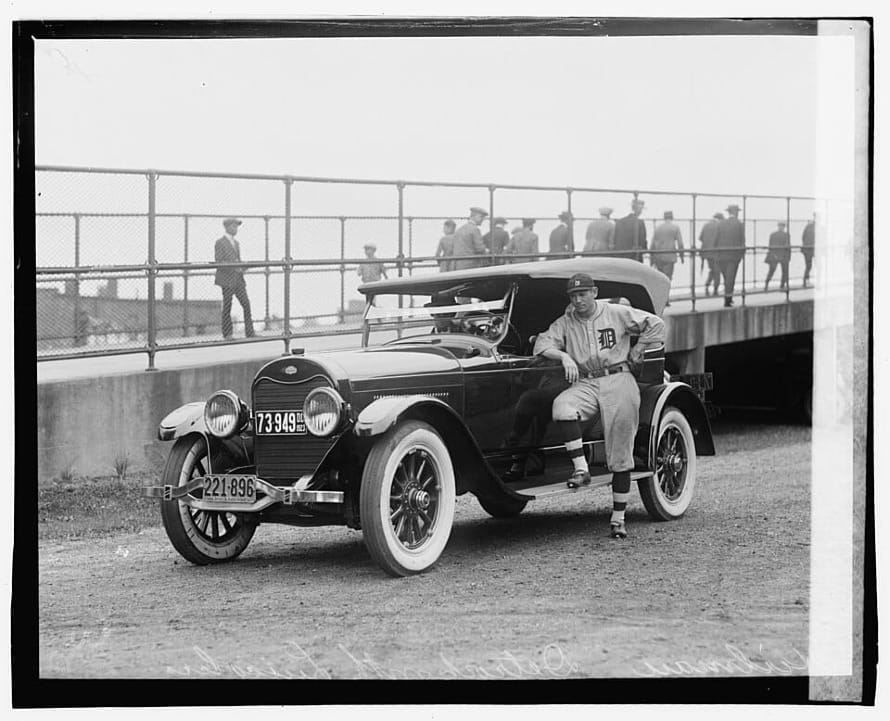
By the 1920s, Heilmann was one of the American League's biggest stars, and his friendship with Babe Ruth became a well known part of Tigers and Yankees lore. When New York came to Detroit, Heilmann often served as Ruth's guide to the city's nightlife, matching him drink for drink and cigar for cigar in the speakeasies scattered across town during Prohibition.
That friendship produced one of the better stories in Heilmann's file. He spent his offseasons selling life insurance to make extra money, and one night he cornered Ruth during a long evening out and made his pitch. By the end of the night, as the story is usually told, Ruth had agreed to a $50,000 policy to protect his wife and daughter. Heilmann liked to joke afterward that keeping pace with Ruth through a night of Detroit speakeasies was the hardest work he ever did to close a sale.
The two men were competitors on the field too. In 1923, Heilmann and Ruth were locked in a tight race for the AL batting crown. Heilmann won it with a .403 average, ten points ahead of Ruth's .393. Newspapers at the time noted that the rivalry never cost them their friendship. Ruth was reportedly among the first to congratulate "Ol' Slug" whenever Heilmann got the better of him at the plate.
As with many stories from the Prohibition era, some of the wilder Heilmann-Ruth tales, like the claim that Heilmann once drove his car up to a speakeasy and honked for the bartender to bring drinks to him, are told secondhand and have not been independently verified. They circulate as part of the era's folklore, and readers should treat them as color rather than confirmed fact.
The Prankster in the Clubhouse
Heilmann's reputation extended beyond hitting and heroics. Teammates knew him as a needler and a trickster, someone who treated the game with a sense of humor even in tight spots.
His favorite story from his own career, by his own account after retirement, was not a home run. It involved his childhood friend, pitcher Dutch Ruether. With a runner on third in a close game, Ruether started his windup. Just as he began to deliver the pitch, Heilmann suddenly spun toward the umpire and staged a loud, furious argument out of nowhere. The distraction froze Ruether mid-motion, and the umpire called a balk. The run scored, the game swung, and Ruether was left furious at his old friend for pulling off the prank in the middle of a real game.
Heilmann's mischief was not limited to the field. In the 1920s, he and Babe Ruth volunteered to staff a gift shop at the Shrine of the Little Flower in Royal Oak, Michigan, selling prayer books and rosaries for charity. Crowds swarmed the counter to buy from two of baseball's biggest stars. The two men added their own twist: they refused to give any change. If a fan handed over a five-dollar bill for a fifty-cent item, Heilmann and Ruth pocketed the whole thing for the church and moved on to the next customer. It was a prank with a purpose, since the money went to a good cause, but it captured the same streak of mischief that ran through Heilmann's career.
The Numbers Behind the Legend
Heilmann's statistical record backs up every bit of his reputation as one of the game's great hitters. Across 17 seasons, mostly with Detroit and briefly with Cincinnati, he posted a career line that stands among the best of his era.
|
Category |
Career Total |
|
Batting
Average |
.342 |
|
On-Base
Percentage |
.410 |
|
Slugging
Percentage |
.520 |
|
OPS |
.930 |
|
Hits |
2,660 |
|
Home
Runs |
183 |
|
RBI |
1,543 |
|
WAR |
72.4 |
He won four batting titles, all in odd-numbered years: 1921 (.394), 1923 (.403), 1925 (.393), and 1927 (.398). Heilmann joked that the pattern existed because the Tigers only gave him two-year contracts, so he pushed harder before each renewal came up. His .403 average in 1923 made him one of only six American League players ever to clear the .400 mark in a single season.
Ty Cobb, his teammate for over a decade, later called Heilmann the best right-handed hitter he had ever seen, behind only Rogers Hornsby. Cobb pushed for Heilmann's Hall of Fame induction in the years after his playing career ended.
From the Batter's Box to the Broadcast Booth
Arthritis eventually cut short Heilmann's playing career, and he retired after the 1932 season. He did not step away from the Tigers for long. In 1934, he became one of the first former players to move into radio broadcasting, taking over as the voice of the Detroit Tigers. He held that job through 1950, building a reputation for a calm, detailed style that fans trusted for nearly two decades.
Heilmann died of lung cancer in July 1951 at age 56. The Baseball Hall of Fame elected him six months later, in January 1952, a posthumous honor for a career that combined elite hitting with a broadcaster's steady voice and, briefly on a July day in 1916, a young man's instinct to jump into a river and save a stranger's life.