

There are 3,000-hit men in the Hall of Fame who played the game beautifully and went home. Roberto Clemente played it beautifully and then went to work on the world. When the Pittsburgh right fielder doubled off Jon Matlack at Three Rivers Stadium on September 30, 1972, he became only the eleventh man in the big leagues to reach 3,000 hits. Nobody in the park knew it would be his last regular-season swing. Three months later he was gone, and the arithmetic of his career, as grand as it was, suddenly looked like the smaller part of the ledger.
Look at the line and it still staggers: 18 seasons, all in a Pirates uniform, a .317 average, 440 doubles, 166 triples, 240 home runs, 1,305 runs batted in, 95.0 wins above replacement. But the argument of this column is the one his countrymen have made for fifty years. Clemente was a transcendent ballplayer whose impact on a society, and on a small island in the Caribbean, far outran his statistics.
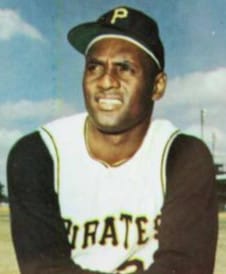
The Boy from Carolina
Roberto Clemente Walker was born August 18, 1934, in Carolina, Puerto Rico, the youngest of seven children in a family of modest means. He grew up on sugar-cane wages and sandlot ball, and he was good enough at 18 to sign with the Santurce Crabbers of the Puerto Rican winter league. In 1954 the Brooklyn Dodgers signed him, then tried to hide him in the minors at Montreal. Pittsburgh's Branch Rickey saw through the ruse. The Pirates took him in the Rule 5 draft that November for $4,000, perhaps the best bargain in the history of the franchise.
The Right Fielder with a Cannon Arm
Forbes Field was a graveyard for lazy outfielders. Its right-field corner was deep and its wall was unforgiving, and Clemente treated both as an invitation. He ran down balls in the gap with a loose, sidearm grace that looked reckless and never was, and he fired throws from the corner that seemed to leave his hand already on a line. Runners who tested him once rarely tried twice. He finished with 269 outfield assists, and his arm became folklore in the National League. The hardware followed: twelve consecutive Gold Gloves, 1961 through 1972.
He was not a defender who happened to hit. He was the first player many fans saw who made right field the most exciting spot on the diamond.
Dignity in the Face of Adversity
The league that cheered him was not always kind to him. Clemente arrived in 1955 as a Black Puerto Rican in an American game still sorting out its first integration, and he met two prejudices at once. Writers quoted his English phonetically, turning a proud man into a punchline. Some called him moody, others a hypochondriac, when he was a player grinding through back, shoulder and leg pain that would have sidelined most of his peers. His early numbers were modest. He hit .255 as a rookie, .253 in 1957, and the criticism came easily.
What he demanded, and what he finally earned, was respect. He said plainly that he wanted to be judged as a ballplayer and as a man, and he did not soften the message to be liked. The reporters who dismissed him in the fifties were eulogizing him in the seventies.
The Pirates Rise, and the Batting Titles
The bat caught up with the glove. In 1960 he hit .314 with 94 runs batted in as Pittsburgh won the World Series, and from 1961 forward the line reads like a different player: .351 that year, then .320, .339, .329, and in 1967 a career-best .357 with 209 hits. He won four batting titles in all. In 1966 he hit 29 home runs, drove in 119 and was named National League Most Valuable Player.
The 1971 World Series Masterclass
If the sport had been slow to see him, October 1971 forced the whole country to look. Baltimore, a 100-win powerhouse, was the heavy favorite, and the Orioles took the first two games. Clemente, 37, carried the Pirates back almost single-handedly. He hit safely in all seven games and finished at .414, with a home run in Game 6 and another in the decisive Game 7, a 2-1 Pittsburgh win in Baltimore. He played right field like a man defending his own backyard. He was named World Series Most Valuable Player. Millions of Americans saw, perhaps for the first time, what Pirates fans had known for a decade.
The Magic Number
The following summer Clemente was 37 and nicked up, and he played only 102 games. Even so, he hit .312 and kept pushing toward the milestone he had chased for years. He reached it on that Saturday in September at Three Rivers: a double off the Mets' Jon Matlack, hit number 3,000, exactly. It came in the Pirates' 152nd game of the year. He would take the field once more, in the second-to-last game of the season, but he never collected another hit. It was a perfect and unplanned punctuation mark. No one could have written it more cleanly, and no one wanted to read it.
The Trailblazer
Clemente understood that he was a door, not just a player. Before him, Latin American stars were a trickle. After him, they were a flood, and a generation of kids in San Juan, Santo Domingo and Caracas wore number 21 because he had shown them that greatness did not require changing who you were. He insisted on being called Roberto, on being identified with Puerto Rico, on carrying himself as a proud Afro-Latino man in rooms where that was not always welcome. Every Latin player who followed owes him something, and most of them say so.
The Humanitarian
The story that makes Clemente more than a ballplayer was written mostly in the winters. Each offseason he went home to Puerto Rico and traveled the island and the region holding free baseball clinics for poor children, teaching the fundamentals and something more: manners, work habits, citizenship. He dreamed of a Ciudad Deportiva, a Sports City, a vast complex where low-income kids could play, study and stay out of trouble. He was still raising the land and the money when he died. His widow, Vera, and his family finished the work, and Roberto Clemente Sports City still stands outside San Juan.
On December 23, 1972, a catastrophic earthquake leveled much of Managua, Nicaragua. Clemente had been in that city only weeks before, managing a Puerto Rican amateur team, and he took the disaster personally. He formed a relief committee, worked the phones and radio for days over the holidays, and helped collect more than $150,000 and some 26 tons of food, clothing and medicine. When word reached him that officials were diverting the supplies, he decided the only way to guarantee that the aid reached the victims was to ride along himself.
On the night of December 31, an aging, overloaded cargo plane lifted off from San Juan and fell into the Atlantic within minutes. Roberto Clemente was 38. His body was never recovered. Puerto Rico went quiet. The man who had come home to help had not come home.
Immortality, by Exception
Baseball's rules require a five-year wait before a player can appear on the Hall of Fame ballot. The writers set the rule aside. In March 1973 the Baseball Writers' Association of America voted him in, and he became the first Latin American player enshrined at Cooperstown. It was the rarest of honors, given to a man who had not had the chance to retire.
The Lasting Impact
Major League Baseball soon renamed its annual community-service honor the Roberto Clemente Award. It goes each year to the player who best combines excellence on the field with service off it, and it carries his name because no one has ever combined them better. The players who win it say that it means more than any trophy on the mantel.
Clemente once said, “Any time you have an opportunity to make a difference in this world, and you don't, then you are wasting your time on Earth.” He never wasted a day. The numbers are enormous: 3,000 hits, four batting titles, an MVP, two World Series rings, twelve Gold Gloves. But they are the platform, not the monument. The monument is the clinic in the dust, the ballpark in the barrio, the flight that should not have left. Baseball was simply the stage the Great One used to change the world.